
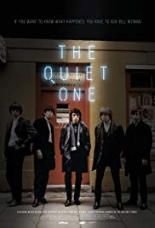
The Quiet One (2019)

The Rolling Stones, while being indisputably one of the greatest bands of the rock era, are, for the most part, an unattractive group of dudes. But, for some reason, former bassist Bill Wyman is the one that the media singled out from day one, dubbing him the slightly rude “Stone Face.”

Wyman, featured in the documentary The Quiet One, at least has a good sense of humor about most of it as he not only narrates the flick but opens up his vast archive of near-obsessive Stones (and Stones-related) memorabilia — from childhood pictures to backstage films — much of which has never been seen before, mostly because only a few people knew it even existed.

I guess at age 82, Wyman figured it’s now or never to tell his story before one of the other Stones (read: Mick or Keith) characteristically bad-mouths him in place of a meaningful pull quote. And while it would be well within Wyman’s rights to beat them to the punch, instead, he does it for himself, giving us (what I’m assuming are) truthful accounts of his good and bad years with the Stones.

All the stories you want to hear are here: guitarist Brian Jones’ death, the tragedy at Altamont and the disastrous recording of Dirty Work. But Wyman even goes into a few tales that were formerly thought of as taboo, like his notorious sexual attraction to a 13-year-old girl in 1983, and shooting the hideous music video for the funky solo hit “(Si Si) Je Suis Un Rock Star.”

Hey, at least it was better than She’s the Boss.

Currently touring with his band, the Rhythm Kings, Wyman comes off as probably the most “normal” Stone — the jury’s still out on Charlie Watts, though — and The Quiet One works hard to make him a warm-enough grandfather type who, you know, lived the demonic rock ’n’ roll lifestyle while probably being all up inside your coked-up mom backstage on the Stones’ ’72 Tour of the Americas. —Louis Fowler

Get it at Amazon.

The Wax Mask (1997)

For the sake of argument, let’s say you’re at the local park on a lovely fall day and you happen to see a gentleman, clad head to toe in a black coat and a black hat, not only buying a young street urchin a large tuft of cotton candy but taking him on a small paddleboat ride across a lake to a desolate clearing. Surely, if you didn’t forcibly stop him, you’d call the authorities, right?

If not, then it’s a good chance you’re the faceless killer of the mostly mundane Italian flick The Wax Mask, a latter-day effort from former masters of horror Dario Argento and Lucio Fulci — who had the good sense to die during production and leave directing duties to special effects maestro Sergio Stivaletti, who, in all fairness, does a pretty capable job.

Inside a randy brothel — one that’s housing some of Italian porn’s finest actors, I’m sure — like many people at the turn of the century were wont to do, a pair of men are placing bets on whether one of them could make it through an entire night at the new wax museum that recently opened down the street. I’m not giving anything away by telling you this white fool gets himself killed.

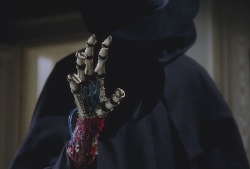
His corpse, like so many others throughout the course of the film, are used in the wax museum’s life-like (not really) exhibitions, seemingly presided over by a mad scientist — at least I think he’s a scientist — with a de-gloved hand that is seeking revenge on a cheating wife, although I think it’s safe to say he had his revenge by now and is just acting out for attention.

Even though the flick is nowhere near the standards horror fans have come to expect from Argento and Fulci over the years, Stivaletti salvages what he can, relying more on mystery and atmosphere than the usual buckets of grue; but, to be fair, the gore effects are, of course, watchably graphic and suitably grotesque. But, and I ask this rhetorically, is it, as the box copy tells us, the “last great Italian gore film of the 20th century”? —Louis Fowler

Get it at Amazon.

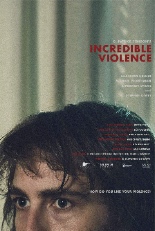
Incredible Violence (2018)

Thirtysomething Canadian filmmaker G. Patrick Condon excels at procrastinating — so much so that he’s squandered the money intended for his latest feature, a slasher film. Fearing investors’ kneecap-breaking action for his fraudulent inaction, the possibly alcoholic director has no choice but to make his movie, pronto.

Because desperate times call for desperate measures, he rents a three-story house in the country and on the cheap; wires closed-circuit cameras in every nook and cranny, Big Brother-style; and requires the cast to live there during the weeklong shoot. That edict is especially curious since Condon considers actors to be “vile human beings.” No wonder he hires himself to play the killer.

The trick of Incredible Violence is Condon isn’t playing at all; he’s snapped under pressure and prepared to slaughter his cast members for the good of the project. Actually, Incredible Violence has another trick waiting: Its director is also G. Patrick Condon. What I didn’t realize until later, however, is that the Condon of the movie within the movie isn’t really Condon; he’s played by Stephen Oates (TV’s Frontier).

Part of me wonders if watching would be any less of a meta-on-meta mindfuck knowing that information in advance, but I have my doubts, because Incredible Violence is pretty crazy as is, thanks to Oates’ performance as the master manipulator in the attic. Pulling the strings on his own Milgram experiment, his Condon pecks new scenes on the fly, sending them to be spit from dot-matrix printers in each room. His unpaid actors do his spurts of his bidding 24/7 and improvise the rest. When his narrative needs advancing, Condon emerges only to murder, adding a crude papier-mâché theater mask to his ensemble of fur coat and increasingly soiled undershirt.

Although it may not look or sound like it, Incredible Violence intends to disturb and delight, with Condon — the real one, mind you — veering into scenes of the darkly comic and transparently savage with little forewarning. Too bad the performers’ conversations in between are drawn-out to the point of being too conversational — the result of a slack pace and, I suspect, actual improv. Love it or hate it, the film is its own thing: mumblegore. —Rod Lott

Get it at Amazon.

Scream for Help (1984)

One of the weapons utilized in Scream for Help is a Swiss Army knife — fitting for the film’s all-purpose refusal to commit to one genre. Ultimately, it’s a thriller, as sleazy as it cheesy. Would you expect anything less from Death Wish director Michael Winner?

At 17, Christie Cromwell (Rachael Kelly) is a regular Nancy Drew in Guess jeans. As she details in her diary (and narrates to us), she’s convinced her stepdad, Paul (David Allen Brooks, The Kindred), is trying to kill her mother (Marie Masters, Slayground) for her wealth. As becomes irrefutable with each increasingly ludicrous scenario, she’s not wrong.

After the film devotes about an hour to Christie’s snooping and sleuthing, screenwriter Todd Holland (1985’s Fright Night) turns the tables into a siege picture, as Paul and his posse trap the Cromwell ladies in their own house. Luckily, Christie holds the home-court advantage, although throughout Help, the girl is at turns crafty and clumsy, per the needs of the story beats, and Kelly (who never graced a movie before or since) makes an impression as the bratty but well-meaning heroine.

Having recruited Led Zeppelin’s Jimmy Page to score Death Wish II two years prior, Winner this time procures Zep’s John Paul Jones to provide the soundtrack. But it also finds Winner returning to the well for his reputation of being cruel to his female characters. The nudity required of Lolita Lorre (as Paul’s mistress) is udderly utterly humiliating, and when Christie loses her virginity (to her BFF’s BF, played by How I Got into College’s Corey Parker), she emerges from the sheets in horror at the amount of blood — and no wonder, as it appears she has pressed her palm into a full tray of red paint. One wonders if Winner cackled at himself for costuming the underage girl in a shirt emblazoned with the word “MUFFS.” (Probably.)

There’s another thing one wonders, as Christie relies on a bicycle and Polaroid camera as her tools of reconnaissance: What would Brian De Palma do? Better, to be certain, but I’d be lying to suggest I didn’t thoroughly enjoy Scream for Help as is. —Rod Lott

Get it at Amazon.

Killer Crocodile (1989)

Two moderately appealing lovers frolic on the shore, playing guitars and rejecting sexual advances, but something monstrous is waiting for them in the water. To the similar-sounding cues from a very popular theme by John Williams, a swimming woman gets dragged down to the merciful depths of the shallow water; we can only assume that the much-loved shark Jaws has moved into a freshwater lake in the beautiful Italian countryside.

Turns out, however, we’re actually in an unnamed Latin American country and, what the hell, it’s not a shark, it’s a crocodile. A killer crocodile, if you will.

As a group of annoying journalists (led by Richard Crenna’s son, Richard Anthony Crenna, The Great Los Angeles Earthquake) venture down the river in search of fake news to write regarding multiple cans of toxic waste destroying the marshlands, they come across the foam-and-latex killer crocodile, picking them off one by one; the newsmakers plan to get revenge on the murderous reptile with a series of stupider and stupider plans after each well-earned kill.

Meanwhile, the crocodile stays busy, eating small dogs and smaller children as well.

A local adventurer — complete with a seemingly magical floppy hat — helps the survivors to track the killer crocodile down; additionally, they’re in a sad race with the town’s linen-suited judge (played by Hollywood legend Van Johnson, The Scorpion with Two Tails) and his local toxic waste broker, apparently also on the hunt for the crocodile, mainly so they can catch him and blow him up with dynamite. Luckily, the croc eats their boat.

Directed by Fabrizio de Angelis under his Karate Warrior series pseudonym Larry Ludman, even though the crocodile and many of the bloody effects are usually effective, as you can guess, everything else here is bottom of the toxic waste barrel, all done in the likably exploitative style that the Italians became known and vaunted for, at least by lonely dudes at horror conventions.

Killer Crocodile, interestingly enough, was shot back-to-back with its very similar sequel, but didn’t we kind of say everything we really needed to about killer crocs with this one?  —Louis Fowler

Get it at Amazon.

Random Genre & Cult Movie Reviews