The Rental (2020)

With actor Dave Franco casting his wife, Alison Brie, in his directorial debut, one can’t help but wonder, “How much of this is autobiographical?” For their sake of their union, I hope the answer is “none,” because no character in The Rental is what we would call “in a good place,” literally or figuratively.

Brie (The Disaster Artist) and Dan Stevens (The Guest) play spouses Michelle and Charlie, who do the Airbnb thing for a weekend getaway. Tagging along are Charlie’s troubled brother (Jeremy Allan White, Movie 43) and his bro’s good-influence girlfriend (Sheila Vand, XX), who happens to work with Charlie. The house is amazing; its owner (Toby Huss, 2018’s Halloween), much less so — definitely a creep and possibly a virulent racist.

Without getting into specifics that would spoil the film, the house — again, amazing — offers neither the serenity nor the sanity the couples seek. One red flag is the discovery of what appears to be a camera lens embedded in the showerhead. In the process, given the criss-cross-applesauce nature of the foursome, the lines of their relation to one another are bound to be redrawn.

While The Rental is ultimately a horror film, it only gets comfortable with that identity in the last 20 minutes. Until then, it treads the thriller waters with the occasional dip of the toe. More attention to the interpersonal drama is paid than expected, which gives a big chunk of the movie an ambling, possibly even improvisational quality. Turns out, there’s a rational explanation for that: Joe Swanberg, the king of the loosey-goosey “mumblecore” movement, is credited as co-writer. His first-draft vibe most affects the middle section, tugging engagement levels downward — having generally unlikable characters (although well-acted) further yanks that chain hard — until Franco finally commits to the frights he so skillfully sets up an hour earlier.

And wow, what a primal, powerful 20 minutes follow, right to a truly chilling montage that overtakes the closing credits. That’s the movie I wished The Rental were for the entirety, and why I suspect Franco’s follow-up will deliver more on that promise. —Rod Lott

Get it at Amazon.

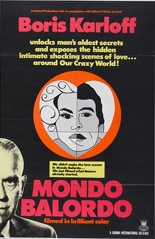
Mondo Balordo (1964)

Following closely to the perversely entertaining Mondo Cane and with a title that roughly translates to “crazy world,” Mondo Balordo is one of the earliest exploitative travelogues to offer shocking glimpses of the misbegotten world of 1964 that was only really brandished about in the nudie-est of men’s magazines.

Hosted by the effortlessly charming Boris Karloff, we’re taken to a large swath of Europe to see sexy transvestite Spaniards on stage, the smoking-hot German lesbian scene, stuffy British bankers dancing like penguins, and Italian strong men throwing fake boulders on a film set — it’s a crazy world!

Meanwhile, in America, women raise money for the pyramids of Luxor by having their own pyramids of flesh judged and rated; an elderly man is married by a lady of the night and is then dumped at an old folks’ home; and a sexualized little person is taken to the abandoned back seat of a car parked in an alley and illicitly made love to — it’s a crazy world!

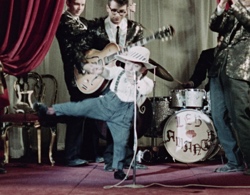
In India, hungry fisherman pull giant turtles out of the sea and tear them apart flipper to flipper; a little person sings terrible rock ’n’ roll on stage; and some random crooner tries to recapture the success of Cane’s “More” by singing a ballad that rationalizes all that is about to visually scar you in this film — it’s a crazy world!

With terrifying trips to an opium den, a ladies’ balloon-wresting ring and plenty of dirty streets filled with a mix of three-legged dogs and one-legged humans, all directed by Robert Bianchi Montero (of Sexy Nudo fame, of course), Mondo Balordo, like many of the mondo flicks of this era, is an acquired taste of delicate putridity that will willingly seduce any less-traveled pervert after 3 a.m. After all, it’s a crazy world! —Louis Fowler

Get it at Amazon.

Hot Chili (1985)

Whereas most directors would typically fill a mid-’80s teen sex comedy about a quartet of slobs working the summer at a hotel south of the border with near-constant Mexican stereotypes, not every director is Galaxina’s William Sachs, who inexplicably fills the flick with so many sexed-up European characters that you almost want to give him some sort of award for his wokefulness.

The movie is the extra-spicy Hot Chili and its big star is Allan Kayser, who you might remember as Bubba from TV’s Mama’s Family … well, that’s where I remember him from. He’s the leader of this motley crew of horny high schoolers, including those oft-repeated tropes of the cool guy, the fat guy and the nerdy guy. As much as these guys talk about “fucking,” they all seem to be totally afraid of sex.

Which isn’t to say there’s not a good reason for their erectile frights, especially given the oversexed ladies who are remarkably booked at the same time; this includes the accomplished-but-horny musician, the muscular-but-horny workout queen and the German-but-horny dominatrix who wants to do Mapplethorpe-esque things with bullwhips to the fat guy’s ass.

A set of parents — the cool guy’s parents — show up and they’re erotically horned-up as well; even his little sister is sexually vapid, taking a video camera and making homemade revenge porn to show on the television screens at a modest dinner in the hotel’s restaurant where everyone is eating the titular magical fruit.

As you’d hope, Kayser is basically Bubba on vacation, while the chubby Joe Rubbo spends most of the movie in ill-fitting boxers. Add to the pot a trio of stacked blondes — Bea Fiedler, Victoria Barrett and Taaffe O’Connell — and, well, you still have a very dumb movie, but the type of movie that only Sachs could have ever made. ¡Olé! —Louis Fowler

Get it at Amazon.

Sorority Babes in the Slimeball Bowl-O-Rama (1988)

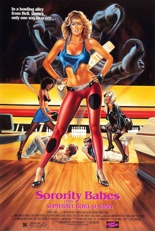
Like Fred Olen Ray’s Hollywood Chainsaw Hookers, David DeCoteau’s Sorority Babes at the Slimeball Bowl-O-Rama is one of those titles that told a potential VHS renter everything he (or she, but let’s be real) needed to know: Will there be blood? Will there be boobs? Although both concerns were legitimate, answers were not needed, thanks to an unspoken contract of trust.

Tri Delta pledges Lisa (Michelle Bauer, The Erotic Misadventures of the Invisible Man) and Taffy (Brinke Stevens, the Mommy movies) are in the midst of hazing rituals dealt by the paddle-clutching hands of Babs (Robin Stille, The Slumber Party Massacre). The final piece of their initiation puzzle is to break into the bowling alley at the local mall to steal a trophy. Three Peeping Tom frat guys accompany Lisa and Taffy, who happen to arrive at the alley as a punky thief named Spider (Linnea Quigley, Witchtrap) performs a little B&E on the premises herself.

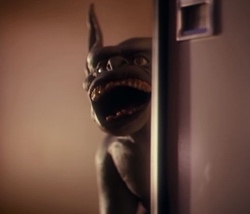
As luck would have it, the six knock over the one trophy containing an imp (played by a rubber monster voiced in an urban patois by — ahem — Dukey Flyswatter, aka Michael Sonye of Surf Nazis Must Die). Uncle Impie, as he’s called, grants each a wish for letting him loose — the most obvious placing Bauer in (and then out of) incredibly sexy lingerie for the movie’s remainder — but his acts of kindness are merely a cover for plans of flagitious intent.

The premise of DeCoteau’s Sorority Babes in the Slimeball Bowl-O-Rama is no smarter than DeCoteau’s A Talking Cat?! — in fact, it may be more stupid — yet the difference between the two is significant, and I don’t mean the 25-year gulf between them. It’s effort and spirit — both of which the 1988 cult classic possesses, to be clear. Today, it’s as if he doesn’t even try, because the free element of fun has disappeared.

For all the production’s limitations, Sorority Babes does so many things right. In typical Charles Band style, most of the movie takes place in a single location, but a bowling alley is engaging. The imp barely moves beyond his mouth, but Flyswatter gives him a personality. Scripter Sergei Hasenecz’s human characters are one-note, but the actors’ performances have gumption. By embracing its trashiness, this early work of DeCoteau radiates a silliness and sexiness that tickle all the buttons video-store exploitation should. —Rod Lott

Get it at Amazon.

Impractical Jokers: The Movie (2020)

If you’ve ever been in a hospital — multiple times for me — you probably know there’s really nothing to do except watch the most basic of cable television for hours on end. But, it was there I discovered truTV and its nearly constant airings of the reality show Impractical Jokers, starring Long Island comedy team the Tenderloins.

With a premise of four friends who compete in various challenges to embarrass and humiliate each other, every laugh, guffaw and chortle was always one step closer to busting my surgery stitches, but it was always a hilarious way to pass the body-aching time.

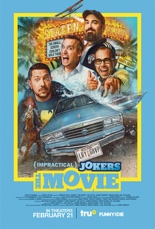
In Impractical Jokers: The Movie, their film debut, the four jokers — Murr, Q, Joe and Sal — mix a mostly fictional story in between their nonfictional stunts, as the guys try to make their way to Miami to see a Paula Abdul show. I guess she fit perfectly in the truTV budget.

And while that part of the flick is somewhat weak, opposites attract, because the pranks are some of the funniest since Jackass Presents: Bad Grandpa, including a birthday party at a strip club where Murr’s entire family — including some children — shows up while he’s in the middle of a lapdance. It’s a disturbingly hilarious bit that hurts my gut just writing about.

Still, at an hour and a half, Impractical Jokers: The Movie eventually wears out its welcome with overkill, while any TV episode’s 22-minute running time is enough to keep you binge-watching. Regardless, this flick came out at the worst time possible — COVID, y’all! — with most people missing it during its short theatrical run.

So, I guess the joke’s on them? —Louis Fowler

Get it at Amazon.

Random Genre & Cult Movie Reviews