
The Haunting of Hill House (2018) vs. The Ghosts of Monday (2022)

The Haunting of Hill House (2018) vs. The Ghosts of Monday (2022)

 Like the small towns that dot the lonely roads here in Oklahoma, Nebraska is not far off from us. Dusty and decrepit, all the towns really need are many stalks of wilted corn (or wheat) and spiritually inbred children.
Very loosely based on the tight short story by Stephen King, Children of the Corn was made into a movie by now-Oklahoma-based director Fritz Kiersch (interviewed in Flick Attack Movie Arsenal: Book One) in 1984, with many critics then (and today) calling it one the worst King adaptations of all-time.
But I consider Kiersch’s bastardized adaptation to be King’s best movie for the horror screen.
A long time ago, in the rural town of Gatlin, Nebraska, the entire kid community massacred all the adults under the leadership of the diminutive messiah Isaac (John Franklin). Now, a few years later, a young couple — Burt (Peter Horton) and Vicky (Linda Hamilton) – run over a child on the lonely road, with foreboding cornstalks on both sides.

As Burt and Vicky go to town to find answers, they find the children are part of a corn-worshipping blood cult that pays homage to “He Who Walks Behind the Rows,” a demonic force that turns innocent children into bloodthirsty anti-saviors of mankind. As Burt looks for a way out, Vicky is eventually strung on a cornstalk cross at the esoteric deity comes for her. With the children running from the ’84 special effects, the demonically possessed man-child Isaac gives a final stand!
While the personas of Burt and Vicky are fine in their cardboard stock-characters, the teen followers of this dirty deity are simply frightening, especially the ginger-haired fireplug Malachai (Courtney Gains) and, worse, the infernal hayseed Isaac.
 I believe this movie is all about Kiersch’s willingness to showcase most of the sacrilegious slaughter on the big screen, even if most of the gore scenes are grossly implied; still, the idea of a community of murderous children will always keep me awake, haunting my dreams since my small-town VHS rental. From a native Texas filmmaker (with, I’m guessing, an Oklahoma background), it seems what rural Oklahoma is actually like: endless miles of ghostly towns with one or two people outside a filling station on a sweaty afternoon, a cult of devil-worshippers behind every curtain.
From the troubled-teen drama Tuff Turf (with James Spader) to the sadomasochist fantasy Gor (with Jack Palance), Kiersch’s low-budget films have been given the Oklahoma Outlander Seal of Approval from the psychotronic fan in all of us, even if we don’t want them. I don’t blame you. —Louis Fowler
1. Paul McCartney, “Spies Like Us”
2. Paul Simon, “You Can Call Me Al”
3. Ray Parker Jr., “Ghostbusters”
—Rod Lott

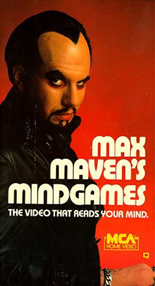 As of November 2022, the magician Max Maven is no longer of this earth. Anyone watching TV in the 1980s will likely remember him; he was the guy who wasn’t David Copperfield, Doug Henning or Harry Anderson. With ink-black slicked hair, a single earring and pencil-thin mustache and goatee, he’s the one who looked like a satanist, albeit a satanist who could produce a rabbit from a hat.
Pioneering at the time, Max Maven’s Mindgames was an hourlong special made exclusively for home video. Marketed as “the video that reads your mind,” it’s plant-the-camera directed by Bruce Seth Green, the guy behind such VHS rental gold as Nudes in Limbo and Massage … the Touch of Love.
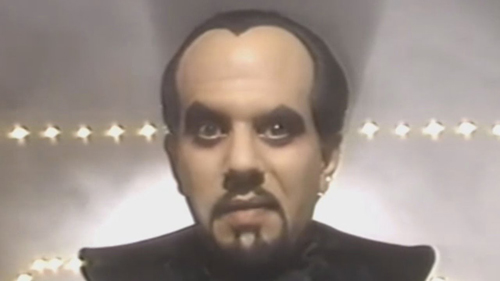
Maven “communicates” with viewers through a series of magic tricks. Most are considerably lame, like the opening stunner of “making” your two index fingers touch one another. Oooooh! On a set reminiscent of Match Game PM (if Gene Rayburn had tolerated strobe lights and dry ice), Maven uses his brain powers to force you choose a preselected flag (the true neat bit) before moving on to the requisite card tricks. In between, he acts like a moron in some horrid “comedy” bits; as the writer, Maven only has himself to blame.
Many tricks have themed backdrops — the jungle, a surgical ward, a Vegas casino — but no matter the locale, they reek of cheap thrills. The guy had talent, but the limitations of videotape don’t exactly make for mesmerizing feats of mentalism. With support from a talking computer, a rotund ratings rep and a pair of sequined sweeties, Mindgames includes a musical number to “Yankee Doodle,” a clip from Battlestar Galactica and a man in a duck suit. —Rod Lott

 Between Pamela Anderson’s Barb Wire, Joan Severance’s Black Scorpion and Nicole Eggert’s The Demolitionist, 1995-6 proved to be a banner year for B movies starring surgically enhanced TV vets befit in tight black leather costumes. Also in this club of sexed-up superheroines within that calendar range? Electra! As in Shannon Tweed’s with-a-C, not Jennifer Garner’s with-a-K Elektra.
Tweed (Hot Dog … the Movie) is Lorna, a quiet woman who favors farm life and floral prints. She’s stepmom to Billy (Joe Tabb, 2002’s Feedback), a muscular, blank-faced, long-haired, Jersey-accented, bare-chested bo-hunk whom she lusts after. And what soccer mom wouldn’t? The boy’s got freakin’ super powers! In addition to allowing him to jump real far, run real fast and flip real vans, Billy’s powers are youth- and health-restorative.

Naturally, that appeals to the evil Dr. Roach (Sten Eirik, Darkman II: The Return of Durant). Being confined to a wheelchair outfitted with two expandable TV antennas, he longs for the young man’s goods. Trouble is — and here comes the genius part of the Damian Lee/Lou Aguilar screenplay — they can be transmitted only through Billy’s semen and, well, Roach doesn’t play for that team.
So when the leatherbound wiles of a pair of backflippin’ bitches fail to extract the mighty virgin’s super juice, Roach kidnaps Lorna, teases her with a vibrator and makes her up to be some ultra-hot harpie who can bare vampiric fangs, levitate during catfights and shoot bolts of electricity from her palms. Needless to say, she’s up ’n’ grindin’ on her jeans-model stepson in no time, tricking him into making a small deposit.
Speaking of unloading, director Julian Grant (The Cropsey Incident) does that with a slew of bloopers during the sequel-threatening end credits. Most of the foul-ups, bleeps and blunders entail one cast member or one another saying “fuck” or variations thereof. In addition, Tweed claims she’s about to barf, and I can’t say I blame her. —Rod Lott