
Category Archives: Kitchen Sink

Sarah T. — Portrait of a Teenage Alcoholic (1975)

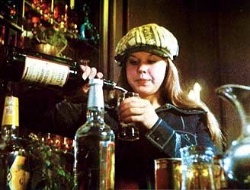
WTFAfter new student Sarah T.’s (Linda Blair) hopes are dashed when she fails to make it into the glee club, she begins a staggering road to faux-drunkenness in the classic made-for-TV melodrama Sarah T. — Portrait of a Teenage Alcoholic. Made at a time when open liquor was practically its own food group, it doesn’t help that Sarah walks around Hollywood with her deadbeat dad (Larry Hagman) as he’s slugging brews out of a paper cup.

Things start looking up when she duets with Mark Hamill on a Carole King song, but with congratulatory booze passed around at the wildest shindig you ever did see — they’ve got a party sub! — things get really crazy when Sarah T. smashes a plate of far too much potato salad into a rival’s chest after a rather cutting comment about Raquel Welch and how she eats all of her potato salad. While for most of us that would be a real popularity killer, but, because of her alcoholism, Sarah T. is now the most fun girl in school, especially among the chunky kids who carry their lunch in a ratty brown sack and still say “Far out!” Far out!

At home, though, things get worse as she’s not only busted for boozing while babysitting, but inadvertently get her nice old maid fired. Luckily, by the end of the film, Sarah T. goes to a teen-centered Alcoholics Anonymous and, after listening to a junior alkie spill his guts, mostly gets her life back on track — the drunken horseback-riding into oncoming traffic helped too, I’m sure.

Directed by Richard Donner in what feels like the one true sequel to The Omendominus tequilium — the facts about teen drinking are clumsily presented to the parents watching at home with their kids, while the kids are given plenty of great tips on how to score booze and not let Mom and Dad find out about it. Sadly, I had to learn that college. And it wasn’t booze, it was Doritos.

Just call me Louis F., I guess. —Louis Fowler

Get it at Amazon.

The Fiend of Dope Island (1961)

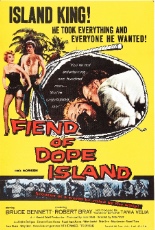
WTFSomewhere in the Caribbean, psychotic pot farmer and arms dealer Charlie Davis (Bruce Bennett, The Alligator People) is The Fiend of Dope Island, who physically abuses the native slaves he calls his employees. (Comparisons to Michael Fassbender’s Oscar-nominated role in 12 Years a Slave are not out of line.) Meanwhile, right-hand man David (Robert Bray, My Gun Is Quick) tries to right his boss’ wrongs. Besides being the only white guy on the payroll, David stands out for wearing a yacht captain’s hat as if he’s the top half missing from an “& Tennille” marquee.

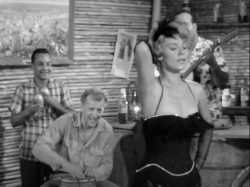
One day at the isle’s bamboo-walled cantina (and the movie’s primary set), in sashays Glory La Verne (Queen of Outer Space’s Tania Velia, billed here as “the Yugoslavian bombshell”), a shapely firecracker Charlie has hired to perform hoochie-coochie dances for his viewing pleasure to the point of literal exhaustion for her — a weakened state making it all the easier for him to attempt rape.

Although directorial duties fell to oater specialist Nate Watt (Hopalong Cassidy Returns, et al.), the script was co-written by Bennett, who sure gave himself a meaty part as the antagonist. Seeing him bark orders — each punctuated with the crack of his trusty whip — is one thing, but Bennett is at his ham-hock best during the dance numbers, maniacally laughing and feverishly bongoing his way into an orgiastic frenzy as Glory shakes her groove thang. Dope Island may be nothing more than a melodrama, but his Reefer Madness-styled overdelivery infuses the picture with a nutty flavor, kicking it over into the stuff of many a men’s adventure magazine cover. —Rod Lott

Get it at Amazon.

High School Confidential! (1958)

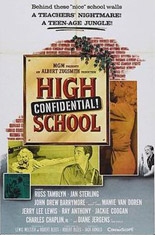
WTFTwo years before producer Albert Zugsmith had Sex Kittens Go to College, he went undercover in High School Confidential! (Exclamation his.)

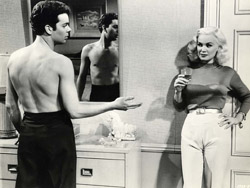
A juvenile-delinquent exposé of sorts, the film centers on snot-nosed transfer student/perennial senior Tony (Russ Tamblyn, Satan’s Sadists), who arrives at Santa Bellow High with a wad of cash and a roll of weed. As the faculty members get schooled on the ravages of marijuana addiction, Tony tries to claw his way to the top of the town pushers’ org chart, as well as into the pants of not-so-good girl Joan (Diane Jergens, Island of Lost Women), the main squeeze of BMOC J.I. (John Drew Barrymore, Death on the Fourposter). Ironically, the woman who really wants to bed Tony is his soused ’n’ sexy aunt (Mamie Van Doren, 3 Nuts in Search of a Bolt), whose home apparently came prebuilt with its own wah-wah-wah soundtrack.

Helmed by Jack Arnold (The Incredible Shrinking Man), High School Confidential! is one of those teen pics in which all the students are played by actors at least a decade removed from the classroom. It’s also quite the time capsule, with an overuse of “crummy” (second only to the narration of J.D. Salinger’s The Catcher in the Rye) and slang weighing down every line of dialogue, e.g., “That’s the way the bongo bingles.”

In other words, I loved it! Both the Fast Times of its day and Reefer Madness if made by skilled craftsmen, the film is a now-alien world of crew cuts, Beat poets and race-ready jalopies. Tamblyn is delightfully smug; Van Doren is off-the-charts sexy; and the ace cast also includes Teenage Werewolf Michael Landon, Plan 9’s Lyle Talbot, The Little Shop of Horrors shopkeeper Mel Welles, Charlie Chaplin sidekick Jackie Coogan and Jerry Lee Lewis as himself, singing and playing the piano in the back of a moving pickup truck and probably hoping for a Junior High School Confidential! This one’s tops, chum. —Rod Lott

Get it at Amazon.

The Big Cube (1969)

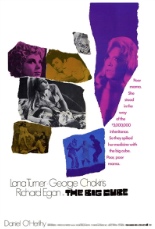
WTFAt the curtain call of her latest play, acclaimed, yet over-the-hill stage actress Adriana Roman (played by former Madame X, the legendary Lana Turner) announces her retirement. As the prologue for The Big Cube, the scene could stand in for the uneasy career transition Turner and her Tinseltown peers experienced when New Hollywood pushed boundaries and buttons, and in doing so, shoved Old Hollywood’s melodramas and musicals out of the way. The elderly white men who ran the studios sought to capitalize on the youthquake they never understood, resulting in supposedly “with-it” pictures that succeeded only in demonstrating how sorely out of touch said studios were.

At least their failures put some choice cuts of camp on our plates, The Big Cube included.

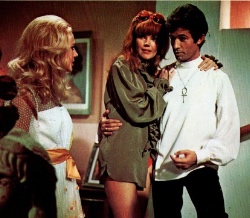
Adriana trades the theater for playing the part of well-to-do wife of über-wealthy Charles Winthrop (Dan O’Herlihy, Halloween III: Season of the Witch). The news doesn’t sit well with his daughter, Lisa (Swedish actress Karin Mossberg, The Uninhibited), whose accent is explained away by Daddy having shipped her to a Swiss school following her mother’s death. Lisa leads a life of Riley, partying with airheaded pal Bibi (Pamela Rodgers, Dr. Goldfoot and the Bikini Machine), who suggests things like, “Hey, large idea! Let’s call half a dozen guys and have an orgy!” and ditches her dresses when she gets sky-high.

At one groovy soirée, Lisa catches the eye of slimy med student Johnny Allen (George Chakiris, West Side Story), who manufacturers LSD in the university lab for his social circle. And when Johnny learns Lisa’s loaded, well, she catches his other eye, too. Just as Lisa warms to her new stepmother, her father dies. Per the sizable Winthrop will, Lisa is set to inherit a trust of $1 million unless she gets married and if Adriana consents to the union. Which she does not. Being human sleaze, Johnny hatches a scheme: Dose Adriana with enough LSD to drive her crazy — and perhaps even to her death.

Here is where the title of The Big Cube comes into play, priming viewers for its craziest sequences as Chilean filmmaker Tito Davison, helming his first and last Hollywood film, attempts to portray LSD trips, both from an insider’s and outsider’s POV. Johnny mansplains acid to Lisa with the you-don’t-say words of “You see sounds. You hear colors,” and Davison tries his damnedest to put that way-out feeling onscreen. I’ve never touched the stuff, but something tells me it’s more like the kaleidoscope of primitive special effects and less like the shot of Chakiris chunking a rock at your car windshield.

Anyway, the kids’ attempts to gaslight the ol’ bag give Turner the green flag to emote histrionically, as if she broke the glass marked “IN CASE OF EMERGENCY, JOAN CRAWFORD.” And that comparison is apropos because The Big Cube nearly qualifies as “hagsploitation” — if only it weren’t quite so colorful, dressed in puffy shirts and weighted down with horoscope medallions. It’s like the soap bubbles of Valley of the Dolls as filtered through the clutched pearls of Reefer Madness, but not as fun as either. —Rod Lott

Get it at Amazon.

Pastor Paul (2015)

WTFThe cinema of Ghana and Nigeria — referred to colloquially and collectively as Nollywood — is best known for its low-budget goofy actioners and laughable melodramas, but there is very much a frightening side to their filmmaking: the ominous atmosphere and existential dread of their many demon-possession films. Forget The Exorcist, Rosemary’s Baby, whatever … Ghana and Nigerian filmmakers have them beaten and beaten brutally.

Maybe it’s because they still fear Satan in a way that Westerners (lamentably) don’t anymore, but regardless, their horror epics featuring demonic witch doctors, torso-shaking, eye-rolling vessels and sweaty preachers calling on Jesus to get rid of that vile creature tend to leave audiences praying for their own soul by the time the credits roll.

But then you’ve got to deal with a sequel … or two … or three …

It’s a trend that I’m surprised took American filmmakers so long to latch onto, but auteur Jules David Bartkowski, armed with a camera, a white suit and about 100 bucks or so traveled to this foreign land, gathering the biggest names in (regional) African cinema — Wanlov the Kubolor, Funsho Ogundipe and Lady Nancy Jay, to name a few — and actually made a pretty good first attempt at introductory cinematic diplomacy.

Bartkowski is Benjamin, a mathematician working on African drum rhythms and their supposed equations. When sitting in a bar one afternoon, he’s talked into starring as a white ghost in a film called Pastor Paul. During the filming, however, he goes into a strange trance and when the eccentric director yells cut, Ben can’t remember anything. People tell him he’s possessed, so he travels to a nearby town to hook up with the area witch doctor, and then it gets truly bizarre — but in a financially responsible way, making it even more scary.

While many fish-out-of-water films use a certain sense of xenophobia to get their paranoid feelings of danger and despondency across, this film mostly avoids that; surprisingly, mostly everyone in Pastor Paul, from the little kids following the characters around to the long stretch of Christian preaching, is just doing their thing and Benjamin is caught in the middle of it, walking along, letting them tell their stories, letting the audience experience what he does.

Sure, he’s shaking and convulsing around them, stricken by evil creepy crawlies, to bring it all back to the main story, but it’s the moments in between that are infinitely more interesting, to explore the souls of the friends (and enemies) he’s just made, sitting around talking and enjoying bowl after bowl of fufu with his grimy fingers.

But even more interesting is instead of bringing American techniques to Ghana and Nigeria, the filmmakers used theirs, the Africans, as a way to tell a compelling enough story, filled with plenty of strange tangents and obscure jokes to keep both Hollywood and Nollywood viewers both intrigued and waiting for parts two, three and four, which we’re promised is coming, to great terror and foreboding.  —Louis Fowler

Get it at Amazon.