
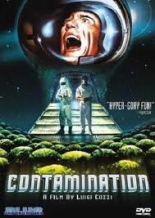
 Contamination’s opening credits have the balls to claim it’s “based on an original story by Lewis Coates.” It should read, “based on an original story by Dan O’Bannon and Ronald Shusett,” because what writer/director Lewis Coates (aka Italy’s Luigi Cozzi, the man who gave us Starcrash, the Star Wars rip-off that’s more fun than Star Wars) came up with clearly wouldn’t exist without Ridley Scott’s Alien. In fact, Cozzi wanted to call it Alien Arrives on Earth.
Mind you, I’m not complaining. Cozzi took Alien’s elements of the outer-space eggs and stomach bursting, and ran with them. When you have an effect as cool as an exploding gut, why use it only once? Why not a dozen times? You certainly get your money’s worth. Just ignore the stupid ending.
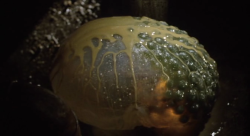 The intestinal problems start in New York City, when a ghost ship from the tropics wanders into port without a crew — alive, anyway. The conditions the investigating authorities find the seamen in will put you off deli meats for the day. And in boxes bearing a coffee company’s logo are slimy, green eggs that pulsate. Posits one investigator, “It could be somethin’ like a giant squash or an avocado or some kind of mango!”
Despite the decrepit-flesh buffet they’ve just witnessed, another investigator thinks it best to pick the egg up. Let the tummy troubles begin! Who cares if the actors suddenly look pregnant before their midsection blows? Cozzi had the good sense to shoot them all in slo-mo. The eggs even emit a pre-kablooey sound, like sea lions orgasming. Speaking of sound, the great Goblin provides the synth-tastic soundtrack, which is good considering how slowly the film’s final third moves. —Rod Lott
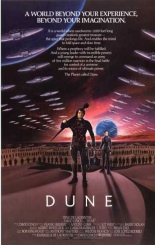
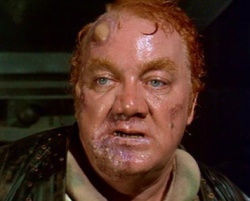 Yet within Dune lie the seeds of something much greater. Watch as the Guild Space Navigator (an effects wonder) speaks through a grotesque vaginal slit. Gaze upon Baron Harkonnen (Kenneth McMillan), his face swollen with boils, hovering beneath a shower of oil. Listen to the absurd rock score by Toto, which under no circumstance should work, yet does so gloriously. View the premature birth of a mutated reverend mother from the inside of the womb.
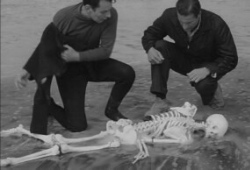 And how! Their horrors begins by finding a whole human skeleton on the beach, grasping that aforementioned bikini top. Then there’s the glowing fish bones. It’s all due to the “silver stuff” in the water that results in some nifty, surprisingly gory effects on the skin it touches. A beatnik (Ray Tudor) wearing rope sandals doesn’t heed their warnings at first: “Where’s the love, Max? Don’t tell me about that ugly jazz!”
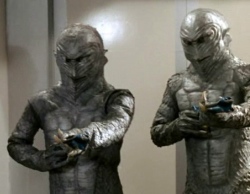 Later, Ken and Jenny check it out by boating over to the island where atomic waste products are dumped and get their answer: shiny, silver Sleestak-like creatures with crossed eyes too close together, mouths that do not move, and no genitals whatsoever.
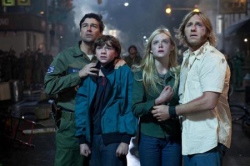 Not that that’s a bad thing, when it’s done this well. A group of kids shooting a zombie epic on Super 8 film witnesses a spectacular midnight train wreck during the summer of 1979. Said wreck unleashes a spider-like alien that proceeds to wreck their tiny town, taking all the microwave ovens and sending all the dogs fleeing to surrounding counties.