
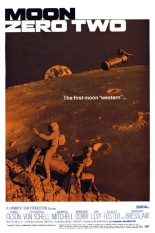
 Hammer Film Productions was and is known for horror, but give the group credit for its one and only attempt at a sci-fi Western in Moon Zero Two. In the year 2021, the moon is inhabited; its residents play a circular-shaped board game called Moonopoly; and social life amounts to hanging out at the Lazy B Saloon, where the drink of choice — distilled rocket fuel, of choice — runs $35 a shot.
Our hero is Capt. William H. Kemp (James Olson, The Andromeda Strain), who specializes in retrieval of satellite scrap, and doesn’t want to shuttle interplanetary tourists: “I’m a space pilot, not a mechanically minded wet nurse.” However, when safety violations threaten to ground him, a guy’s gotta look long-term.
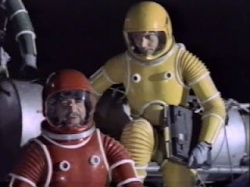 For Kemp, that means listening to Hubbard (Warren Mitchell, Jabberwocky), the purple-cloaked, eyepatch-sporting baldie about illegally mining the sapphire from a 6,000-ton asteroid. Total fox Clementine Taplin (Catherina von Schell, On Her Majesty’s Secret Service), searching for her missing brother, shows up to provide much sexual innuendo.
The film’s highlights are a gravity-free bar brawl, however brief, and cartoon opening credits in a loony spirit not exhibited by the mostly serious story that follows. Directed by Roy Ward Baker (Quatermass and the Pit), Moon Zero Two certainly looks cool — and sounds it, with a swingin’ ’60s score — but feels forever set at quarter-speed. Good thing that in space, no one can hear you snore. —Rod Lott



 Although I give returning director Shinsuke Sato immense credit for not doing the same thing twice, I found myself pining for at least the mission-after-mission, go-get-this-goon structure to stick its head into the proceedings. In its place is a plot twist that the big, black ball called Gantz has up and changed the rules of his own game, thus pitting the black leather-costumed “contestants” against one another. Never underestimate the love of a human heart to fracture a team.
 They miss us, guys, and they’re ready for some lovin. So what we’re gonna do is this: We’re going to send three, handsome, Captain Kirk-esque woman-tamers into space so the Venusians can capture and fall in love with them. We’ll also throw in a middle-aged scientist because it’ll be hilariously awkward when he’s sitting by himself while the good-looking astronauts are making out with Zsa Zsa and her two, hot friends around the campfire. Don’t worry about him, though. He’ll totally get mobbed by sex-starved babes once the revolution’s over and all the women realize that the three attractive guys are spoken for.