

 It’s not hard to appreciate the impulse to turn supermodels into movie stars, despite the fact that it has never actually worked. Here you have someone who is already famous and who has already shown a tremendous ability to look fantastic in front of camera. What could possibly go wrong?
To answer that question, I give you Alien from L.A.
There is no doubt that Kathy Ireland had an arresting onscreen physical presence. The word “hot” in this case would be most à propos, especially if it was preceded by the words “goddamn” and “fucking.” But, just like many famous silent-era stars whose careers ended when talkies took over the medium, the power of Ireland’s charisma is tragically undone each and every time she opens her mouth and does us the tremendous discourtesy of allowing words to escape from it.
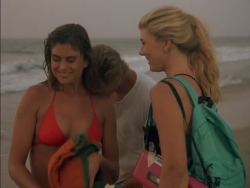 Cursed with the kind of voice that causes dogs to howl in misery whenever she speaks, her is further diminished by a script that requires her to essay the role of the whiniest protagonist in the history of narrative storytelling. At times, the dialogue suggests that this was a deliberate choice on the part of director/co-writer Albert Pyun. Forced to cast Ireland as his lead, he obviously decided to turn her greatest weakness into the film’s main running joke, but chose to do so in a way that only makes watching it more of a chore than it might have otherwise been.
The nominal plot concerns a California waitress (Ireland) going to Africa in order to find out more about her absentee (and presumed dead) father, only to fall down the same hole he did and become trapped in the underground city of Atlantis. To say that Alien lacks dramatic momentum is something of an understatement. The only memorable scene comes at the very end, where Ireland is finally shown in the kind of outfit that got her the role in the first place. It’s almost worth the previous 90 minutes, but in this day of Google, you can easily find similar pictures of her in similar outfits and never once fear that she might ruin it all by saying something. —Allan Mott

 They’re all fighting for control of something called a “grimhole.” (Can you say that in a Disney film?) Distracting Dave are his hormones; his magic wand grows for his childhood crush, bland blonde Becky Barnes (Teresa Palmer). He impresses her by playing musical Tesla coils. When she’s coming over, he has to clean up the place lickety-split, allowing the film to re-create Mickey Mouse’s ill-fated, abracadabra approach to housekeeping, but only after a shot of a dog urinating.
 This leaves them lots of time to talk and eat and talk. The men start seeing each other as a threat, and Betsy as a prize. But all they do is talk and eat and talk.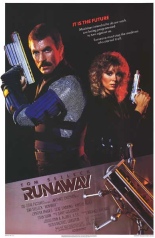
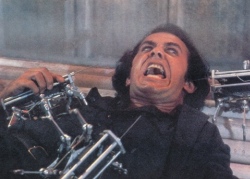 Set in an unspecified future where most menial tasks are now undertaken by non-anthropomorphic robots, Tom Selleck stars as the head of the local police force’s “runaway” squad, which is in charge of catching and stopping malfunctioning machines that pose a hazard to the public. When a robot murders three people, Selleck and his cute new partner, Cynthia Rhodes, uncover a plot by ruthless killer Gene Simmons to fuck everything that moves by selling a “smart bullet” capable of targeting an individual’s heat signature.
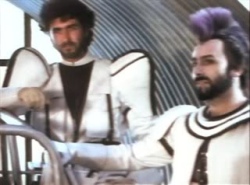 Stepping up to right wrongs and challenge the Templars is Scorpio, a disillusioned former member who looks like a hunky Peter Riegert. He’s joined by a vacant female love interest, a rock-slinging, tow-headed ugly kid and, best of all, crossbow-wielding Fred Williamson and his girly headband, rightfully playing a guy named Nadir.