
Category Archives: Horror

This Land (2023)

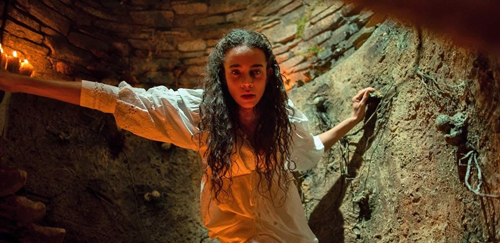
Like Zach Cregger’s Barbarian, Richard Greenwood Jr.’s This Land hinges on a double-booked weekend rental property. Unlike Barbarian, This Land’s threat lives outside the home’s walls.

A year after losing their in-utero daughter to an assault, the mixed-race Owens spouses — a pragmatic, PTSD-afflicted nurse (Hostile Territory’s Natalie Whittle) and an ineffectual, NPR-addicted soy boy (Nazis at the Center of the Earth’s Adam Burch) — rent the Cortez Grove manor for the Fourth of July. They stay despite all the red flags: skinning shed out back, sink full of dirty dishes, blood seeping from the eyes of paintings in crooked picture frames, bowl of saltwater taffy in the living room …

But guess who’s also coming to dinner? Mr. and Mrs. Moss: a chaw-spittin’ (ptui!), flannel/camo-clad, deer-huntin’, deer-grillin’ redneck (John J. Pistone, whose part certainly would’ve gone to David Koechner under a more generous budget) and his Karen-esque wife (Mindy Montavon, #iKllr).

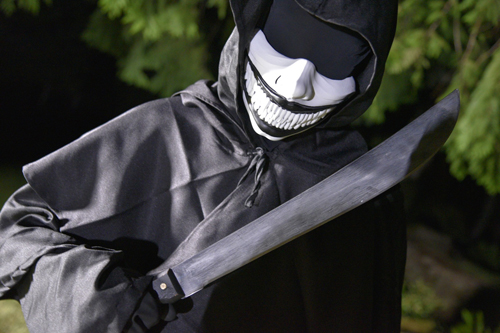
Having these mismatched peeps’ reservations all screwy is no accident. See, every four years, the townsfolk put on their best purple cloaks and have themselves a good ol’ fashioned blood sacrifice to honor “The Flayed One,” a misnomer for “corpse that looks like a human Slim Jim.” To the death!

What begins with pure cringe — a flashback of Whittle speaking in an unnatural manner to her belly’s unborn child — quickly becomes a moderately stimulating story of survival horror and satanic panic, spring-loaded with a couple of functional jump scares. It also makes hot-take statements on such triggering topics as our political divide, emotional trauma, economic inequality, gun control, abortion and — you betcha — race. Compared to like-minded, well-meaning indie thrillers of late, This Land’s makers comment on society without the hammer-slamming; it knows it doesn’t have the panache to pull off taking itself too seriously.

Lest you take This Land for a treatise, Greenwood’s first feature is exploitation first and foremost — so “most,” in fact, it contains the line, “According to the welcome book, it’s an Aztec death whistle.” (Plus, the Moss patriarch announces his teen daughter “done gone preggers.”) In other words, it’s aware of its limitations, so the third act leans hard toward delirium, especially with Garret Camilleri’s performance as the park ranger. That he stands on the opposite end of the tonal spectrum from Whittle’s fully grounded (prologue excepted) work? Eh, I had enough fun to forgive. —Rod Lott

Get it at Amazon.

Cram (2021)

Cram finds college student Marc Lack (John DiMino) having to do just that, in order to write a paper overnight for class. Working on his laptop in the library, he’s having problems getting past page 2. His friends slowly abandon him as the night rolls toward quitting time.

When the building closes for the night, however, Marc is left inside. That’s a scary prospect for viewers who’ve put in long hours at any university library, as their grand architecture and maze-like aisles make them ideal locations for horror. So of course, strange things start to happen, beginning with Marc’s Word document and notebook pages suddenly becoming blank.

Clearly, he’s dreaming, and writer/director Abie Sidell keeps Cram on that realm for the film’s duration without outright acknowledgment. That’s a difficult line to toe for long, which may account for why Cram clocks in at a mere 45 minutes. Although Sidell gets away with teasing between fantasy and reality scene after scene, I didn’t like where the thing lands: at an overly chatty denouement between Marc and another person. Telling instead of showing, this protracted end halts the swift, quick-pivot pacing of everything before it.

With assured direction and acting, Cram finishes just above average, albeit graded on a curve. —Rod Lott

Get it at Amazon.

Rewilding (2023)

If you’re making a folk horror movie, especially on a miniscule budget, the one thing you must do is take advantage of the United Kingdom landscapes. In the anthology Rewilding, his first effort as writer or director, Ric Rawlins does this in spades — all in a smidge under an hour, Millicent. From shores to forests to fields, Mother Nature deserves a co-starring credit in each of “three folk tales.”

Each story centers on its setting. After two people enter a seaside cave, inexplicably vanish, then turn up safely and say they saw the devil, an aging archeologist professor investigates. A woman working on a book of interesting trees is told about a man so obsessed with one, he perished there. And finally, for the Halloween edition of the newspaper, a journalist visits a remote village to witness its festival.

All the rage since Robert Eggers’ The Witch broke big in 2015, folk horror is arguably more popular now since its early-1970s heyday. Among its points of appeal are the deep-seated mysteries in its roots; although any go unresolved in part or whole, audiences are willing to sacrifice answers if they get a good jolt in return. The short-form film is the ideal delivery system for this sort of storytelling, and Rawlins succeeds by batting a fitting 0.666.

Naturally, its Midsommar-on-$2-a-day financial limitations mean a few performances resemble Ren Faire theatrics. So Rawlins powers through by leaning into his influences — Picnic at Hanging Rock to Eyes of Fire to The Wicker Man — and coming out the other side with no fewer than three shocking and disturbing images that are hard to shake. —Rod Lott

Get it at Amazon.

Cat Eyed Boy (2006)

Based on the late-1960s manga by Kazuo Umezu, Cat Eyed Boy is about a cat-eyed boy. (Let’s just call him “CEB” to make things easy and not spend all our hyphens in one review.) Resembling what I’d imagine the McDonald’s Hamburglar to spawn — but with short pants, tube socks and cleft lip — he lives in the rafters of an empty home in a village outside Tokyo.

As the shot-on-video movie opens, a family moves in and CEB slowly reveals his presence to the brother and sister. The precocious brother is cured of his asthma when CEB power-hocks a loogie straight from his sinuses into the back of the kid’s throat. The teenage sister’s hair-hidden, half-face birthmark peels off when CEB licks it with vigor and without consent. Lest you think this is all about his magic saliva, you’re wrong; CEB also urinates on the boy’s bullies.

Director Noboro Iguchi, he of such Japanese nonsense as Mutant Girls Squad and Zombie Ass: Toilet of the Dead, works in a story — kinda sorta — with the village terrorized by a trench-coated, bandage-wrapped Darkman-looking motherfucker and a bumpy meatball monster that’s a dead ringer for a type 2 on the Bristol stool scale.

Luckily, CEB’s spit bores holes … so I guess the movie is all about his magic saliva. Expectorate or no, Cat Eyed Boy is a missed opportunity. Umezu’s original stories — including “The Meatball Monster,” which this adapts — are a blast of gateway horror; what they aren’t, weirdo premise and all, is goofy comedy dependent on gross-out humor. That makes Iguchi the wrong type to faithfully bring CEB to the screen. Other than replicating the main character’s design, this translation doesn’t work. If it were on film, it might better sell the facade. However, the utter flatness and cheapness of video only heightens the fakery, making the entire thing look like a joke.

As of this typing, Cat Eyed Boy has no legitimate American release, but you can watch it on YouTube below. While no English subtitles exist, they’re not what you’d call necessary. —Rod Lott

Winnie-the-Pooh: Blood and Honey (2023)

Contrary to popular belief, the worst type of movie isn’t a bad one; it’s a bad one that’s not any fun.

Enter Rhys Frake-Waterfield, one of the “talents” behind Spider in the Attic, Firenado, Dinosaur Hotel and other extremely lazy assembly-line flicks, many of which seem to take place on the same piece of property in rural England. The man deserves credit for seizing the day: Jan. 1, 2022, to be exact, when A.A. Milne’s Winnie-the-Pooh legally entered the public domain, meaning now anyone can make a Pooh film (or TV show or book, etc.), free of fear of copyright infringement. Frake-Waterfield’s literal million-dollar idea was to turn the silly old bear from kiddie icon to serial killer.

Unfortunately, the imagination stopped there. The piss-poor outcome, Winnie-the-Pooh: Blood and Honey, appears to be written and directed by someone who has never seen a feature film. While that’s clearly not the case, Frake-Waterfield struggles (although that implies effort) with the concepts of pacing, plot, frame composition and other elements of storytelling, visual or otherwise. Its poster boasts the tagline, “This ain’t no bedtime story,” because it hasn’t a story at all. Jason Voorhees and Michael Myers are the stuff of Charles Dickens next to this.

A hastily animated prologue in charcoal sketch posits the idea of Pooh, Piglet and friends becoming crazed once young Christopher Robin leaves the 100 Acre Wood for university. Suddenly short of food, they even eat Eeyore.

The second prologue finds Christopher (Nikolai Leon of Frake-Waterfield’s The Killing Tree) returning to introduce his fiancée (Paula Coiz, Tooth Fairy: Queen of Pain) to his animal buddies. Despite many minutes of her sensing danger and pleading they GTFO, they don’t, so he gets to watch her be slaughtered by Pooh (Craig David Dowsett of Frake-Waterfield’s The Area 51 Incident) and Piglet (Chris Cordell, Werewolf Cabal) — now hulking man-creatures in rubber masks because just go with it, I guess.

Prologues now over, we meet Maria (Maria Taylor of the Frake-Waterfield-produced Mega Lightning) and her four friends, none of whose names I caught, not that you need. They’re girl-tripping at a rented cottage, so they, too, can help reduce the world’s population in less than 90 minutes. The most vapid (UK model Natasha Tosini) is yanked from a hot tub to be squished under a Pooh-driven car. Gore looks like cartoon strawberry jelly, because the entire movie is underlit.

Between its kills are enough padding to generously stuff the fluff of the pillows of every orphanage, hospital and hostel within a 100-mile range. I get the curiosity factor; I, too, succumbed. But I implore you: Stick with the trailer. Life’s too short. So short I’ll tell you how the movie ends: Pooh repeatedly stabs Maria in the head; fade to credits; everyone is the audience is agog, like, “What? That’s the finish? Is a scene missing?”

One would expect the thing to keep going to an actual denouement. Instead, Frake-Waterfield will keep going, returning to the honeypot with Winnie-the-Pooh: Blood and Honey 2, Peter Pan’s Neverland Nightmare, Bambi: The Reckoning and assuredly several more until the ROI is DOA. It’s not unlike the brief flurry of classic literature/modern horror mash-ups that followed Seth Grahame-Smith’s 2009 viral-smash novel Pride and Prejudice and Zombies until the craze ran itself dry, except the film adaptation is watchable.

Look, when you cover genre film for as long as I have (three decades plus, professionally), you often end up “taking one for the team.” However, Blood and Honey is a different sort of beast. Upon buying two tickets at the AMC Theatres kiosk and seeing the total exceed $30, it’s the only time I started to question my life’s choices. Oh, bother. —Rod Lott

Get it at Amazon, if you absolutely have to.