
Category Archives: Horror

The Welder (2021)

In merging horror with racial politics, Florida-based filmmaker David Liz seems to draw inspiration from Jordan Peele’s Get Out. After all, Liz’s The Welder is about a Latina woman and her Black boyfriend in fear of a white man who can’t get over the death of his Black wife. The movie affixes these labels, not I, then presses hard to make their corners don’t peel. Subtlety is not found in The Welder’s toolbox.

Eliza (Camila Rodríguez) and Roe (Roe Dunkley) play the respective girlfriend and boyfriend. With her PTSD growing more intense, he books them a much-needed weekend ranch getaway: ATVs! Horseback riding! Godforsaken science projects!

The ranch owner, Dr. Godwin (Vincent De Paul, Rottentail) screams “sinister” upon greeting his guests. Despite enough red flags to cover a used-car lot on inventory-clearance month, Eliza and Roe stay.

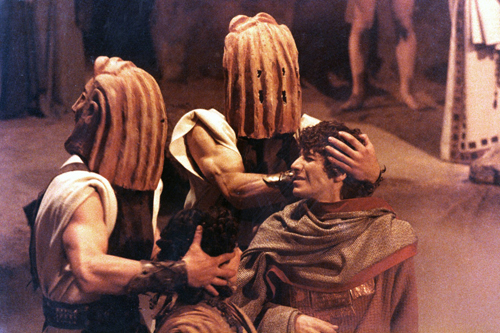
Dr. Godwin’s on a personal mission to “cure the blight of racial hate” vis-à-vis an experiment that’s downright Frankensteinian. While I won’t disclose the deets, viewers will see Leonardo da Vinci’s iconic Vitruvian Man drawing with one slight change: He wears a welder’s mask. It’s not meant to elicit the giggles it did.

So obvious it’s oblivious, The Welder is 90% a drag. No amount of poetic slow-motion scenes with music swelling can convince otherwise. Liz’s film is deeply hindered by poor acting from almost everyone in a cast numbering precious few. As the female lead, Rodríguez’s groggy performance proves contagious to her audience; as her male counterpart, Dunkley displays more energy, perhaps attempting to distract from consistently demeaning dialogue, e.g., “We gotta hella recharge these phones.” He at least appears to be aware of something the movie does not: its own ludicrousness. —Rod Lott

Get it at Amazon.

The Long Dark Trail (2022)

Teen brothers (newcomers Carter and Brady O’Donnell) escape their abusive, alcoholic father (Mick Thyer) and bike through the wilderness of Northwest Pennsylvania. They’re in search of their mom (Trina Campbell), who left them for a satanic cult into pig heads, fireside rituals and human sacrifice via sharp, wooden stakes.

Although adult in themes, The Long Dark Trail is structured not unlike a YA adventure novel, presented in eight short chapters bearing a one-word tease of a title (e.g., “Absconded,” “Lake,” “Salvation”). Our two protagonists are likable, yet deliver their lines rather flatly, void of personality.

However, the true star is nature, which co-directors Kevin Ignatius (My Best Friend’s Famous) and Nick Psinakis (who plays the cult leader) treat more than a mere backdrop. It bears the brunt of establishing and building a pervading sense of doom. Despite all the portents, a satisfactory payoff isn’t found at the end of the map. At least one can appreciate the elements that are first-rate — namely, Ignatius’ score and Mitchell Kome’s cinematography. —Rod Lott

Get it at Amazon.

Free to a Bad Home (2023)

After a woman is fatally shotgunned in her sleep, her belongings are dumped into a curbside cardboard box marked “Free to a Good Home.” Kameron and Scott Hale’s Free to a Bad Home follows a possessed ring plucked from said trashed stash as it moves from person to person to person, telling three stories in total.

Amy (Miranda Nieman) is given the ring in marriage, as the jewelry is surreptitiously swiped by her beau, even after watching her recoil by feeling “bitten” by trying on a necklace from the box. This intriguing-enough setup leads to undue padding and an anticlimactic conclusion.

Next, a burglar (Jake C. Young) finds the ring after silently exploring a targeted house for 10 minutes, flashlight in hand. Eventually, the ring is taken by his sister, Julia (Olivia Dennis), who heads to a costume party with three friends — cue an eight-minute drive, complete with eyedropper drugs. Once there, the ladies wander for eight more minutes before running across anything resembling a story point. That gives way to a lengthy monologue and more confusion than the scene’s neon-dream lighting can mitigate.

The cursed-object concept has been done before, none as ineffectually as Free to a Bad Home. As the previous two paragraphs hammered home, nearly nothing happens in the segment, individually or in total. Although the Hales found a credible method for threading one central character to the next, none is developed enough to merit focus. Each story seems to have been built with a clear beginning and desired ending, but little attention paid to plot the all-important middle. In concocting the passed-property gimmick, the Hales gave themselves a fuse they never get around to ignite. —Rod Lott

Get it at Amazon.

Vampus Horror Tales (2020)

On Halloween night, the elderly gravedigger Mr. Fettes — “Call me Vampus,” he says — shares his miserable existence with viewers of Vampus Horror Tales, not to mention four stories of stone-cold death.

Obviously inspired by the dawn of Spanish horror comics, the anthology film is shot lovingly in black and white. As the playful but murderous Vampus, Saturnino García (The Day of the Beast) introduces each tale. He seems to be filled with them, because after all, “Death is a business that never falls flat.”

Unfortunately, the first story sure does. “The Wedding” depicts a clandestine meeting between bride and groomsman in an escape room basement. What follows is a 20-minute conversation ending with a sputtered-engine twist not worth the wait. Afterward, a filter-free Vampus dismisses it as “submissive drivel,” and I agree.

The middle pair gives the collection its chewy center. “Birthday” follows two girls at a theme park, where a killer lurks the tracks of the stalled dark-ride attraction. The ladies-in-peril theme continues with “Second Date,” as a woman discovers her man-friend has an ulterior motive for bringing her to a quiet, remote cabin. Complicating her escape: She’s blind.

Finally, “Lineage” wonders what to do when someone you love falls victim to a vampire apocalypse. The answer fails to interest; worse, the premise does the same. I would have preferred to see the wax-museum interstitial at the onset be expanded into a full tale, as its brief life packs more of a punch. (Speaking of that setting, Vampus creator Victor Matellano revives the Paul Naschy “cameo” trick from his 2014 film, Wax, so keep your ears peeled.)

The host bits are more developed than your average horror omnibus, with rapid cuts that approximate the experience of comics’ panel-by-panel reading. More beholden to that medium than las películas, Vampus Horror Tales leans toward slicing and/or stabbing necks as a means of slaughter, presumably because it’s cheap for an indie production to pull off. (And on that note, I swear the crawl of closing credits is soundtracked by the “Rain Storm” setting on my phone’s White Noise app.). —Rod Lott

Get it at Amazon.

The Outwaters (2022)

Last summer, as part of a spinal procedure requiring me to remain semi-conscious, ketamine was administered as an anesthetic. A first-timer to the drug, I was ill-prepared for the trip of its drip: one in which my body was pushed through shapes and colors that do not exist. Members of the Trainspotting generation know better, using it recreationally for the very reason I found terrifying.

The experience is so tough to describe with an approximation of accuracy, I yield to the Reddit poster who writes, “you are kitty tripping balls. It’s when MEOW becomes WOEM and the sky is on the floor and vice versa.”

That merits reuse when discussing The Outwaters. It’s a found-footage movie like none you’ve seen. Heck, that still applies if you pull “found-footage” from the equation. On paper, it sounds like every other project in the subgenre: Four friends venture into the Mojave Desert to shoot a music video. Something happens. What we see comes from three memory cards the police recovered from the scene.

In execution, it’s so much more than that, although you wouldn’t know it if you gave up before it gets there — and many will. As writer, director and producer (and editor and cinematographer and sound designer and SFX person and …), Robbie Banfield boldly dares to double down on the mundanity for The Outwaters’ first 52 minutes, only to throw audiences for an absolute loop thereafter.

We meet two brothers (Banfield and Scott Schamell), an aspiring singer (Michelle May) and a newlywed friend (Angela Basolis), as they prep to leave L.A. earthquakes behind for the shoot. In the desert, Banfield’s able to capture moments of beauty, both visually and aurally. Camping overnight, they hear what they think is ball lightning. The next morning, what’s with the electric currents running through the rocks?

Then, with no forewarning, the film takes such the hardest hard right, spatial concepts like degrees and directions cease. For the next hour, The Outwaters trafficks in sheer terror and cosmic whatthefuckery at once Lynchian and Lovecraftian. You’ll question what you’re taking in as it unspools. It’s as audacious as it is mind-bending, and weeks later, I’m still trying to parse how several of its shots were pulled off.

For all the viral brouhaha Skinamarink recently enjoyed, The Outwaters deserves it more, despite being equal in viewer polarization and befuddlement. —Rod Lott

Get it at Amazon.