Category Archives: Documentary

Chariots of the Gods (1970)

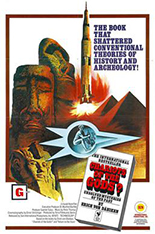
Based on the famed book by Erich von Däniken, the documentary Chariots of the Gods was always from the school of thought that if a white man couldn’t do it, then it had to be aliens.

Throughout, we’re given otherworldly examples of astounding architecture in Egypt, stone wonders in Mexico and so on throughout the non-white world, learning that it was impossible for these ancient cultures — that, quite honestly, we still have barely an idea about — to build them in their wholly primitive and desperately unknowing ways.

The simple solution? Aliens, of course!

Hey, it was the ’70s, as the world was deep into the Mondo Cane-structure of many popular documentaries. Chariots of the Gods was probably on the low end of this somewhat fantastical spectrum, utilizing more of a science class film strip approach to telling its tall tales of universal visitations and, apparently, community rebranding.

The usual suspects are all here, including the famous Easter Island statues and the not-as-famous Nazca Lines, which, we learn, were used to guide incoming spacecraft to the burgeoning brown civilizations. While these ideas, though mildly racist these days, can still be fascinating to hear, they’re also extremely quite dated and filled with mostly made-up facts, like said science class film strip.

Chariots of the Gods takes us back to a time when we so desperately wanted to believe in extraterrestrials that helped to shape the then-Earth, except that it’s viewed through a whites-only telescope that really doesn’t — and really shouldn’t — hold up today. —Louis Fowler

Get it at Amazon.

On the Trail of UFOs: Dark Sky (2021)

With his Small Town Monsters label, Seth Breedlove has, well, bred a cottage industry of documentaries on all things cryptozoological and/or mythological. After features on Bigfoot and Momo: The Missouri Monster, he again watches the skies for On the Trail of UFOs: Dark Sky.

In this one, he and paranormal investigator Shannon LeGro visit the Appalachians and “hills of hollows” of West Virginia, as the Mountain State plays home to several “quintessential cases” in the lore of unidentified flying objects. Mixing clips from 1956’s Earth vs. the Flying Saucers and stock footage with actual interviews, Dark Sky presents firsthand accounts, hearsay accounts, “anonymous witness” accounts and even the occasional kids’ crayon drawings to present the locals’ stories of encounters both close and close enough. Among them are a diamond-shaped craft sucking energy from power lines, a sighting while playing hoops with the old man, spinning lights, flashing lights and more — all professionally recreated with first-class motion graphics. Without them, Dark Sky would feel feather-light on content.

You can practically watch the doc with a bingo card at hand with squares for all the usual-suspect terms one might hear involving UFO conspiracies and conversations: military ops, psy-ops, Mothman, men in black, Project Blue Book, Dow Chemical, WMD, FBI, CIA, NSA, mobile homes …

Not a follower of UFOs, I’m not qualified to state if On the Trail unearths anything new, but Breedlove brings a theory regarding mineshafts to the table, while an interviewee raises the question of whether aliens target families. Typical of his work, this film impresses with top-notch production value. The only drawback is in LeGro’s narration, which is halting and hesitant, as if she’s not only reading from cue cards, but reading from cue cards written in a foreign language she’s translating on the fly. Her interest and knowledge, however, are not in question.

Whether the movie plays as mere entertainment or belief reinforcement is left for you to decide. —Rod Lott

The Witches of the Orient (2021)

Unless you’re a pinko commie, hearing the phrase “Olympics upset” should conjure memories of 1980’s “Miracle on Ice” — or at least the 2004 Kurt Russell movie about it — when the U.S. men’s hockey team out-pucked the Russians to surprise gold. Less known (for now) is a similar story of victory over the USSR, this time by the 1964 women’s volleyball team from Japan. The players’ global accomplishment capped an extraordinary streak of 258 consecutive wins — a feat so mighty and magical, it earned them a moniker adopted by a new documentary about the team: The Witches of the Orient.

As the septuagenarian surviving members relate to French director Julien Faraut (John McEnroe: In the Realm of Perfection), being part of the Nichibo Kaizuka volleyball team was less fun and games, and more conscription: After a full day of factory work, the young ladies hit the gym until midnight, then did the same all over again, often operating on a mere three to four hours of sleep.

After this context, Faraut delineates the team members’ individual personalities behind the often-demeaning nicknames (Fugu, Horse, et al.) given to them by mercurial coach Hirofumi Daimatsu. In present day, as the women relay stories from their grueling path to the 12th Olympic Games, the film incorporates relevant clips of a Witches-inspired anime series, as well as historical footage set to an atmospheric but uptempo electronic score by K-Raw and Grandaddy’s Jason Lytle. Although lengthy, these marvelously edited musical sequences work to the doc’s enormous benefit, pushing it beyond 30 for 30 territory into modern art. (I need this soundtrack album, although it doesn’t exist.)

Taking up Witches’ final third is, of course, a condensed version of the Land of the Rising Sun’s on-court attack against the Iron Curtain at the Olympics. Quite simply, this is one of the most captivating half-hours in sports-doc history. Hosted in Tokyo, those Games represented the loftiest of stakes for Japan as a crucial step in post-WWII rebuilding. That burden is evident by the sheer aggression and swiftness of the Witches’ strike-and-spike strategy to conquer their Soviet Union counterparts, revealing our heroines as an even more formidable threat than Faraut has shown us thus far.

When they win, the pride, humility and exhaustion shining from their faces is COVID-level infectious. That their gold-medal moment comes free of ego makes the scene — and the film — all the more moving. —Rod Lott

F.T.A. (1972)

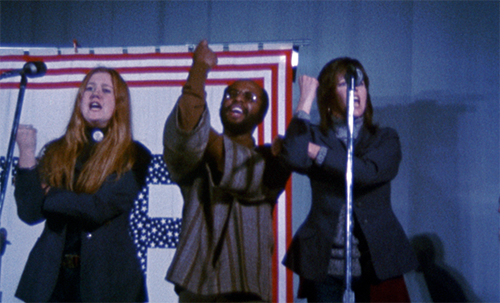
Long hidden from the public eye for its supposedly controversial content, F.T.A. — translating to, in case you need to be riled up, “Fuck the Army” — is a documentary about the anti-military roadshow headed by Jane Fonda, already a controversial character in her own right, mostly for being a woman who dared to speak up against the war.

Filmed over a few years in the early ’70s, this alternate-universe Bob Hope special went right to the military bases — or as close as they possibly could — and performed dated skits and songs about America’s then-current war with Vietnam and this intense need to leave, featuring interviews with servicemen who have experienced racism and other ills while in the military.

Along with Fonda, Donald Sutherland and a team of somewhat-comic actors perform mostly unfunny comedy bits written by the likes of Jules Feiffer and others, but the musical interludes by folk singer Len Chandler are rabble-rousing enough to forgive the inane jokes and lackluster parodies; I guess it was the only live entertainment anti-war protestors had at the time.

But where the film really succeeds is not only in the interviews with disgusted military men, but with the citizens in Asian countries where America kept (keeps?) its bases, as the local anti-war movement marches against soldiers being in their neighborhood; especially sobering and particularly moving is a trip to a Hiroshima museum.

The thing about F.T.A. that truly surprises me, however, is just how dangerous the American government considered Fonda and this film to be at the time — and probably even do now — attempting to stop the concerts and even reportedly forcing the doc to be pulled from theaters a week in its initial release. It kind of proves what a farce the First Amendment is, especially for the enlisted people who die to fight for it. —Louis Fowler

Get it at Amazon.

Mean Man: The Story of Chris Holmes (2021)

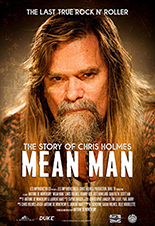
When you ask the many fans of The Decline of Western Civilization Part II: The Metal Years what their favorite scene is, they’ll probably say those involving an absolutely drunk Chris Holmes, the guitarist for W.A.S.P., nearly drowning in a pool as his mother sits on the edge leering. It is for me.

While I thought he died shortly after that glimpse of living the high life, but turns out he’s alive and kicking around in Europe, where he’s something of a draw with his new band. So that’s a relief, I guess.

In the documentary Mean Man: The Story of Chris Holmes, we learn that W.A.S.P. lead singer Blackie Lawless was an idiotic showman who had no real respect for Holmes; to be fair, almost every night Holmes would get blackout-drunk, culminating in losing his house and sleeping on the couch of his fellow rock buddies, as you’d expect.

Still, even after a couple of new bands and a W.A.S.P. reunion, he needed to express himself “artistically,” culminating in this new tour. From traveling to gigs, playing onstage and recording a new album I’ll never listen to, there are so many moments of inspired comedy, this almost becomes a true-life Spinal Tap.

While there seems to be a lot that doesn’t work for Holmes musically, I’m surprised how much actually does in his own life, at least what the camera shows us. He has a loving and understanding wife; he’s genuinely nice to his fans; and he seems, at least in his head, poised for something of a comeback.

If you can take the corrupt past of Holmes and genuinely separate it into this recent life, Mean Man becomes something of a rock ’n’ roll survivor story. That being said, I’m still not listening to any of his music, but I’m glad he’s still here and still pushing the envelope. —Louis Fowler

Get it at Amazon.