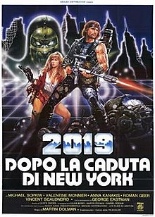
 The year is 2019. America is under the rule of a tyrannical despot that will, without mercy, capture and kill those who don’t meet his idea of genetic perfection simply to attain his primarily dark goals of world domination. No, it’s not the long-awaited Donald Trump biopic — give it a few years, though — instead, it’s the
 Martin Dolman Sergio Martino flick 2019: After the Fall of New York.
In a now-alternate timeline devised by the unusually prescient Martino (Hands of Steel), the world is currently a radiated cesspool that is under the dubbed thumbs of the megalomaniacal Eurax conglomerate, a united league of unspecified evil that rounds up the deformed humanity that roams the wastelands to do far-fetched cybernetic experiments on them. At least I think so.
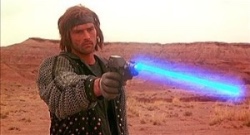 Meanwhile, in the vastness of the desert that now resides outside of New York City — I’m thinking New Jersey — a Snake Plissken-type that goes by the name of Parsifal (Michael Sopkiw, Blastfighter) rules most of the primitive sporting events of the time — including the demolition derby, unsurprisingly — winning dirty coins and dirtier women; he’s very much a serviceable anti-hero with a five-o’clock shadow, a kicky headband and one questionable quip after another.
Hearing of his somewhat heroic deeds in the field, a rival confederacy called the Federation tells him that not only is the only fertile woman in the world hidden somewhere in the Big Apple, but that he needs to rescue her before a (completely obvious model of a) rocketship shoots the few chosen survivors into space in order to, I’m guessing, restart the human race on the moon.
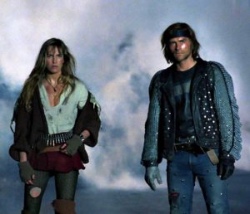 Once in New York, however, there’s no time for sightseeing, as a rather pathetic group of dwarf-killing mutants who rope and wrangle rats for various barbecued meals are looking for an unnecessary fight; it’s here where Parsifal meets his smudgy ladylove, Giara (Valentine Monnier, Devil Fish), as well as the wily little person Shorty (Louis Ecclesia) and a monstrous big person named, suitably enough, Big Ape (George Eastman, Warriors of the Wasteland).
It’s Big Ape, by the way, who, when they find the working womb sleeping in a hyperbaric chamber, proceeds to have unconscious sex with her, spreading his diseased genes even further and hopefully into space; it’s a bit of sexual assault that Parsifal makes a cool aside about as his armored station wagon makes it past some of the worst traps that the obviously dense Eurax army has to offer.
Widely regarded to be one of the best spaghetti rip-offs of John Carpenter’s Escape from New York — and it is — 2019: After the Fall of New York is actually far more entertaining than its original source material, from the lonely jazzman who blows a golden trumpet among the ruins to the Eurax leader who has his eyes ripped out and cybernetic ally re-implanted. By the time the open ending came around, I was kind of wishing that 2020: After the Fall of L.A. were a real thing. —Louis Fowler

 Only in the 1970s — or at least the New World Pictures version of the 1970s — could you make absolute heroes out of a pair of cop-shooting, hostage-banging, dynamite-toting bank robbers the way that the drive-in favorite

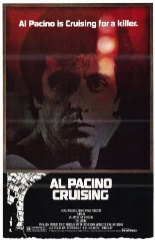
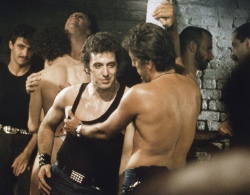
 Undoubtedly one of the most controversial films ever made, William Friedkin’s provocative tale of a homosexual killer on the loose in the sultry sexual playground of New York City in the 1980s is constantly being re-evaluated and reinterpreted through far more educated eyes than mine, but time has aged it well enough for me to at least admit that it’s an incomprehensible serial-killer flick that you just can’t look away from.