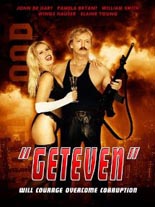
 If at first you don’t succeed, fund your own movie. That appears to be the case for John De Hart, an L.A.-based attorney-at-law who wrote, produced, co-directed and stars in GetEven (one word, please), an action movie of such stunning hubris and incompetence, it offers enormous entertainment value in ways its multihyphenate creator could not have intended.
The vanity project bears all the tell-tale signs of a wannabe actor so frustrated with years of rejection that he vowed to “show them all” every drop of his untapped potential. Scenes exist simply to allow De Hart to demonstrate each item one imagines is listed under the “Special Skills” heading of the résumé printed on his headshot’s backside: kickboxing, animal-training, singing, joke-telling, reciting Shakespeare, driving a stick shift, motorcycling, wearing an American flag denim shirt with several buttons open past what counts as acceptable.
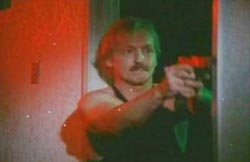 As Bode, De Hart throws his mustached self and what looks like a rug into the demanding role of a former cop turned limo driver who burns rude clients with the scalding rhyme of “Adiosie, Bela Lugosi,” and cuts down authority figures with the razor-sharp “Here’s a quarter. Buy yourself a personality.”
What can’t Bode (read: De Hart) do? Nothing. He can pack his dumpy frame into black leather pants. He can warble an off-key, achy-breaky, can’t-unhear-it country tune titled “Do the Shimmy Slide” (written by De Hart, natch) that gets at least four bar patrons to line-dance. He can crunch a Mexican restaurant’s complimentary basket of chips as loud as his wardrobe. He can shoot goons off rooftops with a crossbow in the dead of night. He’s like a West Coast Rambo!
I’m sorry, did I write “Rambo”? I meant “hambone.”
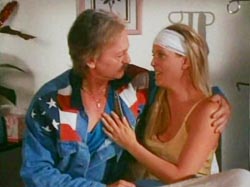 De Hart appears less interested in depicting Bode’s feud with corrupt Judge Normad (gravel-throated William Smith, 1982’s Conan the Barbarian) than depicting himself as sexual catnip. As a good creator would, he gives himself three sex scenes with 1978 Playboy centerfold Pamela Jean Bryant (H.O.T.S.) as the out-of-his-league Cindy. She’s back in his life after getting mixed up in coke and a coven of devil worshippers; the final straw was that night they sacrificed a baby, she explains, “so I left Hollywood the next day.” And lucky for Bode (again, read: De Hart) she did, because he gets to rub ice on her nipples, squeeze her breasts in a slow-motion bubble bath and be mounted after a honeymoon striptease.
Be sure to look out for the patio furniture in Normad’s office, not to mention the middle-aged woman whose face appears to have had so much plastic surgery, she struggles to blink. One thing viewers will notice with ease is the performance of Wings Hauser (Vice Squad), who’s an in-on-the-joke hoot as Bode’s best bud, Huck Finney. Hauser plays Huck as eternally inebriated, whereas De Hart unwittingly plays Bode as having been dropped on the head as a child.
So gloriously helpless and inept is GetEven that I laughed harder at it than 99 percent of on-purpose comedies. I genuinely wished De Hart had made a follow-up. I’d pay double to see him and his some of law buddies in their version of The Expendables. Kickstart that off, Boris Karloff. —Rod Lott
Buy it at Amazon.

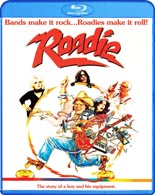 We’re giving away a copy of Roadie on Blu-ray to one lucky summabitch in these United States of America. How to enter? Easy!
 If “giallo” could be translated to Español, the term applies to

 Having spent more than a decade in the realm of music promotion, I say with experience that receiving shitty, unsolicited albums is all part of the job. Rob Zombie’s