
All posts by Rod Lott

Death Valley (1982)

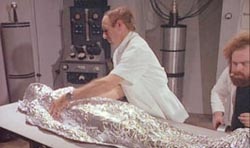
deathvalleyOne year before he nearly shot an eye out in A Christmas Story, Ralph Billingsley deliberately attempted it in Death Valley — just not his own peepers. The tyke’s target is an economically depressed waiter named Hal (Stephen McHattie, Pontypool), whose slaughter of three tourists in an RV can be tied back to him, thanks to a frog pendant the curious boy pilfered from the scene of the crime.

Billingsley’s Billy leaves New York City for an Arizona vacation with his divorced mom (Catherine Hicks, Child’s Play) and her new beau (Paul Le Mat, Melvin and Howard), a land developer for whom cowboy gear is work clothes. While at an abandoned gold mine, Billy pokes his nose where he shouldn’t, thereby earning himself the top spot on Hal’s list of precocious kids to kill today.

deathvalley1Directed by Dick Richards (1986’s Heat) with a dearth of visual flair, Death Valley is a rather routine thriller of the psycho-on-the-loose variety. Thank goodness Richards cast Billingsley, because the boy’s natural presence is the film’s saving grace.

There’s so little to the story — all 87 minutes of it, including credits — that screenwriter Richard Rothstein (Universal Soldier) includes a rather lengthy scene with the sole purpose of underlining how fat the fat babysitter (Mary Steelsmith, H.O.T.S.) is: She’s so fat she eats a whole chocolate bar, then inhales an entire bag of Fritos, then goes out for a banana split, only to meet her doom by being lured into the shadows by a soda machine that spits out an irresistible free pop. It’s like a chunk of cheese upon a mouse trap, and it’s needless, embarrassing, cruel, demeaning and, oddly, the movie’s only note of nastiness. —Rod Lott

Buy it at Amazon.

It Doesn’t Suck: Showgirls / Raise Some Shell: Teenage Mutant Ninja Turtles

itdoesntsuckBefore it went belly up, Soft Skull Press produced a series of small-size film books under the Deep Focus banner. Each paperback found a different noteworthy author (i.e. Jonathan Lethem, Christopher Sorrentino) delivering an anything-goes essay on the movie at hand (i.e John Carpenter’s They Live, Michael Winner’s Death Wish). It was a nifty idea, mostly brought to its full creative potential, but only lasted five titles.

Now, ECW Press embarked on a similar (and similar-sized) project, Pop Classics, but has expanded the scope beyond just cinema to encompass all of popular culture. First out of the gate are Adam Nayman’s It Doesn’t Suck: Showgirls and Richard Rosenbaum’s Raise Some Shell: Teenage Mutant Ninja Turtles.

I don’t particularly care for Paul Verhoeven’s Showgirls or those heroes in a half-shell, but found both titles to be enjoyable reading (one much more than the other), so I imagine actual fans would respond even more positively.

People argue whether Showgirls — a notorious NC-17 flop in 1995 that since has become a cult fave — is a masterpiece or a piece of shit, and Nayman argues, to paraphrase, “Why not both?” In little more than 120 pages, the author compares the film not only to the obvious — Basic Instinct, also from Verhoeven’s and screenwriter Joe Eszterhas — but also how it parallels such disparate entertainments as Busby Berkeley musicals, David Lynch’s Mulholland Dr., the classic All About Eve, Verhoeven’s own Starship Troopers and even Elaine’s “dancing” on that episode of Seinfeld. Dude’s done his homework and put some serious thought into the subject.

raisesomeshellRosenbaum, however, may have overthought his. Readers may suspect as much throughout Raise Some Shell: Teenage Mutant Ninja Turtles — and proven correct by the time he equates the Teenage Mutant Ninja Turtles to Salman Rushdie’s The Satanic Verses.

His book might be better if he were not an unabashed fan. On one hand, he demonstrates tremendous knowledge in pointing out the differences between the comic book and the movies; on the other, he should have done more research on the non-TMNT parts. Avoidable errors dot the text, from stating that The Big Bang Theory airs on NBC (it’s CBS) to writing that Star Wars was a product of Universal (20th Century Fox begs to differ).

To his credit, Rosenbaum gets off some good lines — I particularly like his dissing of the Justice League of America as a country club — and boggled my mind with the heretofore unknown fact that Roger Corman proposed a TMNT movie in which the turtles would have been played by comedians in green makeup. (Forget this summer’s reboot — Corman’s is the one I would totally see!)

With both books, Pop Classics is off to a solid start. Get onboard now so other editions may follow. —Rod Lott

Buy them at Amazon.

UHF (1989)

uhfOpening with an elaborate, extended Raiders of the Lost Ark spoof, UHF is never as funny as it wishes it were, but is too darn likable to knock it for the gap. In essence, the movie is like that one guy at the office who always wears short-sleeved button-down shirts: You’ll never vacation with him, but hey — dude brings donuts!

The first and final big-screen showcase of polka-leaning parodist “Weird Al” Yankovic, UHF casts the Grammy-winning chart clown as George, a minimum-wage loser whose sole hope for redemption is also a long shot: making a success of his uncle’s penny-ante TV station, channel 62.

uhf1Through a mix of sheer luck and sheer stupidity, rating skyrocket under George’s watch. Turns out viewers can’t get enough of watching a game show where contestants win fish, or a nature series in which the hosts hurls poodles out an apartment window. Channel 62’s smash, however, is a live kids’ program starring station janitor Stanley Spadowski (a pre-Seinfeld Michael Richards), who isn’t all there mentally, but that’s no prerequisite for having children drink from a fire hose. All of their Nielsen fortune means squat if George and friends can’t raise $75,000 to settle his shyster uncle’s debt.

From Spatula City to Gandhi 2, the fake commercials strung throughout UHF provide more of a jolt to the funny bone than the actual story. Yankovic, who co-wrote the flick with his videos’ director Jay Levey, is a pleasant comic protagonist even when his lampooning finger isn’t exactly on the pop-culture pulse; the worst offender is a dreamt video that simultaneously pokes fun at Dire Straits’ “Money for Nothing” and The Beverly Hillbillies — then a respective 4 and 27 years old. Yankovic and Levey’s collaboration falls short of the Zucker/Abrahams/Zucker vibe it tries to emulate, but respectfully so. It’s a shame that, unlike George, they never got another chance. —Rod Lott

Buy it at Amazon.

Need for Speed (2014)

needforspeedEarly in Need for Speed, an adaptation of the video game series, the main characters are seen playing what I assume is one of those games. It further accentuates how thin the story measures, and how thinner the source material. At its best, Need for Speed plays like a sequel in the Fast & Furious franchise; at its worst, Need for Speed plays like a sequel in the Fast & Furious franchise.

Fresh from five seasons of TV’s Breaking Bad, the talented Aaron Paul underwhelms in the miscast lead role of bankrupt, glowering gearhead Tobey Marshall. He can drive fast cars faster than anyone else because he says so, and because these things dictate that he must. His considerable skills behind the wheels of modified rides shift into personal when an incredibly dangerous, dick-measuring race down both sides of a highway results in the fiery death of his pretend “little brother” (Harrison Gilbertson, Haunt), thanks to a bumper nudge from rich, hot-as-snot Dino Brewester (Dominic Cooper, Captain America: The First Avenger).

needforspeed1Payback for Tobey will come in the crushing defeat of Dino in a super-secret, super-illegal annual race that is invitation-only and thrown by a super-embarrassing Michael Keaton (The Other Guys) in Wolfman Jack mode. First, Tobey and his British passenger/love interest (Imogen Poots, 2011’s Fright Night remake) have 48 hours to get from New York to San Francisco, thus allowing for several races along the way of this race to that race. Director Scott Waugh (Act of Valor) shoots these sequences in a gung-ho manner that delivers the shiny, well-oiled goods in the department of vroom-vroom, but does so via a template of Bruckheimerian angles viewers can check off mentally.

Despite the here-and-now gloss, Need for Speed seems to herald from another era, like the jalopy-ready pictures AIP pushed to teens in drive-ins — you know, like 1955’s The Fast and the Furious. (Need for Speed even begins at a drive-in!) Paul, Cooper, Gilbertson and company all sport haircuts so high and spiked, they visually recall a live-action version of Dragon Ball Z. It’s particularly distracting for Paul, who’s all forehead, which he touches constantly as he looks toward the ground and then up dramatically. Half his performance is this move.

Need for Speed is diverting enough, but also needlessly exhausting for something so frame-one predictable. Imagine what a better, more interesting movie it would be had Poots — such an ugly name for such a pretty woman — been placed in the driver’s seat instead. For 130 minutes of my life, I think that’s a fair trade. —Rod Lott

Buy it at Amazon.

Death Occurred Last Night (1970)

deathoccurredIn Milan, a middle-aged man by the name of Berzaghi (Raf Vallone, 1969’s The Italian Job) is not only widowed, but the sole caregiver for his mentally handicapped daughter, Donatella (Gillian Bray, The Bod Squad). Although she is 25 years old, her mind is stuck at 3; she can’t even put on a brassiere without her father’s help. Innocent flirting on her part is misread as sexual invitation from strangers, so Berzaghi must lock her up in their apartment when he goes to work.

One day, however, he returns to an empty home. The doors and windows remain locked; there’s no sign of forced entry. He fears the worst, as he should: that she has been abducted from his well-intentioned prison to one that has only the worst intentions in mind.

Enter the sinus-infected police captain (Frank Wolff, Once Upon a Time in the West) and his younger, shaggy-haired partner (Gabriele Tinti, Black Emanuelle), who have a feeling Donatella may have been kidnapped into a prostitution ring, so they tour the area’s buy-before-you-try bordellos.

deathoccurred1The mystery of Duccio Tessari’s Death Occurred Last Night is not whether Donatella will be found among the whores, but who will find her and/or her captors first: the police or Berzaghi? The increasingly desperate father doesn’t think the authorities are acting fast enough, so he takes matters into his own vengeful hands.

Tessari (A Pistol for Ringo) directs this grim yet gripping polizia picture with a straightforward objective that makes its story timeless: suspense. So do the colorful supporting players who weave in and out of the story, not always by their own volition, including a suicidal “Negro prostitute,” a former pimp stooping to a less respectable career (that of car salesman) and a teddy bear with an ugly face. However, the show belongs to Wolff and Vallone; the former for portraying how a cop’s professional life infringes upon his personal one, and the latter for showing how an honorable man in his position gives up his own life to focus on that of his only child. —Rod Lott

Buy it at Amazon.