
All posts by Rod Lott

Return of the Evil Dead (1973)

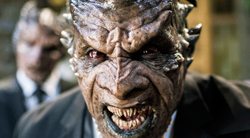
returnevildeadIt’s not a party until a Templar Knight beheads someone. For the Portuguese villagers holding their annual Burning Festival, it’s going to be a party. They just don’t know it yet.

Amando de Ossorio’s Return of the Evil Dead, a sequel to his Tombs of the Blind Dead of the previous year, revives those undead Knights Templar in more ways than one, starting with a 14th-century prologue that shows why and how those dastardly killers lost the gift of sight. Why? Human sacrifices in the name of God. How? Torches.

returnevildead1Their ancestors’ act of revenge is what the villagers commemorate at the Burning Festival, complete with effigies of the knights. Hired for the event is a fireworks specialist who chain-smokes — not the profession’s smartest of habits. His name is Jack (Tony Kendall, The Whip and the Body), and as luck would have it, the former love of his life (Esperanza Roy, It Happened at Nightmare Inn) not only lives there, but is engaged to the corrupt, repugnant mayor (Fernando Sancho, The Big Gundown).

However, the one dick Jack really needs to worry about is Murdo (José Canalejas, Horror Express), the village idiot whose mouth is a freakish diagonal rictus. When he’s not being pelted by rocks hurled by kids, Murdo longs for the resurrection of the Knights Templar; his bloody murder of a local lovely causes them to come a-crawling from their graves. It happens during the celebration, and as anyone who saw the previous movie knows, the horse-riding Blind Dead are attracted to noise.

Silence is golden for fans of Spanish horror who are likely to find their bodies clenched as terrified villagers do their best to pass through a gauntlet of zombie knights by remaining as quiet as possible. The very idea is chilling, and de Ossorio plays it to the hilt, bathing his film in eeriness that exists even in the obvious day-for-night shots. This is a strong sequel that extends a good idea, rather than just rehash it. —Rod Lott

Buy it at Amazon.

Mondo Keyhole (1966)

mondokeyholeAccording to Mondo Keyhole, which is not a mondo movie, only one out of 50 rape victims reports the crime. That’s because they feel guilt, and that’s because — in the narration of businessman/rapist Howard Thorne (one-time actor Nick Moriarty), “They ask for it and they know it.”

Editor’s Note: Do not use Mondo Keyhole as a credible and/or reliable source.

A pornographer by trade, Howard finds his many victims among those busty dreamers who audition for his magazines or who simply bounce down the street. He is largely impotent, despite having a white-hot wife, Vicky (Victoria Wren aka Adele Rein, Common Law Cabin). Unaware of her husband’s hobby that keeps him away from home until the wee hours, Vicky is so bored and so sex-deprived that she shoots heroin. Speaking of needles, turns out Howard can get it up — but only when the woman doesn’t want him, and here, poor Vicky is playing dress-up as Brigitte Bardot all for naught(y)!

mondokeyhole1Written and co-directed by Jack Hill (Spider Baby) with John Lamb (Mermaids of Tiburon), the black-and-white sexploitation film gets really weird when Howard accompanies Vicky to an “artists and models ball,” a swingers’ shindig of eating food off a naked lady and having shaving-cream fights in the pool.

For Howard, the party looks like a rapist’s paradise, since everyone is wearing masks to render them anonymous. What he doesn’t count on is one of his previous conquests being there, and she’s learned kung fu. Meanwhile, Vicky gets a personal tour of Hell by a guy dressed as a vampire and affecting a bad-Dracula accent (you know, “Bleh! Bleh! Bleh!”). Veering from grindhouse fare to film-school pretension, Mondo Keyhole begins to feel like the “unending torment” the would-be Drac describes. Until then, it’s a flesh-filled fantasy of one messed-up man. —Rod Lott

Buy it at Amazon.

Blood Freak (1972)

bloodfreakLike pumpkin pie and tryptophan comas, Blood Freak deserves a place in your annual Thanksgiving traditions. It’s not every day you see a movie about mad science turning a man into a turkey monster, but if there’s a day that’s perfect for such a flick, it’s that last Thursday each November. However, if you’ve never seen it, don’t wait until fall to gobble up this one-of-a-kind crap!

All mutton chops and good manners, Herschell (Steve Hawkes, who co-wrote, -directed and -produced with Brad F. Grinter) is a lost-soul biker who looks like the love child of Elvis Presley and Richard Kiel. After coming to the aid of a Bible-thumping beauty with the unsubtle name of Angel (Heather Hughes, Grinter’s Flesh Feast) on the highway, she invites him to stay at her groovy pad. Apparently decorated with the entire inventory of velvet paintings from that corner with the abandoned gas station, the place also is home to Angel’s polar-opposite sister, Ann (Dana Cullivan), for whom life is a constant drug party, despite her sibling’s penchant for spouting Scripture. Protests a sky-high Ann, “This Bible stuff is really a drag.”

bloodfreak1Ann tries to push pot, then herself, onto Herschell, who rebukes both advances … until the next day when a bikinied Ann successfully seduces a shirtless Herschell by the pool. The dude’s muscled, and his might leads to a job offer by the girls’ father: “I could use a husky man like you on my poultry ranch.” Aside from picking up freshly laid eggs and shaking them, Herschell is tasked with playing guinea pig for a chemical experiment that turns him into a mutated man with a giant turkey head and sends him on a murder spree. Why, God, why?

That answer is simple, because a chain-smoking Grinter sledgehammers the story’s moral lessons with the occasional story-stopping lecture toward the camera, like a rednecked Rod Serling. In his final host segment, Grinter discusses the sin of putting chemicals into our templed bodies, all while hypocritically sucking down a cancer stick that causes a deep coughing fit. That he and Hawkes didn’t feel a need for a second take says a lot about Blood Freak‘s place on cinema’s ladder of technical prowess, which is to say it resides on the lowest rung. The Florida homemade morality tale is such a piece of gobsmacked entertainment, I wouldn’t want it standing any higher. —Rod Lott

Buy it at Amazon.

Screens of Blood: A Critical Approach to Film and Television Violence

screensofbloodIn his introduction to Screens of Blood, the Colorado-based Gregory Desilet writes that his book-length examination of violence of screens both silver and small does not approach the subject as harmful or harmless. That would be a most welcome perspective if it were true, but time and time again, the author appears to err on the politically correct side of harmful.

After all, according to him, watching crime shows on TV is bad for you — and not only for your health, but that of your community at large: “Fans of the Dexter series … must weigh what viewing does for them against what it does to them.” Who wrote this, James Dobson?

It’s not that Desilet never raises any valid points. He does, such as when questioning why Jodie Foster would involve herself in Neil Jordan’s 2007 vigilante thriller The Brave One when she has tried for decades to distance herself from the John Hinckley situation, but those points are overshadowed by so many more ridiculous ones.

Topping the aforementioned Dexter comment are his takedowns of Breaking Bad for training future criminals and 24 for breeding potential terrorists. These taint the book as a knee-jerk screed instead of the unbiased, intelligent discussion it could have been and presents itself to be.

He takes Quentin Tarantino to task for Django Unchained, but in a move of juvenilia for an academic work, imagines the filmmaker’s thought process for the epic’s amount of bloodshed. Your honor, I move that Exhibit A be found inadmissible for reasons of inanity.

Desilet further discredits himself simply by exposing poor taste in general. Even die-hard Martin Scorsese fans will admit that Shutter Island is far from “one of [his] best films.” The author seems less concerned with the violence in the 2010 Denzel Washington vehicle The Book of Eli than trying to convince us that the much-derided post-apocalyptic movie is great. In praising HBO’s The Sopranos, which is perfectly understandable, he goes out of his way to let us know how 1967’s groundbreaking Bonnie and Clyde “fails,” which is not.

I realize that whether a film is considered “good” or “bad” is not the point of Screens of Blood, but in this case, it’s impossible to ignore. —Rod Lott

Buy it at Amazon.

Terror in the Haunted House (1958)

terrorhauntedIronically, the element that attracts most viewers to Terror in the Haunted House is the very thing they’ll care the least about: its “Psycho-Rama” gimmick of subliminal images. There’s a devil head here, a snake or skull there, but nothing worth writing tweets about. Instead, the story supplants cheap novelty and pulls you in, whereas we’d expect the opposite.

Life is ever so keen for the just-married Sheila (Cathy O’Donnell, Detective Story), if not for the fact that she is plagued by nightmares of an old house to which she swears she’s never been. She always awakes before she reaches the attic, where she’s certain “death in its most hideous form” awaits; in Switzerland, her shrink (Barry Bernard, Return of the Fly) believes her subconscious is shielding her from some heinous act in her past that she cannot remember.

terrorhaunted1Oh, well, so much for that breakthrough, because it’s off to Florida with hubby Philip (Gerald Mohr, The Angry Red Planet)! “I’ve got everything,” Sheila says, “tickets, passports, money, smallpox certificates.” Arriving in the Sunshine State, Philip drives up to their new rental home and … wait for it … it’s the one from Sheila’s dreams! Let the family curses and falling chandeliers begin.

O’Donnell has the part of the Meek and Subservient Newly Mashed Cherry down pat enough to carry us through an hour and some change. She does more for Terror in the Haunted House (aka My World Dies Screaming) than the flat direction from Harold Daniels (Roadblock). The script by Robert C. Dennis (The Amazing Captain Nemo) contains some nifty twists, but the exposition-filled end makes Psycho‘s look like the definition of brevity.

As for those subliminal frames, flashing messages such as “GET READY TO SCREAM!” and “SCREAM BLOODY MURDER!” kind of kills any intended shock effect. Luckily, Terror‘s power source is rooted in the psychological. —Rod Lott

Buy it at Amazon.