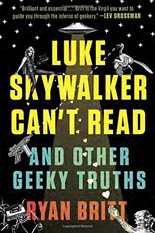
 Like a less pretentious (and thereby more bearable) Chuck Klosterman, Ryan Britt mines pop culture for freakishly accessible essays — a full 14 of them soaked and sautéed in sci-fi for Luke Skywalker Can’t Read and Other Geeky Truths. In the Plume paperback, Britt reminisces about his sexual awakening to the groove of Roger Vadim’s corny-porny Barbarella; considers the power and allure of sci-fi soundtracks; compares various screen Draculas; recalls how Doctor Who saved his life; and praises Sherlock Holmes (and not so much George Lucas). Even if the author can take a while to reach his ultimate point — and can tend to repeat himself along the way — you keep reading because his voice is fresh, because humor acts as a salve against minor transgressions, and because I appreciate his pointed message to foamed-mouth fanboys to (in so many words) calm the fuck down. That said, I remain irritated by the haphazard method by which Star Wars goes unitalicized roughly half the time. Guess lonely Luke isn’t the only one with comprehension troubles … right?
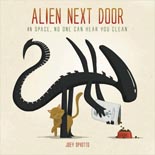 I wonder if there’s an afterlife; if so, I wonder if it has a library; if so, I wonder if it stocks new releases; if so, I wonder if Alien Next Door is among them; if so, I wonder if H.R. Giger will run across it; if so, I wonder if he’ll find a way to come back and cause bodily harm to author/illustrator Joey Spiotto. In the square-shaped hardcover from Titan Books, Spiotto (2014’s Attack! Boss! Cheat Code!: A Gamer’s Alphabet) has turned the Giger-designed Alien into an adorable cartoon character who lives a quiet suburban life; each page is its own standalone joke, with the creature performing mundane household chores. Cute on the surface, the book boasts several clever gags hiding in plain sight, mostly references to the still-going franchise, facehuggers and otherwise. Spiotto’s approach amounts to sacrilege … but only if you don’t have a sense of humor.
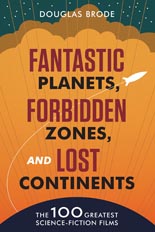 As Fantastic Planets, Forbidden Zones, and Lost Continents’ subtitle promises, the University of Texas Press hardcover counts down The 100 Greatest Science-Fiction Films. “Greatest,” says who? Says Douglas Brode, if that means anything. Whether or not it does, such endeavors are entirely subjective and debatable, which is at least a good half of their appeal. Devoting a few pages to each, Brode covers them not in “Casey Kasem” order, but chronologically, starting with 1902’s A Trip to the Moon and ending at 2014’s Guardians of the Galaxy. He often “cheats” during the trip, jamming several slots with pairs and trilogies, whether official or merely thematic. Don’t expect much in the way of criticism; extracting nuggets of trivia and backstories is what’s truly on the menu. Occasional baffling errors are forgiven by appendices of shorter, niche-oriented lists; Derek George’s impressive design work; and Brode’s own brave, oddball choices, e.g. the Wachowskis’ Cloud Atlas or Disney’s Flubber-fueled The Absent-Minded Professor.
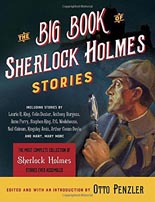 Following similar genre-celebratory collections on vampires, zombies, ghosts, adventurers and pulp heroes (all from Vintage Crime’s Black Lizard line), anthologist extraordinaire Otto Penzler rounds up 83 — repeat: 83! — tales of the great detective for The Big Book of Sherlock Holmes Stories. “Today,” as Penzler notes in his introduction, “Holmes continues to be a multimedia superstar” on screens both big and small, which hopefully (as I’ve counted on ever since Robert Downey Jr. took the role to blockbuster status) will continue to expose more and more readers to the joys of Arthur Conan Doyle’s canon of four novels and 56 short stories. It’s important to note Penzler’s collection is not that. It does contain a couple of Conan Doyle contributions — just not the kind you expect, which is a theme carried throughout this wonderful treasury, short on neither suspense or surprise. You get imitations, tributes, pastiches, parodies and so on, from authors as skilled and varied as O. Henry, Neil Gaiman, Stephen King, James M. Barrie, Manly Wade Wellman and even Anonymous. No Penzler collection — much less a mystery anthology in general — would be complete without a whodunit from the late, but forever exquisite Edward D. Hoch; his inclusion is simply elementary. —Rod Lott
Get them at Amazon.

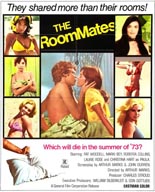
 Warning: Arthur Marks’ The Roommates may cause whiplash. For its first 39 minutes, it plays like one fun-loving, fuck-me pump of a sexploitation flick. Then, at minute 40, one of its many lovely ladies takes more than 100 stab wounds to the torso, and not by choice.
  They’re not vacationing as a foursome, however, which further lends the film a soapy layer similar to the Valley of the Dolls it name-drops. Joining Woodell’s Heather for the trip is her young, feisty cousin (The Stewardesses’ Christina Hart), who is more than happy to make Oedipal overtures after a conquest of Heather’s tells her post-coitally, “Oh, Heather, it’s just like old times, isn’t it? You’re as good as you were when you were 16!” Meanwhile, Rose’s Brea assumes nursing duties at a kids’ camp, where she and her tight Ts and short shorts garner a great deal of hormonal attention from overly (but justifiably) horny boys: “Boy, is she built like a brick shithouse! Boy, would I like to make it with her!” Get in line, brother …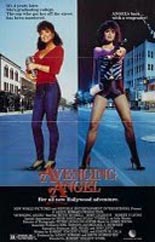
 Whereas Betsy Russell (co-star of 71.43% of the

 As far as I know, Eli Roth’s long-on-the-shelf