
All posts by Rod Lott

Drunk Stoned Brilliant Dead: The Story of the National Lampoon (2015)

drunkstonedWhen I spied a copy of National Lampoon at my Uncle Bill’s house one evening in 1979, the bored, Mad magazine-loving, 8-year-old me snatched it up and started flipping through it. I’ll never forget the shock of seeing real women’s breasts staring back at me from the “Foto Funnies” page. I’ll never forget the comic strip of two boys making shadow puppets using not their hands, but their prepubescent genitals. I’ll certainly never forget, when I laughed aloud and bravely shared that strip’s crasser-than-crass “Abraham Leakin’” punch line, how fast my mom traversed the kitchen to confiscate the issue from my hands and far-too-young eyes.

And that, ladies and gentlemen, was my introduction to the Lampoon. The story has a happy ending, because a mere four years later, in 1983, Mom took me to see my first R-rated movie in theaters: National Lampoon’s Vacation. For fellow children of the ’70s and ’80s, I suspect exposure to the Lampoon brand arrived far more through its films than the actual publication. I’ve never read a complete issue, yet am fully aware of its enormous and ever-continuing influence on modern comedy — dangerous, politically incorrect and sacred cow-punching — perhaps most notably with the birth of Saturday Night Live. Regardless, Douglas Tirola’s feature-length documentary, Drunk Stoned Brilliant Dead: The Story of the National Lampoon, is not to be missed.

drunkstoned1In its opening minutes alone, the documentary does what Ellin Stein’s 2013 book on the topic could not achieve in 464 pages: Capture the anarchic energy and unrestrained creativity of the mag at its mid-’70s’ peak. Its success was not immediate, and that it was successful at all is something of a right-place/right-time fluke. Outside of the magazine eventually sucking from the mid-’80s to its 1998 death, Tirola and his talking heads (Chevy Chase, Matty Simmons, Kevin Bacon, P.J. O’Rourke, John Landis and Tim Matheson among them) skip over the Lampoon’s many misfires beyond the stapled pages; Class Reunion and Movie Madness are completely MIA, while Disco Beaver from Outer Space gets a cursory mention without even explaining what it was (an HBO special). I would call this the only fault to be found in Drunk Stoned Brilliant Dead, but instead I choose to flip it into a positive and say I wish the doc had kept going to share even more.

Not all of the humor has aged well — far from it (especially the live Woodstock parody Lemmings, the appeal of which escapes me based upon the footage shown here) — yet that doesn’t make this retrospective any less fascinating, particularly with so many caustic, drug-fueled egos at play, more than one of whom met tragic ends. Even with those secondary routes into weightier matters, the movie zips by us with immeasurable verve, often so fast that my thumb happily leapt between the rewind and pause buttons so much to get a closer look at the art. In doing so, I inadvertently added nearly 45 minutes to the running time. (The last time I did that, I seem to recall Christie Brinkley stripping for a motel-pool skinny dip, just to bring this review full-circle.) —Rod Lott

Get it at Amazon.

Stung (2015)

stungMaybe the marketers behind Stung didn’t even consider that using the tagline “The Ultimate Buzzkill” could come back to sting them in the ass — as in, “Stung is a real buzzkill.” Because it is.

A throwback to the big-bug invasion flicks of the 1950s, the first movie from director Benni Diez pits wasps against WASPs. A garden party to honor a deceased, well-to-do patriarch represents a do-or-die opportunity for the catering company owned by Julie (appealing newcomer Jessica Cook), having taken it over on the occasion of her own father’s death. On hand to help her is her one employee, the smart-mouthed Paul (Matt O’Leary, Sorority Row), who obviously carries a torch for her with more devotion than he carries buffet trays.

stung1What should be a routine gig is ruined when a swarm of giant, mutated wasps zooms in and crashes the party. The insects have the wings; the humans haven’t got a prayer. And what should be a fun hour and a half just isn’t, falling as flat as a soufflé removed from the oven too early.

Everything seems to be stuck at the halfway mark for optimal conditions: its energy level, the jokes, characters for whom to root, creatures frightening enough to fear. (Committing to the practical route vs. relying on CGI to create critters would have taken care of the last point.) When you cast Aliens’ Lance Henriksen, yet his big moment consists of him ordering the wasps to “kiss my ass!,” an opportunity clearly has been wasted. As is, the film is watchable, barely. —Rod Lott

Get it at Amazon.

Murder Can Hurt You! (1980)

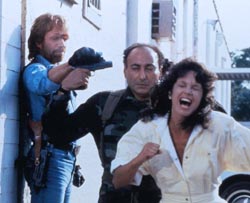
murdercanhurtCop shows ruled the prime-time lineup in the late 1970s, and the Aaron Spelling-produced Murder Can Hurt You! poked fun at seven of them. Like a massive Mad magazine parody come to made-for-TV life, its sights were set on Ironside, Baretta, Starsky & Hutch, Kojak, McCloud, Police Woman and — oh, yeah, one more thing — Columbo.

The telepic boasts a cast that appears to have been drawn, lottery-style, from a complete series roster of The Love Boat (with which this movie shares director Roger Duchowny), because not only do we have Gavin MacLeod, but Victor Buono, Jimmie Walker, Tony Danza, Jamie Farr, John Byner, Buck Owens, Connie Stevens and Burt Young. These Los Angeles “defectives — I mean, detectives” (per the narrator, Get Smart star Don Adams) match their collective wits (which ain’t much) against the one-person crime wave known only as the Man in White (Mitch Kreindel, Modern Problems), so named because … hell, you figure it out. One by one, the cops are thwarted by such cartoon-ready devices as giant balloons, wet cement and magnetic beds.

murdercanhurt1The level of humor in this thing is every bit as low-aiming as you would expect from an ABC Wednesday-night movie. A recurring bit has flames shoot high every time Palumbo (Young, Paulie of the Rocky franchise) flicks his Bic to light a smoke. The climactic slapstick set piece atop — and hanging from — a ladder connecting two buildings is like the finale of It’s a Mad, Mad, Mad, Mad World as if adapted by sixth graders.

What once was a laugh riot upon its broadcast premiere — hey, I was 9 — is largely an embarrassment now. One thing that hasn’t changed: how unbelievably sexy Connie Stevens is in this. Spoofing Angie Dickinson’s Sgt. Pepper Anderson, the bubble-voiced Grease 2 faculty member plays Sgt. Salty Sanderson by squeezing herself into one homina-homina-homina getup after another, from blue hot pants and, um, purple hot pants to a gold nightie. So what if the bra we glimpse as she plays Strip Go Fish is rather plain in its whiteness? It’s what I remembered most. —Rod Lott

Beowulf (2007)

beowulf07Here’s how little I understood Beowulf when I had to read it in English class in junior high and again in high school: I thought the title referred to the monster, and that the monster was a wolf. Laugh all you want, but Anglo-Saxon epic poems of the 8th century are not the easiest things to decipher.

Luckily, Robert Zemeckis’ Beowulf is different, and I don’t just mean because it’s animated. The film marks his “no-bullshit” version of the classic text, as he promises on the making-of documentary featured on the DVD: “This has nothing to do with the Beowulf you were forced to read in junior high school. It’s all about eating, drinking, killing and fornicating.”

Actually, as scripted by novelist Neil Gaiman (The Sandman) and Pulp Fiction co-writer Roger Avary, the movie doesn’t stray all that far from the story of its source. It’s just that it ditches much of the boring elements and amps up the saucy ones, leaving an action-oriented, sometimes ribald and unapologetically over-the-top experience. Should Beowulf really be shown punching his way out of sea monster by going through the eye? Sure, why the hell not?

beowulf071Getting a CGI slimdown in the process, The Departed heavy Ray Winstone assumes the lead role of Beowulf, a hero — here, made flawed, in direct opposition to the poem — who arrives at the castle of King Hrothgar (Anthony Hopkins, Thor) to slay the monster Grendel (Crispin Glover, apparently having put his Back to the Future beef with Zemeckis behind him), a giant deformed beast from a nearby village who doesn’t like all the noise their merriment makes.

Beowulf agrees, Grendel attacks and — while stark naked and opting to use no sword — our hero slays the creature. That doesn’t sit well with his serpentine mother, who takes the form of Angelina Jolie (Maleficent), whose breastastic reveal sent the tongues of internet bloggers a-wagging when the scene was leaked just prior to its theatrical release. She offers Beowulf a truce: He can say he killed her if he promises to leave her be. Because she looks like a nude Jolie, he agrees.

Women are known to change their minds, however, which results in Beowulf having to engage in the fight of his life with an enormous, fire-breathing dragon. Like much of the movie, this sequence is a thrill to watch. Even when the narrative lags — and at nearly two hours, it does here and there — the visuals are something to behold. While I’ve never been a fan of motion-capture animation, Beowulf represents a huge leap for the medium; it’s difficult to imagine even a whiz-kid director like Zemeckis being able to make it work in the traditional format of live-action. Laden as his film is with violence, gore and nudity, it makes the ages-old story more exciting and accessible (Seamus Heaney or no Seamus Heaney) than it ever has been, or could ever hope to be. —Rod Lott

Get it at Amazon.

Never Say Never Again (1983)

neversayFor legal reasons so tangled and tortured, they could make a book out of the copyright fight (and did, with Robert Sellers’ The Battle for Bond, recommended), Never Say Never Again is not considered part of the 007 canon, despite marking the return of Sean Connery to his iconic role after a 12-year absence.

Last seen doing Vegas in Diamonds Are Forever, James Bond is no longer the glistening gem that Britain’s MI6 requires of its secret agents, so he is shuttered off to a health club to adhere to a strict regimen of calories, chiropractic and colonics. I’d say this is the first sign that something about this adventure is a bit “off,” but it’s actually the third; first is the franchise’s signature gun-barrel POV sequence being MIA, while the second is Lani Hall’s rightly forgotten theme song, thoroughly unmemorable except for the cloying presence of cowbell.

neversay1Back in shape enough, Bond is thrown into a new mission as SPECTRE — headed by pussy-petting Blofeld (Max von Sydow, Flash Gordon) — hatches a scheme to steal two thermonuclear warheads from the U.S. Air Force, which it achieves by getting a USAF captain (Gavan O’Herlihy, Superman III) hooked on smack and then replacing his right eye with a replica of the American president’s. The plan is so crazy, it just … might … work …

In cahoots with Blofeld are the exotic and explosive Fatima Blush (Barbara Carrera, Condorman), who at one point wears what looks like an ensemble of Hefty bags and the see-through plastic tarp you put down before painting, and Largo (Klaus Maria Brandauer, Oscar nominee for Out of Africa), who is as slimy as he his wealthy. His girlfriend, Domino (Kim Basinger, in only her third film), is the sister of the USAF patsy, but really she’s around so Bond can have a fourth woman to fuck within two hours’ time.

Irvin Kershner’s follow-up to directing The Empire Strikes Back, this “unofficial” Bond entry is — again with the pesky laws! — technically a remake of 1965’s Thunderball, but doesn’t quite feel like it until the underwater sequences come into play. Then, shark excepted, Never Say Never Again becomes every bit of a plodding slog as that official fourth 007 film. Because this is the ’80s, Kershner’s take includes a scene built entirely on a video-game challenge between Bond and Largo, as well as a rather uncomfortable bit that more or less sees Domino being butt-molested for laughs, as our suave spy poses as a masseur. For pure action of a nonsexual nature, only the gadgetry-enhanced motorcycle chase wrings the kind of thrills we expect from 007 set pieces.

As if to acknowledge to the audience that Never Say Never Again is an overstuffed and undercooked turkey, Connery closes his reign in Her Majesty’s secret service by breaking the fourth wall to wink directly at us. Its meaning is unmistakable: “You’ve been had, but I made some serious bank.” At the time, nobody did Bond better, but never had Connery done it so flaccidly. —Rod Lott

Get it at Amazon.