All posts by Rod Lott

Hitchcock/Truffaut (2015)

hitchtruffautHowever one pulls off a successful documentary about the making of a book, Kent Jones has done it with Hitchcock/Truffaut. Borrowing its title from the now-seminal film text published in 1966, the feature chronicles the unprecedented week of interviews between the two filmmaking giants (and their unheralded interpreter) and examines the volume’s unprecedented decades of influence ever since.

On one side of the table, we have Alfred Hitchcock, the undisputed “master of suspense” and arguably regarded today as cinema’s greatest director — thanks in part to the man at the other side of the table: Francois Truffaut. The French New Wave pioneer questions Hitch at great length about each of his pictures, which, of course, comes to extend to the broadest scope of cinema as a whole. At the time, Hitch had only a few films left in him, whereas Truffaut was just getting started; while at different points in their respective careers, they found equilibrium in their love of the movies, which Jones renders infectious.

hitchtruffaut1Although film cameras ironically were not present for the men’s talks, an audio recorder was; Jones lucks into having their actual voices at his show-don’t-tell disposal, along with a smattering of behind-the-scenes photographs. Without these, the doc would lose what makes it special. He doesn’t rely solely on his subjects, either, opening the floor to such celebrity admirers as Martin Scorsese, David Fincher and Wes Anderson, all avowed fans of the classic book, which has inspired and informed work of their own.

The middle stretch of Hitchcock/Truffaut ceases to be about the book per se and becomes about Hitchcock’s films and his style. That’s not a knock against the doc, as such exploration is on-topic. Naturally, a wealth of clips is employed — with a heavy emphasis on 1958’s Vertigo — so the audience can see exactly the points being discussed; the result is like a crash course in Introduction to Film Theory. (Hitch’s stated position on an “erect” James Stewart as Kim Novak emerges from the closet is priceless.)

All of these tools grant Hitchcock/Truffaut a significant coat of polish; the film exhibits more flair than the Hollywood documentary for which Jones (an ace critic for Film Comment and elsewhere) heretofore was best known: 2007’s Scorsese-produced and -narrated Val Lewton: The Man in the Shadows. That said, there is something Hitchcock/Truffaut’s construction that gives it the feel of being made for cable or a Blu-ray box set vs. the big screen; however, that does not make the hour and a half any less absorbing or delicious. —Rod Lott

Airport ’77 (1977)

airport77In Airport ’77, the third in the Airport series, a private Boeing 747 is transporting the art collection and friend of multimillionaire Philip Stevens (James Stewart, Vertigo) to the opening of his new museum. Says Stevens to a throng of reporters, “It’s going to be a real wingding.”

Based on that jet alone, the old man ain’t joking! Under the control of Capt. Gallagher (Jack Lemmon, Glengarry Glen Ross), the aircraft boasts three luxurious levels that include bedrooms, office space, tabletop Pong, copies of Ebony magazine and even a blind lounge singer/pianist (motivational speaker Tom Sullivan) whose dark glasses look specially designed for Elton John to wear for an hour after getting his eyes dilated. Unbeknownst to Stevens, Gallagher or Gallagher’s mustache, the night flight also hosts a cadre of art thieves who gas the crew and passengers asleep so they can take over and make off with the priceless paintings. But art thieves do not double as ace pilots; a clipped wing sends the Boeing to the bottom of the ocean, square in the Bermuda Triangle — for no reason other than Trianglesploitation was a trend at the time.

airport771With the submerged plane taking in water, Airport ’77 appears to be cribbing from The Poseidon Adventure of five years earlier. No stranger to the disaster genre, director Jerry Jameson (Raise the Titanic!) spends ’77’s second hour detailing and depicting the rescue efforts of Gallagher on the inside and the combined might of the U.S. Navy and Coast Guard on the outside. However, this removes focus from the most fun part of these exercises in cinematic calamity: the all-star cast. This TV-looking sequel is as overstuffed as the rest, with faded idols (Olivia de Havilland, Joseph Cotten), up-and-comers (Kathleen Quinlan, M. Emmet Walsh) and then-current leading ladies (Brenda Vaccaro, Lee Grant — the latter cutting the largest slice of the overacting pie). Returning as Joe Patroni, George Kennedy shows up just long enough to allow ’77 a direct connection to the previous two pictures.

Many of the actors’ clothes sport gaudy, checkered prints that create moiré patterns on your TV screen. Those have more life than poor Stewart, so folksy and noncommittal that one half-expects him to recite that poem about his dead dog. Haven’t heard it? Oh, it’s a real wingding. —Rod Lott

Get it at Amazon.

Saving Christmas (2014)

savingxmasTrue or false: The movie Saving Christmas begins with a three-minute lecture to the audience from Kirk Cameron.

The answer is “false.” It takes up four.

In that prologue — scooch, Alistair Cooke! — the erstwhile ’80s teen heartthrob of TV’s Growing Pains sits in front of a glorious fireplace next to a glorious Christmas tree in a glorious living room and, with awkward pauses to sip from a glorious prop mug, relays all that he appreciates about the most wonderful time of the year: “I love the cookies. I love the fire. I love the fudge. … And I love hot chocolate!” he exclaims. “But some people want to put a big, wet blanket on this.”

Yes, Virginia, Cameron’s talking about the nonexistent “war on Christmas.” And he’s here to narrate and star in a high-definition sermon all about it. Playing himself (and producing), Cameron attends a glorious Christmas party for wealthy people at the glorious home of his big sister (real-life sibling Bridgette Ridenour). The problem — other than Sis’ apparent addiction to Hobby Lobby kitchen decorations — is that Kirk’s brother-in-law with the punchable face (the movie’s writer/director, Darren Doane) isn’t feeling the spirit; he just can’t get over all the people partying because he’s too busy moping about how Christmas trees and Santa Claus aren’t in the Bible, for God’s sake.

savingxmas1True or false: The bro-in-law’s character name is Christian White. The answer is “true”; I’m guessing Christian Aryan was deemed too on-the-nose.

I won’t fault the Liberty University-funded Saving Christmas for its religious beliefs — not even the one justifying material things as being “right.” I fault Saving Christmas because it’s lazy and deceitful. Narrates Cameron toward the beginning, “Stories are tricky things,” which must be why Doane didn’t adorn his project with one. For an hour, Kirk and Christian sit in a car while the former reassures the latter that the Christmas symbols he worries about are indeed holy. Then they rejoin the party so a hip-hop musical montage (complete with Doane breakdancing) can extend the running time into a feature; Kirk jumps in to scream, “Let’s feast!”; the end.

That’s not a plot; that’s a commercial, essentially for itself. (Choir, you have been preached to!) I feel sorry for well-meaning people who paid good money to see “wholesome family entertainment” and soon realized they were hoodwinked into an audiovisual presentation, considerable stretches of which have no movement in them — just inanimate objects shot from rotating angles. If Doane’s digital camera and editing equipment didn’t allow for scenes in slow motion, Saving Christmas would be half the length, but interminable all the same.

Thou shalt not laugh, either, because Doane’s idea of comedy is summed up by an end-credit “blooper” in which the stereotypical black friend improvs, “I’m just gonna keep talking and move my hands until your camera gets what it needs.” Hell, even Cameron’s 2008 hit Fireproof is more accidentally funny.

True or false: I can achieve the same wonderful feeling that Saving Christmas wishes to espouse from Bill Murray’s epic monologue at the end of Scrooged. The answer is “true.” And I can get legitimate jokes with it! —Rod Lott

Get it at Amazon.

Nightmare Weekend (1986)

nightmareweekendNightmare Weekend’s making may qualify as the cinematic equivalent to the child’s party game Telephone: What you say on one end may arrive at the other in a garbled state — perhaps even mutated. In this case, a French crew attempted to make an English-language film, and on the all-American soil of Ocala, Fla. That they failed so spectacularly is exactly why you should watch their doomed enterprise.

Edward Brake (Wellington Meffert — what a name!) is a widowed scientist with 212 patents to his name, including a supercomputer and George, who operates it telepathically and from whom Edward’s hot teenage daughter (Debra Hunter) solicits love advice. George, by the way, is a talking, green-haired hand puppet. Let that soak in before advancing to the next paragraph.

nightmareweekend1Edward’s cunning business associate, Julie Clingstone (Debbie Laster, Bad Girls Dormitory), invites three college girls to the Brake estate for a weekend of research in a personality-reversal project — or so I gathered. The movie is so impossibly incoherent, it is open to the interpretation of Hermann Rorschach’s inkblots. All I know for sure is that Ms. Clingstone makes these Phantasm-sized metal balls pop up at inopportune times (coitus especially), jam themselves into people’s orifices and turn them into murderers. Again, or so I gathered, because to bear witness to Nightmare Weekend is to remain in a narrative haze. Things happen for no reason and then confound further by going without remark, like a tough guy having full-tilt sex with some skank against a pinball machine at the local bar.

That lucky sumbitch is played by Robert John Burke, who would go on to bigger, better parts, like the lead roles of Thinner and Robocop 3. In fact, Nightmare Weekend hosts an inordinate amount of future names, including Dale Midkiff of Pet Sematary, Andrea Thompson of TV’s NYPD Blue and Karen Mayo-Chandler of Jack Nicholson’s bed. On the spectrum’s opposite end, Nightmare Weekend also hosts an inordinate amount of one-and-doners who never had a credit before or after this.

Credited here as “H. Sala,” French director Henri Sala possesses a filmography littered with erotica (e.g. Emanuelle e Lolita), which could explain why so much attention is paid to writhing nude bodies, but Nightmare Weekend resists — if not defies — explanation. That very slovenliness makes it entertaining. Vive le balderdash! —Rod Lott

Get it at Amazon.

The Executioner Part II (1984)

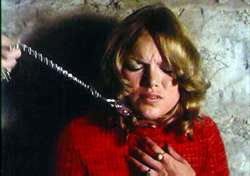
executionerIIFirst things first regarding The Executioner Part II: There is no part 1. Well, there is — it’s just that as a 1970 spy film starring George Peppard, it has nothing to do with this would-be sequel. And if it did, the Peppard picture would call for swift disownment, and be completely justified in doing so. I wouldn’t want a child who has been entirely redubbed, either.

The title character is Mike (Antoine John Mottet, Arctic Warriors), an auto repairman who is plagued by flashbacks of his tour of duty in Vietnam: “I came back, but I’m not home. … Charlie must die!” Fellow vet and best bud Lt. Roger O’Malley (The Day Time Ended’s Christopher Mitchum, son of Robert) doesn’t share Mike’s problem, but is forced to confront it while investigating a string of vigilante murders across greater Los Angeles. As reported by batty “news dame” Celia Amherst (Lady Street Fighter herself, Renee Harmon, who gets away with an oft-incomprehensible accent because she serves as the writer and producer), some masked figure calling himself The Executioner shows up at the scenes of crimes to beat up the bad guys and shove a live, pin-pulled grenade down their pants or somewhere about their person. Kablooey. (Cue the cartoon explosion, each and every time.)

executionerII1That said, I feel like none of these leads did much; O’Malley mostly sits in chairs. Not enough forward motion exists in this supposed main plot to justify referring to the rest as “subplots.” But what else to call them? The most prominent has O’Malley’s gap-toothed, cash-strapped high school daughter (Bianca Phillipi) jonesin’ so hard for “dope” that she follows her ever-giggling BFF (Marisi Courtwright) into part-time hustling. There’s also a street gang that seems straight out of Sharks and Jets territory, talk of a dreaded “Tattoo Man,” and a sex fiend with a bowl haircut and a habit of ripping open the blouse (sometimes the same one) of his lucky partner. Talk of The Executioner Part II isn’t complete without mentioning “Big Dan” (Dan Bradley, director of 2012’s Red Dawn remake), a villain forever dressed like a dinner-theater magician.

Squarely in the sludge section of his once-respectable career — he did Frankenstein’s Great Aunt Tillie the same year — The Green Berets’ Aldo Ray has a few scenes as O’Malley’s commissioner, but clearly shared no actual physical space with the other actors. That director James Bryan (Don’t Go in the Woods) doesn’t take great pains to conceal it is par for his misguided course. —Rod Lott

Get it at Vinegar Syndrome.