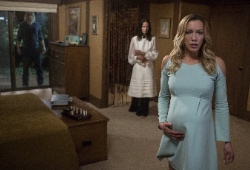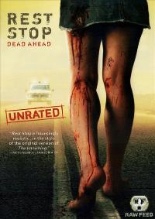
 With an electrical socket as its logo, Raw Feed jolted to life, kinda, in 2006 as a direct-to-DVD subsidiary of Warner Home Video and intended home for envelope-pushing horror free from MPAA meddling. Instead, Raw Feed issued product that felt overly derivative and devoid of imagination; six flicks later, the outlet ran out of juice. Its final offering was 2008’s fittingly titled Rest Stop: Don’t Look Back, a sequel to the line’s debut. That first film, plain ol’ Rest Stop, is so rote, I couldn’t submit myself to a part 2. I feel like I’ve seen it anyway.
Young Midwestern lovers Nicole (Jaimie Alexander, Thor: The Dark World) and Jess (Joey Mendicino, whose only other movie role to date is the sequel) run away from home and hit the open road toward California. (In other words, like John Steinbeck’s The Grapes of Wrath, if the Joads headed west not for work, but the freedom to copulate.) After stopping for an open-air quickie, Nicole’s girl bladder ruins everything when she has to tinkle. Begrudgingly, Jess pulls over to — cue ominous music — a rest stop in the middle of the woods. It’s a place where no right-minded city planner would allow one to be built, lest he’s seeking to serve the body-waste needs of storybook creatures.
 Surprise! The facilities are a dump! (Last Shithouse on the Left, anyone?) While Nic is squatting atop the scum-layered stool to make water, Jess mysteriously makes like a tree and leaves. You won’t pry it outta me, but his vamoose act might have something to do with the shit-kickin’ redneck in the yeller truck.
If not for the pre-existing Joy Ride and Wrong Turn franchises revving up around that time, Rest Stop might be fresher meat … except that still leaves dozens of other crazy-dude-in-a-vehicle films to contend with, notably the ’80s VHS fave The Hitcher and the granddaddy of them all, Steven Spielberg’s Duel.
Better known as a writer of nearly two dozen X-Files episodes and creator of its short-lived The Lone Gunmen spin-off, John Shiban made his feature directing debut with Rest Stop, and has yet to follow it up. He also wrote it, yet given the pedigree of the landmark X-Files series, the only thing shocking about his script is how color-by-numbers predictable it is, which allows boredom to set in faster than quick-dry cement. More about spilling blood than turning twists, it owes its brightest spots not to leading lady Alexander, who spends the back half shirtless, but to the performance by former child star Joey Lawrence (Urban Legends: Final Cut) as a cop. Whoa! —Rod Lott
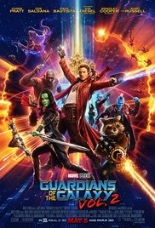
 It does not take much for Guardians of the Galaxy Vol. 2 to generate instant goodwill among viewers — just the earworm that is
 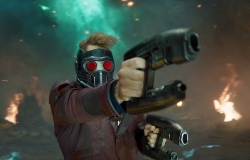 In shortcutting the setup, Gunn frees more time to let Gamora and her fellow Guardians have more to do than in the first film, and benefiting most is Drax (Dave Bautista,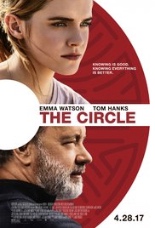
 James Ponsoldt’s The Circle is in no shape to exist as either a technological thriller or an
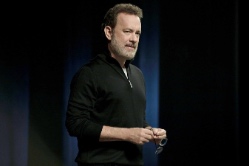
  Bailey’s latest baby is SeeChange, all-seeing cameras embedded in sleek spheres the size of cat’s-eye marbles; because of their portability and line of camouflaged colors, SeeChange cams are ideal for global “accountability.” Mae becomes something of a cause célèbre when she agrees to wear one and live a life of a broadband-broadcast transparency 24/7 (with three-minute breaks to heed nature’s call). Then Bailey releases software that allows SeeChange users to find anyone anywhere in the world in the matter of minutes — crowd-sourced bounty hunting, if you will. Raise your hand if you think Very Bad Things will come of this.
  In past films —