All posts by Rod Lott

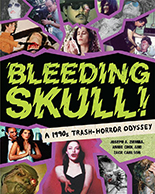
Bleeding Skull! A 1990s Trash-Horror Odyssey

While the rest of the country meme-watches its way through the Friends reunion special, the true ’90s nostalgia awaits in the Fantagraphics-published Bleeding Skull! A 1990s Trash-Horror Odyssey.

The long-awaited, much-anticipated sequel to Joseph A. Ziemba and Dan Budnik’s Bleeding Skull! A 1980s Trash-Horror Odyssey, unleashed to molten minds by Headpress in 2013, this sophomore (and proudly sophomoric) follow-up gives ink to the absolute oddest of no-budget obscurities video stores had to offer, most shot on VHS camcorders. With jackers, crystal forces, death metal zombies, psycho sisters, killer clowns, killer nerds and mad scientists named Dr. Kill, the contents are every bit worth the brand’s fractured exclamation point.

This time, Budnik is nowhere to be found, replaced by Annie Choi and Zack Carlson, whose styles meld better with Ziemba’s. (Please note that’s not a slam on Budnik, whose 2017 book, ’80s Action Movies on the Cheap: 284 Low Budget, High Impact Pictures, is a howlingly funny must-have for every B-movie enthusiast’s library.) The trio’s tag-teamed intro states these virtually unseen movies are deserving of cheers, not sneers … even if the 250 reviews don’t quite carry out this credo, as many flicks are most decidedly mocked — with exuberant affection, but mocked nonetheless.
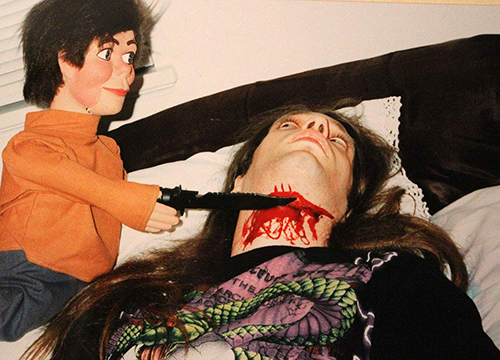
After all, it’s not until the 10th entry (Asylum of Terror) that readers will arrive at anything resembling a “good” review, albeit one in which Ziemba writes, “no one appearing on-screen seems to understand that they’re being filmed.”

Of course, Bleeding Skull! wouldn’t be the tremendously fun read it is without the writers’ often brutal — and brutally hilarious — observations:
• Bad Karma: “The design is one part Etsy, three parts Dollar General.”
• Bloodscent: “The music is the finest junior varsity jock rock that western Pennsylvania has to offer.”
• Blood Slaves: “Looks like it was cast at a baseball card shop.”
• The Laughing Dead: “If a pair of slit wrists got together to make a movie, it would be this one.”
• Psycho Pike: “If you like to watch people drive around in a Jeep Wrangler, Psycho Pike is your movie.”
• The Witching: “The Witching is a saxophone kicking in for 64 minutes straight.”

More or less escaping ire are the DIY directors whose filmographies number beyond “1.” For example, the authors’ collective championing of the Polonia brothers (one of whom provides the foreword) nears idolatry. Fervent enthusiasm also falls to the Jesus-influenced gore of Todd Sheets, the “monstah” movies of David “The Rock” Nelson and the infidelity-themed slashers of Tim Ritter. Not so much for Todd Cook, whose prolificness is overshadowed by his stream-of-semiconsciousness works’ puerility. No matter where the opinions fall, however, the book is never not informative or entertaining; never before has so much thought been placed on explaining why choking is the laziest of murder methods.

No rave for this book is complete without praise for who may be considered its fourth author: designer Keeli McCarthy. With an aesthetic heavy on Magic Markers, highlighters and the purposeful cut-and-paste sloppiness of zines, her design is more aligned with Carlson’s seminal (and sadly out-of-print) Destroy All Movies!!! The Complete Guide to Punks on Film than Bleeding Skull!’s aforementioned ’80s edition. Either way, it’s now in glorious, garish full color. —Rod Lott

Like shot-on-video movies themselves, taking in A 1990s Trash-Horror Odyssey all at once could be overkill — or simply unfortunate, since we’re eight years away from A 2000s Trash-Horror Odyssey if the current between-books gap between holds. If Camp Blood of all things can get 10 installments, I hold out hope Bleeding Skull! at least merits a third. —Rod Lott

Get it at Amazon.

Beneath Us (2019)

With Beneath Us, the genius lie entirely in the pun of the title. First-time feature director Max Pachman’s slice of immigrationsploitation leaves subtlety out of the picture, despite the resonance and seriousness of its premise.

Four undocumented workers — including brothers Alejandro and Memo — are hired by the über-wealthy, über-voluptuous Mrs. Rhodes (Lynn Collins, X-Men Origins: Wolverine) to finish construction on a guest home at a bargain-basement price. The property she shares with her husband (James Tupper, 2017’s Totem) is well-fortified, cut off from the rest of the world and all its promise with an electric fence. Forced to work day and night with no rest until the job is done, the workers too slowly realize they’re not going to be allowed to leave alive, what with the underground cavern of hired hands past.

To call the bosses are “racist” is to undersell their cruelty, which is hardly a one-off; Mr. and Mrs. Rhodes are essentially serial killers with the highest credit limit possible on a Home Depot credit card. The longer the job takes, the crazier Mrs. Rhodes gets, which is both the film’s greatest asset and liability. From the first scene, Pachman takes care to set up the troubled family dynamics of Alejandro (Rigo Sanchez, TV’s Animal Kingdom) and Memo (Josue Aguirre, Incarnate), then play them out … until he allows Tupper and especially Collins to approach their parts from rail No. 3.

Make no mistake: Collins is enormous fun in an utterly unhinged performance, but her Karen-to-the-nth-degree antics distract from the movie’s message even more than her push-up bra. It’s difficult to make politics stick in horror when your antagonist vamps and tramps her way through what amounts to a Tex-Mex Avery cartoon. —Rod Lott

Get it at Amazon.

Death Promise (1977)

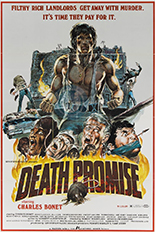
Bruceploitation veteran Charles Bonet (Fists of Bruce Lee, et al.) graduates to his own vehicle in the modern-day Death Promise as — now here’s a stretch — Charley. The young Puerto Rican is living his best life in the worst of Manhattan when the landlord of his shitbox apartment tries to force out all the tenants; when shutting off the electricity, gas and water doesn’t work, a dusty box of rats let loose in the halls is Plan B.

As Charley’s Pops (Bob O’Connell, The Sting II) learns, the blame is on the “landlord syndicate” dba Iguana Realty. With a multimillion deal at stake, Iguana needs to level the place. Pops pushes back, saying they’ll only be able to demolish “over my dead body” — a proclamation the syndicate takes as an open invite. After consulting his local dojo master, Ciabatta Shibata (Thompson Kao Kang, The Black Dragon), on next steps, Charley vows to take out all responsible for Pops’ murder.

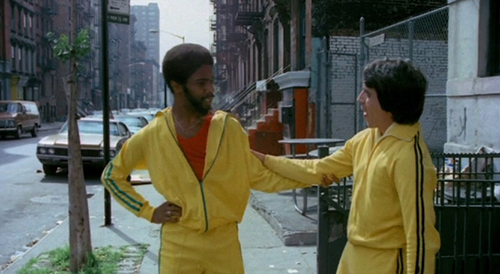
With the help of his bell-bottom jeans and his best pal, Speedy (Speedy Leacock, he of the monogrammed karate uniform and an Afro somehow parted down the middle), Charley makes a list and checks it twice — five times, actually, as his targets include:
• a Cameron Mitchell-esque, cigar-chomping archery buff (Tony De Caprio, Wanda Whips Wall Street)
• a judge by day and philatelist by night (David Kirk, Putney Swope)
• your garden-variety sleazeball, complete with disgustache (one-and-doner Thom Kendell)
• a smack dealer (one-and-doner Abe Hendy)
• and their Hal Holbrook-ian, cane-wielding figurehead, Alden (Vincent Van Lynn, Fuzz), who, until he’s felled by ninja stars seemingly cut from a cardboard box in the alley, takes orders from a Blofeld-ian mystery man — complete with kitty cat

The only movie directed by one Robert Warmflash, Death Promise is dirtier-than-dirt cheap. From its look, sound and vibe, you might think it were made by Fist of Fear, Touch of Death crew members on a potty break. And yet, the martial arts performed by Bonet, the Latin Panther, are impressive. His inevitable showdown against Bob Long (The Super Weapon) and others is especially satisfying because of the feral, crazed noises his foes emit, and because Warmflash isn’t one to move the camera much, that inexperience actually plays as a strength since we can clearly see each fighter’s moves.

In other physical news, many scenes include two- and even three-man walking hugs. Take it as the urban trash classic’s harbinger of charm. As the catchy, soul-infused theme song bellows, it’s gonna blow your mind — that’s a promise! —Rod Lott

Get it at Amazon.

Only the Good Parts (2015)

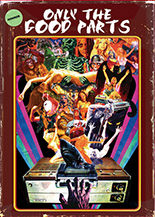
WTFWhen people talk trailers, someone inevitably scoffs, “They show all the good parts.” As if that’s a bad thing? It certainly isn’t in the world that exists underneath mainstream motion pictures. From blaxploitation to sexploitation with a whole heap o’ horror in between, Film Trauma’s Only the Good Parts dishes out a feature’s worth of proof — 39 trailers in all, roughly organized in themes that include badass broads, possession pics, killer kids, Italian ick and sacrilegious sinners.

Like the pair of Colour Correct My Cock compilations, the general selection is noteworthy for overall naughtiness and alternative versions. For example, prepare those loins for the one-two pubic punch of the French trailer for Jess Franco’s Barbed Wire Dolls and the German trailer for Franco’s Love Camp. Those are followed by the Franco-adjacent rump romp Rolls Royce Baby, in which muse Lina Romay is so naked so often, you’ll have (to quote ourselves) “an image of her vagina so thorough and vivid, you could accurately draw it from memory.” Look for Franco’s less dirty-minded but no less nude Demoniac later in the program.

For other name-brand directors, we get Ted V. Mikels’ 10 Violent Women and Al Adamson’s Nurse Sherri, heavy on comparing itself to The Exorcist. A rung — if not an entire ladder — higher on the credibility ladder stands David Cronenberg’s The Brood and Larry Cohen’s creatively effective campaign for It’s Alive and It Lives Again, matched in advertising genius only by whoever wrote the tagline for the X-rated slasher Evil Come, Evil Go: “She’s a Man-Hating, Hymn-Humming Hell Cat!”

Finally, when it comes to the grail of coming attractions — I speak, of course, of obscurities — Only the Good Parts giveth and giveth. I wouldn’t swear on this in the court of law, but I don’t recall even hearing of the likes of The Johnsons, Alley Cat and Beware My Brethren. That goes quadruple for Parts’ greatest piece, She Did It His Way, a 1968 vehicle for seriously stacked stripper Kellie Everts filmed at the Miss Nude Universe Pageant. I’m still not sure what the movie’s about, but it looks life-changing.

All this plus Roger Moore as The Man Who Haunted Himself, the pencil-eraser nipples of Werewolf Woman, a whip-crackin’ Coffin Joe and so much more. And remember, “You’ve not seen all of Marilyn Chambers until you’ve seen Angel of Heat.” —Rod Lott

Get it at Film Trauma or Amazon.

Irezumi (1966)

WTFFrom Japan’s venerated Daiei studio, Yasuzô Masumura’s Irezumi wastes no time in setup, as young lovers Shinsuke and Otsuya run away from their village to elope against parental wishes. Shinsuke (Akio Hasegawa, Navy Yokosuka Prison) is a lowly apprentice to a pawnbroker; Otsuya (Ayako Wakao, Zatoichi Meets Yojimbo ) is that pawnbroker’s daughter, arranged to marry another man. To hide for the night, they stay at an inn run by Shinsuke’s friend Gonji (Fujio Suga, Lone Wolf and Cub: Baby Cart in the Land of Demons).

Happily ever after? Hardly. Gonji hires an assassin to kill Shinsuke and sells Otsuya to the wonderful world of prostitution. Her pimp (Asao Uchida, Samurai Reincarnation) orders a tattooist (Gaku Yamamoto, Zatoichi and the Chess Expert) to chloroform Otsuya and ink her back. He does just that, pouring his literal soul into an elaborate, shoulder-to-shoulder tat of an orb-weaving spider bearing a woman’s fanged head — the Peeing Calvin of the samurai era, I’m sure. When she awakes, he tells her the spider will gorge on the corpses of her lusty clients.

Boy, won’t the memoirs of this geisha be something else!

Although definitely categorizable as a “weird tale,” Irezumi never becomes what you expect it be, so don’t come looking for horror. Even with the obvious influence of Edgar Allan Poe — and, in turn, Edogawa Rampo, whose Blind Beast Masumura would adapt within three years — the stab-happy film stops shy of entering Kwaidan territory, instead taking the guise of melodrama and dipping itself into a vat of the perverse. Fantastical elements are lined up, but never called onto the field; the spider supposedly moves and grows with each kill, but Masumura ladles not even half a teaspoon of the supernatural. At least Hikaru Hayashi’s eerie musical score finally finds a visual match in the chilling penultimate shot.

Regardless of expectations, the vibrantly colored Irezumi is well worth the watch, as picturesque as Wakao is luminous. Her progressive performance provides the magic at which the script continually winks. —Rod Lott

Get it at Amazon.