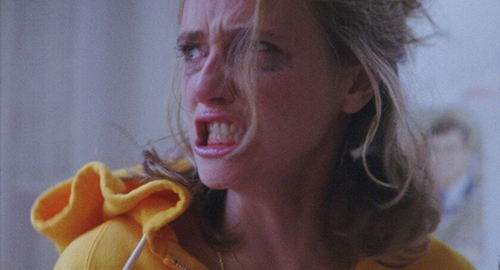
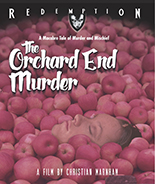
While young men play a cricket match, one team member plays with his girlfriend in an apple orchard directly across the street. After he’s called back to the field, Pauline (Tracy Hyde, Melody), bides her time wandering ’round the grounds.
A path takes her to a gnome-statued garden at a railhouse occupied by a pubic-bearded hunchback (Brazil’s Bill Wallis, almost too creepy) and a towering idiot (Clive Mantle, Alien 3), making for an even grimmer version of John Steinbeck’s Of Mice and Men. And if you want me to tell you about the rabbits, George, they’re as short-lived as the perilous Pauline.
At just under 50 minutes, The Orchard End Murder is a nasty little piece of work. The British picture heralds great promise for documentarian Christian Marnham in his fiction-film debut, particularly as a practitioner of crime and suspense, but to date, he’s made one lone feature: the 1988 rape-revenger Lethal Woman.
Too bad, because rare is the thriller whose suspense lever can be plotted like a diagonal line, rising in proportion with each passing minute toward a slow-burn end more satisfying than films twice its length. Designed to unsettle, hard to shake, The Orchard End Murder proves potent to the core. How ’bout them apples? —Rod Lott
Couched in the hustle and bustle of a Manhattan Christmas season, The Scary of Sixty-First is an equal-parts exercise in conspiracy-theory paranoia and art-school fuckery. Ho-ho-ho-hum.
String-bean roomies Addie (Betsey Brown, Assholes) and Noelle (co-writer Madeline Quinn) score an oddly affordable apartment, complete with two levels, bloody mattresses and one rat-infested ham in the fridge. Growing tension between the friends escalates after an unnamed and unannounced visitor (Dasha Nekrasova, TV’s Succession, making her directorial debut) drops quite the truth bomb: “Something extremely sinister happened in this apartment.”
That is this: The place was owned by financier/pedophile Jeffrey Epstein, who utilized it as “some kind of orgy flophouse.” Mumblecore, meet Pedobear.
As Noelle willingly gets entangled in the visitor’s rabbit-hole internet research of Epstein’s considerable misdeeds and mysterious death behind bars, Addie shows signs of possession by one of his underage victims. Just as those sex-trafficked survivors had to wonder what on Earth they’d gotten themselves into, so may the Scary of Sixty-First viewer as Addie is compelled to furiously masturbate at the stoop of Epstein’s townhouse, even fingering the negative space of the metal “E” on the wall (Later, Addie commits unspeakable acts upon souvenir trinkets of the royal family featuring Prince Andrew.)
It’s not clear whether Nekrasova intended these transgressive scenes as terror or camp, yet I felt embarrassment all the same for Brown, no stranger to willingly humiliating herself onscreen. At least she can act, which cannot be said for front-of-camera newbie Quinn, whose presence registers somewhere between monotonic and blank. Although her rhetorical, likely improvised lines provide the film’s best seconds — from “What kind of loser would fuck somebody in a twin bed?” to especially “Why does Ghislane dress like a fucking nutcracker?” — a performer, she is not.
In the opening sequence, Nekrasova capitalizes on the inherent evil of gargoyles and other statues adorning the borough’s buildings, promising something special that never arrives. By the time she appears at the apartment door to kick off a second act, her grip gives way, and the film flies off the rails. Condemning the male gaze as she actively courts it, Nekrasova seems unsure where to take her tale, so the climax acknowledges word-for-word cribbing from Stanley Kubrick’s Eyes Wide Shut. In the end, The Scary of Sixty-First proves as refreshing as the warm White Claw downed by Quinn on moving day. —Rod Lott
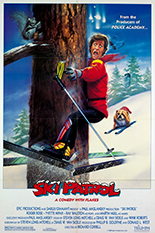
As Snowy Peaks Lodge celebrates 40 years in business, greedy real estate maven Maris (Martin Mull, Clue), in full acquire-and-develop mode, does everything he can to ensure it won’t see a 41st. With the lodge’s lease agreement due, Maris schemes to plant a few violations in order to shut ‘er down. Cue the sabotaged snowmobile to crash through a women’s restroom!
So goes the plot of this slob comedy from Police Academy producer Paul Maslansky, clearly hoping for another franchise. That connection was literally Ski Patrol’s selling point.
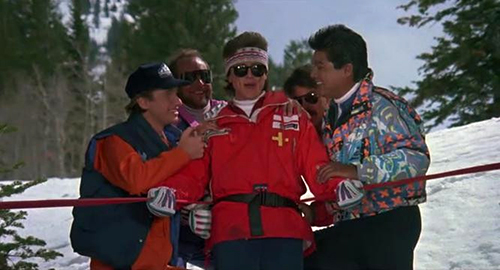
Oh, yes: Snowy Peaks has a ski patrol, whose members band together to save the lodge and its owner, Pops (Ray Walston, Fast Times at Ridgemont High). Roger Rose (Friday the 13th Part VI: Jason Lives) has the Steve Guttenberg role as the charming yet immature group leader, pining after a shapely ski instructor (Doctor Mordrid’s Yvette Nipar — or is that Whitesnake’s David Coverdale?) who happens to be Pops’ niece.
T.K. Carter (Doctor Detroit) is the Michael Winslow-esque Black guy with funny voices. Sean Sullivan (Wayne’s World) is the frazzled weirdo, à la Bobcat Goldthwait. Not large but in charge, the appeal-eluding Leslie Jordan (Barbie & Kendra Save the Tiger King) is the hard-assed G.W. Bailey of the bunch. And so on and so on. Most notable among the cast, however, is future A-list comedy director Paul Feig (Bridesmaids) as a nerdy virgin with major dance game.
What begins with Airplane!-style parodic humor quickly becomes a mix of stand-up bits and low-bar slapstick gags, many involving a farting, belching bulldog named Dumpster. One running joke sees a couple knocked over and sliding down the slopes in positions from the Kama Sutra — fully clothed, of course, because Ski Patrol is PG-rated, with women in Day-Glo bikinis coming the closest to screen skin. In other words, if Hot Dog … the Movie were a hot dog, Ski Patrol is a Vienna sausage Mom sliced into teeny-tiny pieces so Baby doesn’t choke.
An avalanche of idiocy, the movie is packed with montages fueled by the combined energy of the era’s advertisements for wine coolers and chewing gum. If you think all this ends with Feig in Tina Turner drag to compete for $1,000 in a local bar’s talent show, followed by Mull stuck in a runaway wiener and shenanigans involving a giant rubber band, you’re correct, but please don’t write a sequel. —Rod Lott
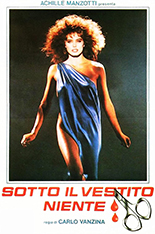
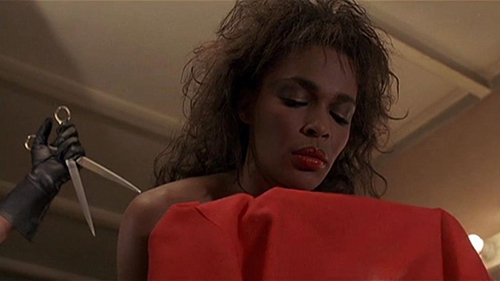
To see Donald Pleasence eat sketti off a Wendy’s salad bar in Milan, you simply must see Carlo Vanzina’s Nothing Underneath.
Other reasons exist in favor of loaning your eyeballs to this bizarro giallo, in which Yellowstone National Park ranger Bob (Tom Schanley, Eruption: LA) senses — thanks to a psychic twin link — that his supermodel sister (Nicola Perring, Duet for One) is in big trouble in Italy. Bob’s not wrong; his sis has just been brutally murdered with an oversized pair of scissors! Naturally, she’s hardly the last victim, which further drives his amateur investigation once he lands in Europe to find out what’s what, aided by Pleasence’s kindly police inspector.
The inevitability of the “twist” is redeemed by the bug-nuts circumstances surrounding it. From top to bottom, Vanzina stirs up quite the ’80s buffet, offering not just lurid thrills, but cocaine, Lycra, Magnum P.I., cocaine, cocaine, “One Night in Bangkok,” Russian roulette and Danish dish Renée Simonsen. Plus, Pino Donaggio’s Body Double retread score auto-grants the film a wonderfully perverse mood it otherwise would fail to achieve throughout.
Nothing Underneath’s killer concept was back — even if Vanzina wasn’t — for 1988’s inferior sequel, Too Beautiful to Die — an obvious misnomer considering the whole movie is about models biting it. Despite the implement of doom being upgraded to a weapon from Conan the Barbarian’s closet, the movie’s virtually the same, Xeroxing everything from the broken glass to the frilly-undies montage. —Rod Lott
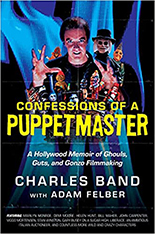
Whether you love, hate or tolerate the movies of Charles Band, there’s no denying the man has no shortage of terrific offscreen stories to share. Otherwise, his autobiography, Confessions of a Puppetmaster, would not exist — or at least not be a must-purchase.
Subtitled A Hollywood Memoir of Ghouls, Guts, and Gonzo Filmmaking and written with three-time Emmy nominee Adam Felber, the book opens with a line all but scientifically calculated to hook and retain: “Unaware of just how insane things had gotten outside her door, Barbie took a shower.” Move over, “Call me Ishmael”!
Having played a pioneering part in sell-through VHS, video stores, license-based video games, the special-features market and, the name “Harry Potter” and toilet-based advertising campaigns, Band takes the reader on the near-Gumpian journey that is his life thus far — a merry-go-round of risk that has earned him as many fortunes as he’s lost, not to mention wives. You’ll learn about him being babysat by Marilyn Monroe, his affair with the very married Demi Moore, his battles with Klaus Kinski and Gary Busey, and his recalibration with director David DeCoteau after finding his erotic flicks “too damn gay!” (Hilariously, DeCoteau prefers to call them “tighty whitey frighties.”)
He may be the only person to go on record as having nice things to say about Helen Hunt. Outside of his actors, cameos include Liberace, Michael Jackson, John Carpenter, Barbra Streisand and “ancient Japanese horse piss.”
While not quite up there with the autobios of Roger Corman and William Castle (to name two filmmakers as beholden to ballyhoo), Band’s collected Confessions make for a delightful afternoon. While he and/or Felber show too much distrust of the reader (“We’ll get to that,” “More on that in a moment,” et al.), the book flies at 288 pages. I would welcome triple that, easily. —Rod Lott


 While young men play a cricket match, one team member plays with his girlfriend in an apple orchard directly across the street. After he’s called back to the field, Pauline (Tracy Hyde, Melody), bides her time wandering ’round the grounds.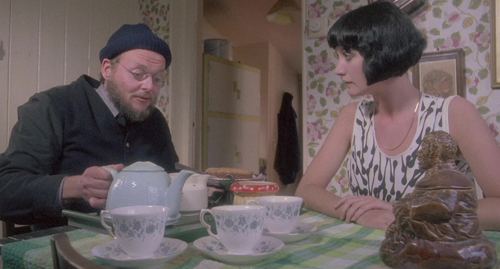
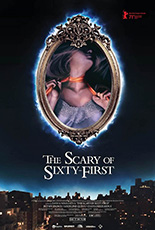 Couched in the hustle and bustle of a Manhattan Christmas season, The Scary of Sixty-First is an equal-parts exercise in conspiracy-theory paranoia and art-school fuckery. Ho-ho-ho-hum.