
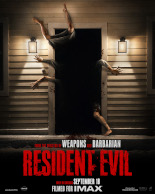

It’s easy for video game adaptations to feel uninspired. Hell, that tendency defines the bulk of Uwe Boll’s career. And save a handful of fun, but otherwise inconsequential animated features, Capcom’s Resident Evil suffered a similar fate at the hands of Event Horizon’s Paul W. S. Anderson and the six films he made starring his spouse, Milla Jovovich.
Though “uninspired” might be unfair. Anderson was definitely inspired by something when making his Resident Evil franchise, presumably The Matrix and Blade, rather than the video games themselves. Because while the presence of zombies, Umbrella Corp. and a few recognizable characters allude to Resident Evil, very little of Anderson attempts actually feel like it.
Introducing some new blood into the biohazard has been long overdue, and among modern horror directors, it’s hard to imagine much anyone who could capture the series’ signature and grotesque campiness better than Zach Cregger (Weapons). Outside of getting a little overzealous with some dialogue that falls flatter than intended, Cregger absolutely nails the vibe of playing Resident Evil without so much as namedropping Leon Kennedy, Chris Redfield, Jill Valentine or even Albert Wesker.
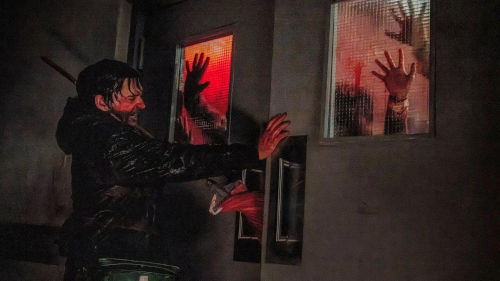
In other words, Resident Evil is definitely a film made for fans of the games, but its devoid of any of the overt, low-hanging fan service that would make it alienating to everyone else.
Bryan (Austin Abrams, Weapons) is kind of like an Uber Eats delivery driver. Except for organ transplants. As he starts to wrap up a snowy night’s shift, as well as a conversation with his girlfriend confirming her pregnancy, Bryan regrettably agrees to take a high-priority package to Racoon City. Unprepared to handle the road’s icy conditions, he plows into what he quickly learns is an infected woman in a sundress. One dead cop and a run-in with a mutated dog later, Bryan is desperately dumbing his way toward the top floor of a hospital at the heart of his tentacle-wrapped destination.
While this is technically a zombie flick, Cregger wastes little time fleshing out Resident Evil’s more monstrous leanings. For example, blasting off a zombie’s head might neutralize it. Or, unfortunately for Bryan, it could sprout some extra fleshy digits from the new opening, drag along a few nearby corpses and turn into its own perverse adaptation of another video game, Katamari Damacy. The variety is much appreciated, with each new sequence feeling like another level that Bryan can barely overcome, capturing the spirit of Peter Jackson’s Braindead, without the heroism.
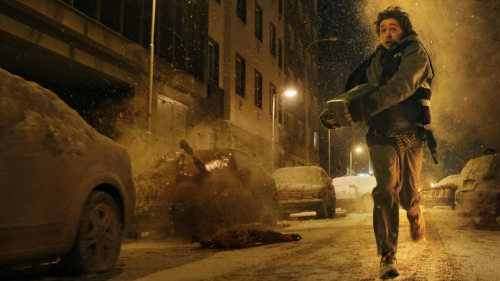
Unlike its source material, Resident Evil is exceptionally good at showing Bryan go through the motion of being a hero without actually becoming one. This idea supports the film’s comically bleak ending, but it’s used throughout to subvert the expectations you’d feel playing a Resident Evil game, or any video game at that. Typically, your actions are presumed justified. Every enemy you mow down or cut in half deserves it, especially when they’re zombies that can transform into outright monsters.
That last part is true for Bryan’s predicament, but he’s far from a cool and collected slayer, nor does he ever really become that. He trips over himself. He misses most of the shots he takes. He accidentally shoots the people he’s trying to save and even promises to rescue a little girl before realizing she’s far too gone, ultimately killing her, too.
Likewise, when we pick up a controller, we’re never actually a hero. We’re pretending to be one. Realistically, we’d tragically end up us monsters ourselves, an idea Cregger uses to put a pin in his adaptation that’s as faithful as it is a rebuttal to Resident Evil as a concept. It’s a paradox that’s well worth the ride. —Daniel Bokemper