
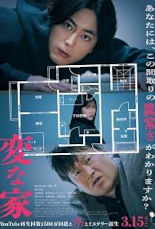

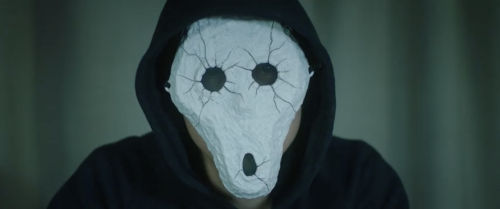
Although I’m a voracious reader, fiction rarely finds a slot in my TBR pile(s) these days. The latest exception: Strange Houses, a 2021 mystery from Japan penned by the enigmatic, unimonikered Uketsu, a YouTuber who hides his/her/their identity behind a minimalist mask that suggests Ghostface by way of an egg carton.
What appealed to me wasn’t the author’s anonymity or horror-ready headwear, but the novel’s use of floor plans as clues to forward the narrative. More than mere gimmick, these scale diagrams are the mystery; you literally couldn’t tell the story without significantly diminishing the experience. I have a track record of falling for this illustrated maps-and-charts approach in fiction, whether erudite (Arthur Phillips’ The Egyptologist) or ridiculous (Matthew Reilly’s 7 Deadly Wonders).
Possibly due to the daunting and imperfect task of translating the Japanese language into English, Strange Houses’ prose struck me as primitive. But the premise? Addicting and unputdownable. No wonder the book’s popularity traversed oceans to become an international phenomenon. Somewhere in the middle of fever-turning page after page, I thought, “This would make a great movie.”
An adaptation already exists! Alas, A Strange House is only decent. Uketsu’s surrogate is Amemiya (Shotaro Mamiya, Bad Lieutenant: Tokyo), a like-and-subscribe-starved YouTuber. He needs views — and gets them after his producer (DJ Matsunaga of hip-hop’s Creepy Nuts) shows him a flyer for a potential abode. They notice an area of the blueprint appearing to serve no structural purpose — but perhaps a sinister one. Amemiya enlists the expertise of antisocial architect pal Kurihara (Jiro Sato, 2015’s Death Note TV series), who spots even more disturbing peculiarities on the page.
Kurihara and Amemiya soon learn the place is tied to the recent discovery of a corpse eerily missing a left hand. As their investigation grows beyond theoretical to physical, floor plans of other residences surface, each literally holding secrets within its walls. To explain further would give away the plot’s twists. Suffice to say, several come built-in.
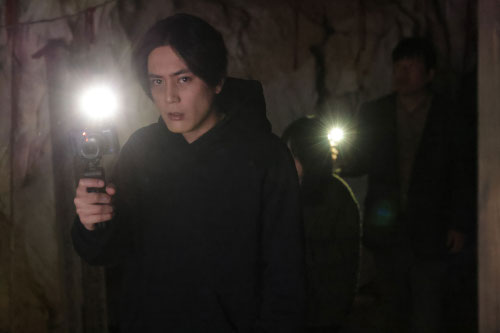
The Strange foundation has solid bones and no shortage of curb appeal. Scripter Kentaro Ushio and director Junichi Ishikawa succeed in nailing the book’s spirit, admirably leaning into the J-horror elements to bestow a multifaceted whodunit of perversity. When the camera pulls back at one point to give the audience a top-down view of the action, it’s like a Clue game board come to life — and, as locked-room and puzzle-box mysteries should, death.
To the filmmakers’ credit, A Strange House is appreciably faithful. However, it could stand to better establish the characters, especially Amemiya, because the movie begins in haste, like a TV show several episodes removed from the pilot. Ishikawa and Ushio primarily labor in the medium of television, conceivably accounting for the zero-to-60 launch. The pic also could use a few turns of an Allen wrench to dispense with add-ons the screen renders superfluous.
With fewer minutes on the clock and a fresh coat of paint on the players, a remodel could work wonders. Considering Uketsu has three sequels (Strange Pictures, Strange Buildings and Strange Maps) currently on the market, no doubt someone will try. —Rod Lott