
The Sword and the Claw (1975)

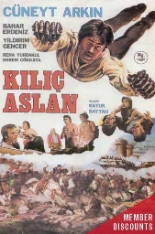
Cüneyt Arkın, one of the proud futuristic freedom fighters from Dünyayı Kurtaran Adam — also known in the States, rather dumbed-down if you ask me, as Turkish Star Wars — is back on the small screen in a rather good-looking print of 1975’s Kiliç Aslan or, for the sake of argument here, The Sword and the Claw.

In this bargain-basement flick, a king with a birthmark of a lion on his back is killed by his sleazy mustachioed rival. When his concubine, pregnant and on the run, has his baby in the woods, said child is kidnapped and raised by lions, mostly done through a quick vignette of a small child feeding an equally immature lion some raw meat, which couldn’t have been safe, but the kid and the lion look like they’re having fun.

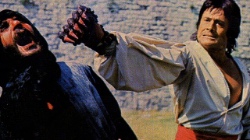
As the child grows up into strapping vine-swinging man Arkin, he immediately runs afoul of the same corrupt leader and, for his troubles, has his hands burnt black, Cajun-style. Thankfully, an old man forges a pair of new unwieldy metal hands — lion’s claws, if you will — and, in the last 10 minutes of film, rips out the throats of the supreme leader’s army and, of course, the big boss. Roll credits.
That seems simple enough, right?

A prime example of the popular Turkish costume dramas of the time, The Sword and the Claw has choppy editing, uneven music and the worst dubbing in history, but damned if it isn’t an entertaining flick, with Arkin jumping off the screen, somersaulting into every fight scene, with particular abandon being given to the bloody finale and his angry lion-face.

If memory serves me, I vaguely remember the VHS box for this movie when it was called Lionman, always overlooked and gathering dust. Still, the American Genre Film Archive’s Blu-ray — from the only 35mm print in existence, natch — is the nicest I’ve even seen of a Turkish film of this ilk, a genre usually reserved for 10th-generation burns.

As a bonus feature, the AGFA disc includes the kung-fu foible Brawl Busters starring Black Jack Chan, produced by the “Official Chinese Black Belt Society.” Yep, that sounds totally legit. —Louis Fowler

Get it at Amazon.

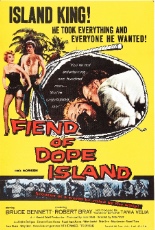
The Fiend of Dope Island (1961)

WTFSomewhere in the Caribbean, psychotic pot farmer and arms dealer Charlie Davis (Bruce Bennett, The Alligator People) is The Fiend of Dope Island, who physically abuses the native slaves he calls his employees. (Comparisons to Michael Fassbender’s Oscar-nominated role in 12 Years a Slave are not out of line.) Meanwhile, right-hand man David (Robert Bray, My Gun Is Quick) tries to right his boss’ wrongs. Besides being the only white guy on the payroll, David stands out for wearing a yacht captain’s hat as if he’s the top half missing from an “& Tennille” marquee.
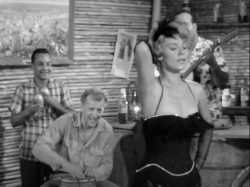
One day at the isle’s bamboo-walled cantina (and the movie’s primary set), in sashays Glory La Verne (Queen of Outer Space’s Tania Velia, billed here as “the Yugoslavian bombshell”), a shapely firecracker Charlie has hired to perform hoochie-coochie dances for his viewing pleasure to the point of literal exhaustion for her — a weakened state making it all the easier for him to attempt rape.

Although directorial duties fell to oater specialist Nate Watt (Hopalong Cassidy Returns, et al.), the script was co-written by Bennett, who sure gave himself a meaty part as the antagonist. Seeing him bark orders — each punctuated with the crack of his trusty whip — is one thing, but Bennett is at his ham-hock best during the dance numbers, maniacally laughing and feverishly bongoing his way into an orgiastic frenzy as Glory shakes her groove thang. Dope Island may be nothing more than a melodrama, but his Reefer Madness-styled overdelivery infuses the picture with a nutty flavor, kicking it over into the stuff of many a men’s adventure magazine cover. —Rod Lott

Get it at Amazon.

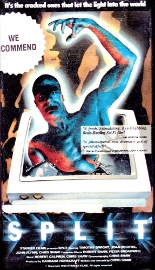
Split (1989)

Not to be confused with the recent M. Night Shyamalan film — but how I hope it is — the Split from 1989 is very much a prototypically bizarre YouTube clip stretched out into interminable movie length, so I guess that’s something to be technologically proud of.

Within minutes of pressing play, the screen is soon filled with bad teeth, bad accents and bad dialogue — including the classic line “We came for breakfast, not for AIDS!” — with the immediate start-stop bent going between this homeless man’s world and some sort of technologically unsound underworld, giving the movie an infinitely more intriguing first half-hour than many other futuristic-repressed films of the time.

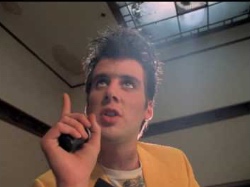
The homeless man, actually, is a sort of quick-change artist, slipping in and out of one bad comedic persona after another; he’s also on the run from this nameless group of American computer-hacker types who are desperately trying to track down the man, whose real name we learn is the unlikely Starker (Timothy Dwight).

Apparently living off the grid, especially in a time when it was easier to, strange computer graphics come to life, pixelating and swirling, proving somehow that Big Brother really is watching Starker and, of course, brainwashing all of us. By the way: Everyone is living in some form of a dystopian future, but I only learned that from reading the back of the Blu-ray case — it still looks and feels like generic 1989 Los Angeles to me.

While writer/director Chris Shaw’s film drags as we follow Starker around from one supposed comedy bit after another, where he goes to art shows as an Austrian psychoanalyst and hangs out at a Terry Gilliam-esque woman’s house, for example, keep with it; if you persevere and give it a few minutes, Split eventually becomes an absolute cheesy mind-melt as it barrels down toward a typically dark and depressing ending that I’m not sure I really get yet, but I appreciated nonetheless.

Apparently one of the first films to use CGI — and it shows — Split was a very low-budget outing with a message bigger than it could possibly contain: Conformity is a soul-destroying beast and the only thing that can save us all is a fat urinal cake to be dropped in the water supply cleaning our clouded visions — something I’ve written about in clandestine pamphlets for years. —Louis Fowler

Get it at Amazon.

DOA: Dead or Alive (2006)

Finally, one of mankind’s greatest mysteries is solved by the film DOA: Dead or Alive: What would happen if a ninja princess, a leggy cat burglar and a star-spangled-swimsuit-clad pro wrestler were invited to join a high-stakes martial-arts competition on a hidden island?

The answer: Kicking.

Based on a video game franchise, the Maxim-rific DOA sat on the shelf for a number of years before quietly receiving a theatrical release. That suggests the flick is unwatchable; in truth, it does exactly what it sets out to do: titillate.

Kasumi (Devon Aoki, Sin City) is the aforementioned princess who leaves her Asian homeland to avenge the rumored death of her brother. Because she abandons her people, she is pursued by an assassin with pink hair.

Christie (Holly Valance, Taken) has just pulled off a lucrative heist when she’s questioned by police in her hotel room. She manages to fight them off while naked, simultaneously grabbing a falling gun as she puts on a bra.

And Tina (Jaime Pressly, Torque) is a beer-guzzling redneck wrassler who’s just defended her yacht from a band of pirates.

All three lithesome ladies are recruited — via electronic throwing-star invitations, naturally — to be among a handful of combatants in the winner-takes-all “DOA” competition, which promises a $10 million prize. No one said this makes any sense, but it all happens over the course of the film’s first 10 minutes, so at least it wastes no time.

On the island, a squeaky-voiced roller skater introduces them to Dr. Victor Donovan (Eric Roberts, Sharktopus), the mastermind behind the games. Yes, he’s evil, with the sport merely a cover for his greedy, misguided machinations.

With snot-slick visuals and leaden attempts at slapstick comedy, DOA: Dead or Alive plays like a marriage — or at least a one-night stand — between Mortal Kombat and TV’s Charlie’s Angels. It’s the kind of movie that keeps cutting away from a karate-laden fight scene to a women’s beach volleyball match because … well, hey, bikinis!

At least DOA wears its T-and-A intentions on its thong strap, not pretending to be anything but a made-for-cable-level exercise in action and eye candy. The DOA logo even appears full-screen at several points, handily suggesting where commercials could be inserted for airings on Spike TV.

It’s mindless, sure, but it cannot be accused of being boring. The actresses are easy on the optical orbs, and up to all the upskirt wire-fu that director Corey Yuen (The Transporter) has in store for them. For the viewer, that also means bright colors, quick cuts, slow motion and other shiny things to keep you entertained while dissuading you from applying logic.

If the shenanigans leave you in the mood for a much smarter film centered around three lovely ladies who know how to throw a punch, rent 2002’s So Close, also directed by Yuen. It may not have a wisecracking black guy in a shark-fin mohawk, but you can’t win them all. —Rod Lott

Get it at Amazon.

Zipperface (1992)

For her heroic efforts in a hostage situation, the Heather Langenkampy policewoman Lisa Ryder (Donna Adams) is immediately promoted to detective after shooting the crazed gunman dead — and I do mean immediately, as she and her fellow California cops are still at the crime scene!

Her first assignment is to find out who is behind Palm City’s string of prostitute murders. As viewers, we know who’s to blame … kinda: Zipperface, a dude decked out in S&M leather, head to toe. Imagine if the Gimp from Pulp Fiction got his own spinoff movie. That’s what Zipperface is — and also more fun to say than watch.

Ryder’s investigation leads her to local photographer Michael Walker (Jonathan Mandell, California Hot Wax), who’d be creepy even if he didn’t sport a butt cut. Despite being on the authorities’ radar for the serial killings, Walker thinks it’s a good idea to lure Ryder into posing for risqué photos by telling her he’s shooting an “Women of Valor” exhibition for an upcoming gallery show. Despite a rep as a top-notch member of law enforcement, she not only falls for it, but falls head over heels for the goob. Sigh, ain’t love grand?

Directed by Mansour Pourmand (not that that means anything), Zipperface plays like the average Skinemax erotic thriller with below-average lighting. In her lone film credit, Ryder does okay for a neophyte, but the romance forced upon her could curdle milk. The movie is sleazy enough to make one believe the scenes of Zipperface assaulting hookers were Pourmand’s top priority, and anything in between was gravy, however ill-whisked.

Lending credence to this theory is that when Ryder’s William Devane-esque partner (David Clover, Kentucky Fried Movie) unmasks Zipperface, he more or less exclaims, “Hey, it’s that guy you probably don’t remember, but he’s related to that prominent character you do!” Otherwise, the viewer would be confused, since Day-Job Zipperface basically shows up in one scene early in the film — a cheat as egregious as the denouement of the first Saw. —Rod Lott

Get it at Amazon.