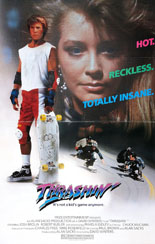

Thrashin’ (1986)

The 1980s had their “big” movies dedicated to the dawn of the most extreme of sports, little-seen mainstream product like Rad, North Shore, Body Slam or even The Dirt Bike Kid with Peter Billingsley and half the cast of HBO’s Not Necessarily the News.

But only one movie made me want to skateboard down a “freewheeling boogieman” on the 405, bounce off a “parallel shortbus” at the youth center and bust out with a “360 knapsack” on a “total doogie” — that’s the lingo, right? — and that movie was Thrashin’.

The whole skating craze was more my younger brother’s bag. I’d watch him and his friends doing “ollie-hopnoodles” and “jitterbuggin’ the manatee” in the neighborhood park while I sat in the shade of a tree and read my dystopian fiction novels above my reading level — a sad childhood, to be sure.

In that summer of 1986, though, Thrashin’ was advertised on the back of every Marvel comic book and, man, I was as pumped as a fat kid with no athletic ability could be pumped: I needed to see that movie!
Too bad there were no theaters in my small town. The next year, I rented it on VHS and thought it was okay, but my skating fandom already had died; by then I was obsessed with extreme bike-messengering, mostly because of Kevin Bacon’s Quicksilver.

Since that long-lost rental, I hadn’t revisited Thrashin’ until yesterday. A dated piece of analog flotsam, it’s from a more innocent time when all you needed to be a hero was your absolute will to be the best skater in the Valley.  

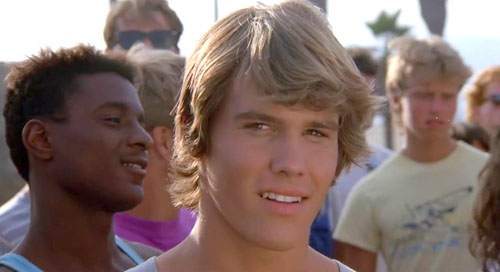
Corey (a baby-faced Josh Brolin) is the new kid in town and he’s got that will. Decked out in his loose Vision tee, stylin’ Jams shorts and parent-approved elbow and knee pads, he cruises in the wind toward PG-13 oblivion while a generic “punk” song by Meat Loaf, with lyrics about “achieving your dreams” and “flying high,” plays on the epic soundtrack,

With plenty of sick “flip-kicks,” “Mr. Coffees” and “Gorgonzola dunks,” Corey and his friends call themselves the “Ramp Locals” because, well, they made a ramp. Eventually, they run into the skater punks from the other part of town, led by swarthy Tommy (’80s mainstay Robert Rusler).

While the Red Hot Chili Peppers play a skate party — the band’s second movie of the year, alongside Tough Guys with Kirk Douglas and Burt Lancaster — the Romeo and Juliet vibes take precedence as Corey and Tommy’s sister, Chrissy (Pamela Gidley), spend time playing games at an outdoor carnival, as you do.

Even though the stakes are low, the punks are pretty mad and make a wager to control the whole skateboarding scene, as well as, um, a corporate sponsorship. As you can guess, after a rehabilitation montage, Corey soundly defeats them and you think the punks will be mad … but, instead, Tuff Tommy shakes Corey’s hand and says, “Good game, brah!” or something to that effect.

Aided by a bunch of ’80s skaters like Tony Hawk and Tony Alva, both Brolin and, to smaller effect, Rusler are pretty good in their melodramatic roles. But the real star is director David Winters, a longtime choreographer whose work on Linda Lovelace for President, Roller Boogie and the Star Wars Holiday Special make me think his life story would be a great movie.

In the end, Thrashin’ was a near-wipeout of the whole skateboard craze, schooling me on the fads and foibles that, as a young person in the ’80s, I could often find myself in. At least not until Gleaming the Cube … right, brah? —Louis Fowler

Get it at Amazon.

Ghost Train (2024)

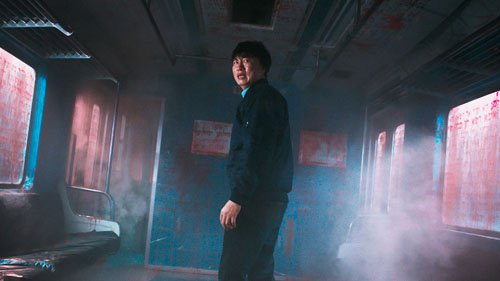
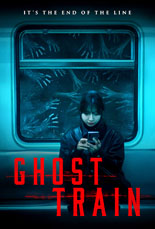
Young, timid YouTuber Da-kyung, aka “Horror Queen” (SNL Korea cast member Joo Hyun-young) investigates strange goings-on at a particular subway station. She hopes her snooping will prove fruitful in terms of traffic, views, likes, clout, etc. — all of which I have difficulty feeling empathy for in modern movie characters.

For intel, Da-kyung bribes the station agent (Jeon Bae-soo, The Wailing) with hooch. He feeds her more stories for her channel, including a schoolgirl pursued by a bandaged-face woman clutching a mug of acid, and a beauty influencer who undergoes a trypophobic transformation after touching a handrail ring.

Until this point, I didn’t know Ghost Train was an anthology. More surprising is not a single story fails. Not even the one that sounds stupid on paper: a homeless man harassed by a bullying cop gets revenge with cans of killer soda. Executed with O. Henry twistiness, this morality tale is one of the more creative and original ideas K-horror has offered.

Like a dog with a full bladder, Ghost Train jumps right out there and does its business. That’s especially admirable for Asian horror, which has a tendency to balloon toward two hours or more, including Tak Se-woong’s previous film, Devil in the Lake. I also appreciate how the wraparound story isn’t an afterthought or a device for device’s sake; it’s actual plot and feels like it takes up a third or more of the running time. Se-woong treats Da-kyung’s efforts as every bit as important as any of the five standalone stories.

In efficiency and effectiveness, Ghost Train reminded me of 2021’s Ghost Mansion — only to find out the omnibuses share the screenwriting mind of Jo Ba-reun. Both deliver more chills to the spine than jumps to the heart, and that’s the way to go. But don’t confuse Ghost Train with 2022’s similar-sounding The Ghost Station, which isn’t an anthology, but is also about a female content creator so desperate for a spooky scoop, she turns to the turnstiles. Only one is worth getting your bags together for and bringing your good friends, too.* —Rod Lott

*With apologies to Cat Stevens. #nofatwas

Get it at Amazon.

Triple Fisher: The Lethal Lolitas of Long Island (2012)

WTF

Name a current narcissistic, headline-hangry piece of shit posing as a human being — I’m going with Ruby Franke — and odds are, you’ll find multiple documentaries about them scattered across various streaming platforms. In the pre-digital world, however, their lives and crimes were quickly churned, burned and turned into made-for-TV movies.

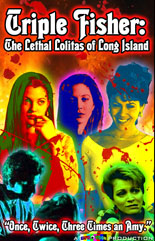
Take Amy Fisher — please! Barely six months after the New York teenager put a bullet in the noggin of her married lover’s spouse in 1992, her story became fodder for such three prime-time premieres: NBC’s Lethal Lolita, ABC’s Amy Fisher: My Story and CBS’ Casualties of Love, respectively starring Noelle Parker, Drew Barrymore and Alyssa Milano. Not only did all three air within a week’s time, but two aired opposite each other. I’ve never seen any.

But I have seen all — in a way, via Dan Kapelovitz’s mashup, Triple Fisher: The Lethal Lolitas of Long Island. Riotously entertaining, it tells the same story using select bits from the competing pics. Other than Barrymore’s Amy longing for eggplant parm, it’s difficult to keep track of who’s in which, and it doesn’t matter. In fact, that’s exactly Kapelovitz’s point. 

Down to the beepers and goombah ’fros, the triplets’ shared resemblance is so uncanny, a 23andMe test would be superfluous. It’s almost as if they worked from the same outline; essentially, by pulling info from the shared Porta-Potti of ’90s tabloid journalism, they were. One can imagine the individual producers collaborating:

“Do we really want to spend time on the promotional shirts for Joey Buttafuoco auto repair shop?”
“Well, we will if you will.”
“Okay, settled.”

Triple Fisher is hilarious, although none of the material was intended as anything but Serious Drama. One has Joey, looking not unlike Saturday Night Live’s Horatio Sanz, snorting coke while driving. One’s Mary Jo Buttafuoco is a spitting image of Amy Sedaris’ Strangers with Candy character. Best of all, one has Mr. Fisher asking his daughter who gave her “the herpes.”

Way to go, Joey! —Rod Lott

Bight (2025)

As box-office returns for The Housemaid demonstrate, America is horny again! Whatever the reason for the erotic thriller’s comeback, if more turn out neither erotic nor thrilling like Bight, that resurgence could quickly go flaccid.  

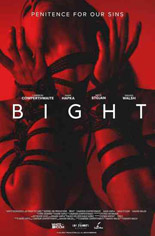
Following a miscarriage (of fetus, not justice), Atticus and Charlie are in a rut. Played by Cameron Cowperthwaite and Maiara Walsh, both likable, the spouses hope for a distraction at a party thrown by their couple friends, Sebastian (Mark Hapka) and Naomi (Maya Stojan). Tension follows Charlie and Atticus through the door, because last time they were all together, things got weird. Meaning, they shared a foursome. 

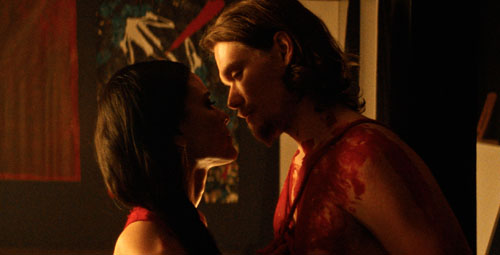
There’s no party — ’tis all a ruse by Sebastian, a pompous art photographer, to coerce his emotionally fragile pals into posing nude for his latest work. This involves — after a round of drugged tea, of course — Atticus and Charlie facing one another and tightly bound in red ropes while Naomi flings paint on their bodies and Sebastian shouts orders (in a manner not unlike the photoshoot scene in Austin Powers: “Burrow! Burrow! Make an interconnected series of tunnels like the Viet Cong!”). 

Until its tail end, Bight is a movie of conversation over action, and such talks are often interminable. Each character says a lot without saying anything of consequence, e.g., “Apologies aren’t weak. What’s weak are the people who don’t say them.” Arguably worse, they speak as if their lines require delivery with a degree of reverence, as if orating Shakespearean monologues onstage at the Globe. You be the judge:

Atticus: “I didn’t know there were rules to exploring, but that first one sounds made up.”
Sebastian: “Well, all rules are made up.” 
Naomi: “We’re the ones that give them power, but fear not. Rules, whether they’re made up or not … are there for a reason.” 

In addition to writing the screenplay with onscreen hub Cowperthwaite (Bury the Bride), Ms. Walsh (Mean Girls 2) calls the shots helming her first feature. She makes Bight look good — even great at times. The problem remains their script. In addition to aforementioned deficiencies, it’s not even clear why the characters get so worked up (not sexually speaking) over certain situations or how they choose to react.

Bight’s most appealing parts are the opening and closing credits, credited to one “Yori X,” who executes both in the style of 007’s celebrated title sequences. But with sex ropes. —Rod Lott

Get it at Amazon.

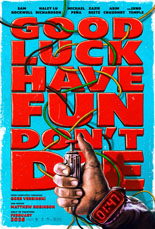
Good Luck, Have Fun, Don’t Die (2025)

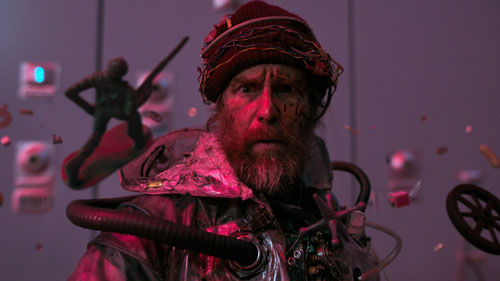
As if you weren’t already aware, our world is, in a word, fucked. Yet hope exists, albeit in the form of a scraggly, smelly and likely unhoused man (Sam Rockwell, Iron Man 2) with explosives strapped to his chest.

Barging into at an L.A. diner one night like a crazy person, he declares he’s from the future and seeking volunteers to help him destroy AI before AI destroys humanity. Seven recruits and 10 minutes later, their revolution begins — with the title singsong-shouted at viewers: Good Luck, Have Fun, Don’t Die! (For these dire times, that resonates harder than “Live, love, laugh.”)

As the man and his charges embark on their mission, director Gore Verbinski flashes back to Weapons-style chapters depicting the events the lead the most recognizable recruits to the diner. Teachers Michael Peña (Ant-Man) and Zazie Beetz (Deadpool 2) flee from students who’ve been algorithm-anesthetized into TikTok zombies. Grieving mother Juno Temple (Venom: The Last Dance) clones her son after he’s killed in a school shooting. And a depressed party rent-a-princess (the ever-winning Haley Lu Richardson, Split) is allergic to cellphones and Wi-Fi.

Like the film overall, these shorter pieces delight at first before running out of steam. This structure makes me believe Good Luck would have worked best as a true anthology, with the Rockwell-led segments doing Cryptkeeper duty as a wraparound. Throughout, but especially in the aforementioned opening scene, Rockwell leverages the fast-talking, smart-ass thing that’s served as his stock in trade for three decades and counting. His manic energy sets the pace for every arm of Verbinski’s epic sci-fi comedy, but attempting to sustain that grows exhausting, much like Y2K — the movie, not the year (although come to think of it …).

Rockwell’s warning to his army that not everyone will make it to the end could hold true for audience members not attuned to its level of quirk. The script by Matthew Robinson (Love and Monsters) is not quite pitch-black satire, but let’s call it close to sunset; among its best ideas is that cloning your kid is hella expensive unless you get “the ads version,” in which your Xeroxed offspring shills a product once a day, “but in his own voice.”

Inevitably, as the chaos continues and the effects overwhelm in what feels like Act 4 or 5, Good Luck, Have Fun, Don’t Die collapses under its own bloat. At 134 minutes, how could it not? (Since earning Disney loads and loads of Pirates booty — as in of the Caribbean — Verbinksi’s rarely met a two-hour running time he didn’t shatter, but I’ll go to my grave defending A Cure for Wellness.) There’s simply too much there here, including a CGI creature’s giant penis slinging while gushing a stream of glitter — a climactic image that reinforces the movie’s message: We’re too distracted to realize how royally we’re getting hosed. —Rod Lott

Get it at Amazon.

Random Genre & Cult Movie Reviews