
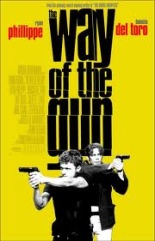
 Christopher McQuarrie, Oscar-winning screenwriter of The Usual Suspects, made his directing debut with — now here’s a step up! — a thriller, centered on two low-life criminals. For The Way of the Gun, he wisely cast Benicio Del Toro as one of them and unwisely cast Ryan Phillippe as the other. I take issue with the latter’s casting because: a) he looks girlie, and b) he attempts an accent that is just so wrong and distracting, mainly because he’s invented his own new accent altogether!
Anyway, while donating sperm, they hear of a woman (Juliette Lewis) who is being paid big bucks by a multimillionaire family to carry their child. Hearing that little “ka-ching” in their head, they kidnap her and hold her ransom for something like $15 million. Of course, things don’t go as smoothly as they planned, because otherwise, this would be a short subject. And maybe it should have been.
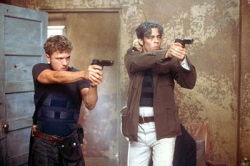 On their tail are Taye Diggs and Nicky Katt as Lewis’ expensive-suit-wearing bodyguards. Also on their tail is James Caan, who never once moves his neck. Also also on their tail is Geoffrey Lewis, for reasons that simply clutter up what should have been a simple story. And we haven’t even gotten to the cops.
After a strong start (albeit containing more utterances of “fuck” than the entire running time of Next Friday) and a painfully slow middle, Gun reaches a less-than-rousing conclusion in a whorehouse shootout, with bullets a-flyin’ as a doctor performs an emergency C-section on Lewis. At least I haven’t seen that before. Not that I want to see it again. No Way. —Rod Lott
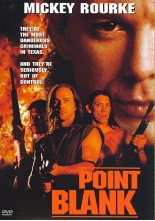
 Like many, I watched the descent of Mickey Rourke’s career with undue fascination. Here was a genuinely talented man, with a handful of superb performances and films under his belt (
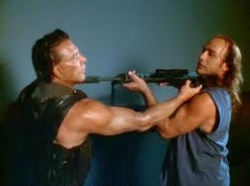 In a performance that defines the phrase “go fuck yourself,” Rourke is Rudy Ray (either the worst or greatest name in action-movie history), a former mercenary called into action when a group of escaped convicts, including his brother, takes over a shopping mall. Mickey mumbles and grunts inarticulately, then goes in, his skin glistening with what I presume to be … oil? God, I hope it’s oil.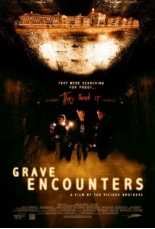
 Had
Had  With Sean Rogerson doing a fine job of portraying the host as a total douche (to a point of tangible annoyance), the requisite strange stuff begins to happen following a belabored setup. This includes a woman’s hair being pulled, a window opening on its own, a door slamming on its own, and so on. Things only ramp up at the tail end, but either are highly reminiscent of scenes from other movies — most notably,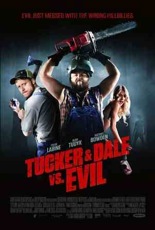
 It’s getting to the point where people are making more postmodern meta-commentaries on the horror genre than they are making actual horror films. But that’s not a complaint. The whole reason I love the genre is because of the opportunities it allows for smart-asses to mess around with it. Which explains why I loved
  Tucker & Dale takes on this cliché by turning the frat-asshole douche-cunts horror movies typically expect us to care about and making them the villains. Our heroes are the titular friendly buddies, whose lack of style and social pretensions could be confused from a distance as something out of Deliverance. Both are in the woods to work on Tucker’s fixer-upper of a vacation home, but when they fish an unconscious coed (Katrina Bowden of TV’s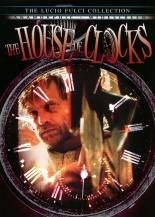
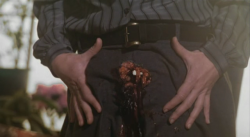 Enter three young ruffians: two guys, one girl. These shoplifting, pot-smoking, cat-in-plastic-bag-trapping punks burst into the place to rob the Corsinis blind, but accidentally kill them, too. At the moment of the old geezers’ murder, the clocks freeze. Soon, their hands inexplicably move backward, thereby enabling the deceased Corsinis to take their revenge. Like sands through the hourglass, so are the days of our lives.