
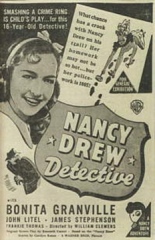
 In her first screen outing, Nancy Drew — Detective, Carolyn Keene’s all-American teen she-Sherlock (Bonita Granville) is out to solve the sudden disappearance of an old biddy who was due to donate a bundle of cash to the local girls’ club to build a swimming pool. And Nancy sure as shit wants that swimming pool!
Getting no help from “that conceited tweet-tweet” police Capt. Tweedy (Frank Orth), Nancy enlists the help of platonic pal Ned Nickerson (Frankie Thomas), the clumsy neighbor boy with the side-swirly haircut and propensity to drop tools on his toes. He’s also a dud in overall social skills, according to Nancy: “You’re about as chivalrous as an oyster!”
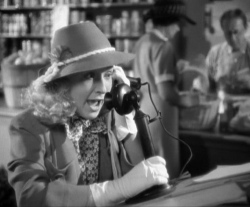 In the climax, Nancy threatens the bad guys with a gun, holding it with disgust as if it were a penis.
The squeaky-clean, super-efficient mystery involves chasing a pigeon carrying a secret message; slapstick with a wrench; dressing Ned in drag, disguised as a nurse; and communicating via the cutting-edge technology of Morse code. Speaking of dated, the flick is filled with now-odd slang, like “Aw, stop disturbin’ the molecules!” Even when presented in context, that made no sense to me, but like the rest of the hour-long adventure, I sure did enjoy it. —Rod Lott
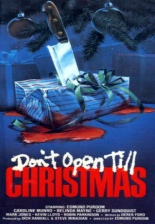
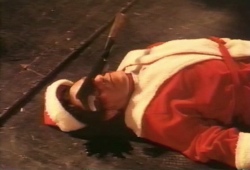
 Who is killing all of London’s drunken bums dressed as Santa Claus? Whoever it is is wildly inconsistent in his methods, using a straight razor, a garrote, a spear and even a broken beer bottle, all the better to gouge Kris Kringle’s eye with. The result is
  Scream queen Caroline Munro appears in one scene as herself, singing a synthy-sweet pop number onstage while caressing her inviting curves in a slinky, sequined red dress that sparkles as bright as her bedroom eyes. (Er, please excuse me for a couple of minutes. … Okay, I’m back.)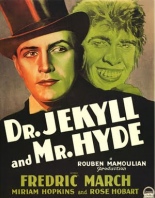
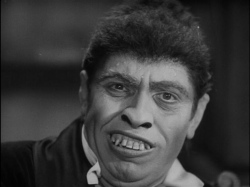 The best thing about this version is Rouben Mamoulian’s direction, which looks innovative even today through his unique use of subjective camera, split-screens and framing of certain shots. It’s way ahead of its time. The film kind of peters out in the last half-hour and I’m bothered by the way everyone pronounces the doc’s name as “JEEK-ul,” but this is still a great old horror movie through and through. —Rod Lott
 A mixed-bag movie franchise comes to a disappointing end (or at least one assumes) with
  The only scenes that resonate are those in which Hannibal exacts his revenge, and we’re made to cheer him along. Yet they’re not built with any shocks; they simply go through the motions. And what to make of his third-act transformation into Action Hero, leaping atop ships to save Gong Li? At least on the page, scenes like this can’t look silly.
 Not to be confused with the
  Directed by