
 How do you know Terror Beneath the Sea is science fiction? For starters, newspapermen aren’t proactive adventurers. They’re lazy asses. Unless they’re played by Sonny Chiba, of course, as in this harmless, colorful Japanese/American production that offers a rare glimpse of Chiba keeping his hands and feet mostly to himself.
As Ken, he and fellow journalist Jenny (pretty Peggy Neal, The X from Outer Space) attend an underwater, press-only demonstration of the Navy’s new, state-of-the-art homing torpedo, the Bloodhound, the shape of a man flashes across the screen. What could it be?
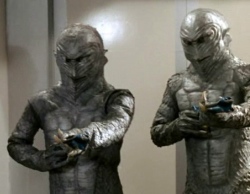 Later, Ken and Jenny check it out by boating over to the island where atomic waste products are dumped and get their answer: shiny, silver Sleestak-like creatures with crossed eyes too close together, mouths that do not move, and no genitals whatsoever.
And 3,000 feet below underwater city ruled by Dr. Rufus Moore (Erik Neilson), they respond to turns of the dial, i.e. “WORK” and “FIGHT.” There, madman Moore changes the physical structure of humans into these mutated gill-men. That gives way to weird sequences of stop-motion arm pustules, perhaps topped only by cool scenes of underwater miniatures action, as only the Toei Company could do. —Rod Lott
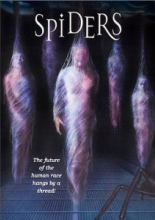
 Stick a spider in a movie, and I’ll see it. While this movie’s title (
 They enter the shuttle wreckage and then the bowels of the secret base, only to find themselves trapped and menaced by this very angry, very aggressive, big-ass spider, who seems to be growing in size at an alarming rate. The U.S. Army’s also running around looking for the thing, so the movie quickly becomes a mix of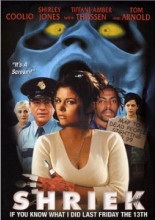
 It was because of
  Tiffani-Amber Thiessen, looking pudgy and threatening to squeak out of her strapless blouses, has the Courtney Cox role as a sexpot reporter to Tom Arnold’s doofus of a security guard. It’s pretty sad when someone like Arnold makes the rest of the cast look like amateurs — including a pre-
 Here’s how much of a true musketeer movie
 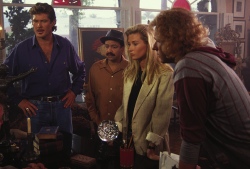 Then there’s Burt Aramis (Cheech Marin), the stereotypical Mexican thief who fences VCRs and jewelry, and ends conversations with the baffling “It’s been a slice!” When he steals the fabled titular item that’s passed down from generation to generation, he has no choice but to join them in their adventures, which include saving a kidnapped 9-year-old boy whose captors feed him dog food on white bread. Two other missions come their way, including one with Corbin Bernsen acting coked-out, which strengthen our “failed TV series” theory.