
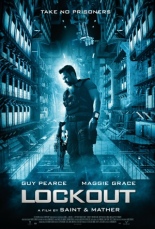
 The setup: The government blackmails a criminal into launching a rescue mission within a heavily fortified prison. The movie? The John Carpenter classic pulp thriller Escape from New York, obviously, implanting Kurt Russell’s borderline-insane Snake Plissken with a bomb so that he’ll willingly rescue the POTUS. But also Lockout, a PG-13 exercise in taking a great concept and smoothing down all rough edges during execution, leaving it a neutered shadow of the original.
The prison in Lockout is almost a masterpiece of ridiculousness: an orbit-bound space jail full of the most dangerous convicts in existence, so there must be no need for visitors to go through even the most rudimentary of weapons searches. Oh, and let’s not forget the remarkably easy access to the solitary button that releases every prisoner at once. So handy.
So when the convicts escape (as is their wont) — the president’s daughter conveniently onboard (Taken‘s Maggie Grace, given nothing to work with) — it’s up to bad dude Snow (Guy Pearce, Memento), wrongly accused of murder, to rescue her. Cue uninteresting fights, paper-thin antagonists, a few neat moments and a motorcycle chase with such inept special effects, it looks like leftovers from a PS2-era cutscene.
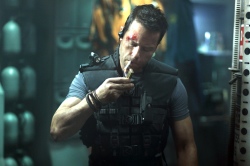 Pearce is a great, charismatic actor, and it is one of the movie’s few pleasures that we finally get to watch him cut loose. He takes to the role with abandon, milking every corny one-liner and proving himself fully capable of acting the hero. If there’s a reason to watch, it’s to see him eclipse everyone and everything else onscreen. You keep wondering what it would be like to watch him in a good film, or at least a competent one.
But Escape’s true genius, and the reason Lockout barely registers as entertainment, is its anti-hero. At no time do we really think Snow to be a “bad guy.” In the end, he’s a misunderstood, huggable hero; Han Solo instead of Snake Plissken. Plissken is a true sociopath, and what drives Carpenter’s film is his and Russell’s refusal to compromise on Snake’s inherent instability. Snake never would have coddled the president’s willful daughter into begrudgingly liking him; Snake wouldn’t have given two shits either way.
Snake made Escape gritty and disturbing, pushing it from a merely neat idea into something memorable. Snow is too much like the movie he’s trapped in: all flash. Now, seriously, someone put Pearce together with a franchise worthy of his talent. Let’s get this guy a Die Hard of his own. —Corey Redekop
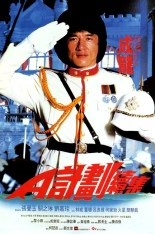
 Director Jackie Chan’s
 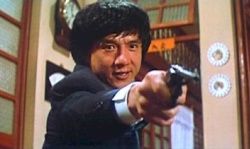 The first two-thirds of Project A 2 are heavy with dull dialogue, although it occasionally comes alive with an action scene, like when Chan and another man are handcuffed to one another and chased by half a dozen hatchet-wielding baddies. The final 20 minutes or so almost redeem the picture, with an extended set piece involving a giant hamster wheel, chili peppers and a toppling facade (a famous nod to Buster Keaton).
 I’m totally paraphrasing, but the worried and protective dad played by Sean Bean (TV’s
  However, this is all convoluted to a point of making the audience not care. If it makes total sense to you, I suspect you’re a serious student of the games, in which case will you please put down the controller and take a shower? Your mother’s asked you three times already!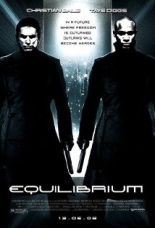
 But when Preston accidentally breaks his dose and can’t get another, he begins to question his ways, allegiance and life. Heck, he even begins to feel and sniff Emily Watson’s red ribbon when no one’s looking.
 Unfortunately, as written, the victims are all so clearly guilty of their “sins,” it’s hard not to assume the filmmakers are on the killer’s side, which is especially disturbing when you consider that the “pervert” The Redeemer punishes is simply a woman in a normal (albeit clandestine) lesbian relationship.