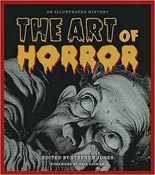
 Without question, the ideal gift book for genre film enthusiasts this holiday season is The Art of Horror: An Illustrated History, a beautiful book depicting ugly things. Edited by Stephen Jones, the full-color hardback from Applause Theatre & Cinema Books presents thousands of images from several centuries past to about a year or so ago, all neatly organized among 10 themed chapters (Halloween, aliens, ghosts, etc.) with accompanying text by an expert in that field. (For example, David J. Skal tackles vampires; S.T. Joshi handles H.P. Lovecraft.) It will surprise that no one that film posters and pulp magazines figure heavily in the mix of monsters and madmen, as do comics and original art, but Jones curates deeper to showcase 3-D sculptures, rare collectibles and even stained glass! Within the chapters, spreads are devoted to more specific studies, from spiders, Cthulhu and Jack the Ripper to Italian zombie movies, various book covers for Bram Stoker’s Dracula and the Halloween postcards of John O. Winsch circa 1910. Opulent in its scope and sporting a fright-friendly foreword by Neil Gaiman, The Art of Horror is that rare kind of coffee-table book: the kind its target readers actually want to read. You’ll get lost in it for hours, and love every minute, making it a more-than-worthy investment.
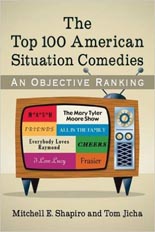 Like art, what is funny is all in the eye of the beholder. I get that. But with The Top 100 American Situation Comedies, Mitchell E. Shapiro and Tom Jicha set themselves up for a good ribbing, even by subtitling their book An Objective Ranking, because at the bottom of their list stands Family Matters. I mean, if only 101 sitcoms existed, I might see Urkel earning the grade, but as is, it makes the cut, while the likes of Parks and Recreation, It’s Garry Shandling’s Show and, heck, even The Brady Bunch do not. Arrested Development is on the list, yet considered inferior to Coach, Night Court and — gag — Full House. All over the Internet as blog posts, these kinds of lists — wholly subjective, yet presented as definitive — are silly, and even sillier expanded to nearly 300 pages. Devoting a full essay to each of their selections, however, Shapiro and Jicha prove themselves fine writers who make their arguments concisely and credibly — just not always convincingly. Prepare to be further enraged by the appendix, which presents rankings all the way to No. 377.
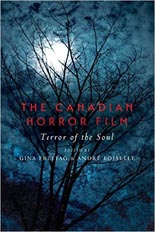 Books on American horror movies are dime-a-dozen. Not so with our friends to our north, so I welcome any book on Canada’s counterpart. Enter the University of Toronto Press’ The Canadian Horror Film: Terror of the Soul, edited by Gina Freitag and André Loiselle. As Andrea Subissati puts it in her piece on 2008’s Pontypool, “There are uniquely Canadian stories to tell, and … they are stories worth telling.” With 14 essays from almost as many authors, the collection touches on topics of gender, belonging, national anxiety and the environment, while also discussing and dissecting films both little-known (Death Weekend, Rituals) and higher-profile (Orca: The Killer Whale, Ginger Snaps). You may learn more about the Great White North’s tax-shelter system and the history of animation house Nelvana than you ever dreamt possible (if at all), but that’s the point in a text leaning heavily academic. While the book does a terrific job of proving that the country’s contributions to cinematic terror don’t begin and end with David Cronenberg, the pieces on his work from William Beard and James Burrell prove the strongest. —Rod Lott
Get them at Amazon.

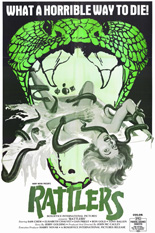
 You can’t argue with a good snake movie, especially one with the balls big enough to kill not one, but two innocent moppets before the opening credits are even set to roll. Producer Harry Novak’s slithering beast of an animal-attack movie, Rattlers, does just that.
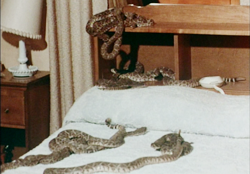 Although the sheer pleasure of seeing a parade of stupid people get bitten becomes muted by a talk-heavy Act 3 and an abbreviated, anticlimactic ending, these Rattlers aren’t for show — they kick ass. Nonetheless, Rattlers marked the first and next-to-last movie for director John McCauley, who followed this up with an even more dangerous project: the Danny Bonaduce vehicle The Deadly Intruder. —Rod Lott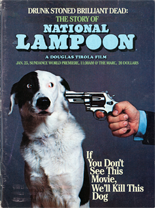
 When I spied a copy of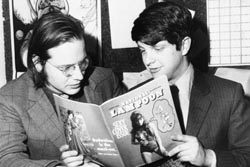
 Maybe the marketers behind
 Cop shows