 Shrewdly timed to the theatrical release of Batman v Superman: Dawn of Justice, Glen Weldon’s The Caped Crusade: Batman and the Rise of Nerd Culture takes longer to consume, yet provides far more entertainment. A companion of sorts to his 2013 tome on the Man of Steel, the book excels as a work of cultural history … provided you can overlook the whiplash appearances of the occasional stuffy phrase (“slyphs in organza gowns”) and dropping of hipster lingo (“mansplaining”).
The book traces the Dark Knight’s “life,” from his 1939 “birth” in Detective Comics #27 to anchoring several DC Comics titles today. With the exacting fervor of someone who may consider The Overstreet Comic Book Price Guide as “light reading,” Weldon details Batman’s many, many changes with the times and trends along the way — not just as a four-color character, but one who has leapt beyond the page to infiltrate the media of radio, television and, of course, the movies.
In comparing the Batman co-created by Bill Finger and liar/thief Bob Kane to the Batman of the 1966 camp television series to the Batman of Frank Miller’s 1986 revisionist graphic novel to the Batman of Christopher Nolan’s brooding film trilogy — to say nothing of all the Batmans in between, including Joel Schumacher’s much-reviled “urban-landscape-as-roller-disco” Batman — The Caped Crusade wildly succeeds. You’ll learn, for example, of an era in which your justice-seeker absolutely used guns and killed people, even on purpose.
Less successfully, Weldon attempts to couch this history of Gotham City’s No. 1 crime fighter as being congruent with the ascent of “nerd culture” from something the mainstream derides to something it now embraces. It’s a theory I’m not 100% subscribed to, and his endless, binary talk of “normals” and “nerds” sends my buy-in down a few notches with each chapter. Still, it makes for interesting reading nonetheless, which is exactly what you hope and expect from such a book, and he is not so beholden to his love of/for comics as to deny that their storylines have grown ridiculously dense.
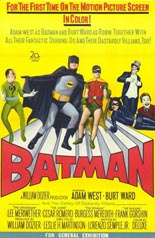 By and large, Weldon is a fun writer to read, especially when he lets his considerable wit off the chain, whether referring to Boy Wonder sidekick Robin as “achingly kidnappable” or describing Adam West’s line delivery on the aforementioned 1960s TV program — and subsequent cash-in film — as being riddled with “pauses that are not merely pregnant but two weeks overdue.” (Even the footnotes are playful.) The sheer amount of times the author refers to something as “kinda gay” would be troubling if Weldon weren’t gay himself; however, this fact will go unnoticed unless one pays attention to the acknowledgments at the book’s end or has heard him mention his husband on NPR’s Pop Culture Happy Hour podcast.
Which brings us to the book’s elephant-in-the-room caveat: If you have been or currently are a listener of that podcast, for which Weldon appears almost weekly as one of its primary hosts, it is impossible to read The Caped Crusade without hearing his voice in your head. Personally, that’s a negative, as his speaking method strikes me as so overly scripted and prepared to a fault, he often comes off as that smug know-it-all who, enabled by the rush of liquor to his bloodstream, corners people at parties and proceeds to cheerlead his own pomposity via $10 words. It’s not endearing.
And yet, like mines on a battlefield, you never know when his prose will unleash a vocabulary bomb that speaks above his target audience: agar, prolix, Derridean, caesurae, augured, febrile, noisome, tincture, bathetic, mesomorphic, abstruse, eschatological, elide, caromed, biliousness. Worse, several others appear multiple times: fealty, bolus, anodyne, gouaches, Sisyphean, lingua franca, mien, evince, gewgaws. Geegaws! That’s a word so goofy and cringe-inducing, it should only be uttered by preschoolers attempting to get the attention of their grandmother.
I mean, once you’ve read the cowled subject described as “po-faced,” “laconic” and “badass” for the third or fourth time, you understandably ache for a little variety. After all, there is nothing wrong with “disapproving,” “terse” or “intimidating,” is there? Holy Roget, Batman! —Rod Lott
Get it at Amazon.

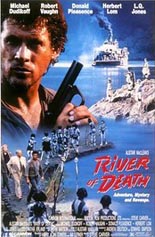
 Narration in the 1965-set River of Death suggests that director Steve Carver (Big Bad Mama) may have viewed this adaptation of the 1981 Alistair MacLean novel as his own Apocalypse Now. Of course, Michael Dudikoff is no Martin Sheen; the American Ninja star has trouble delivering the VO convincingly, stumbling and rolling over the words awkwardly, the way some people tussle with strands of pizza cheese that just won’t break. The more he tries, the goofier he comes off.
 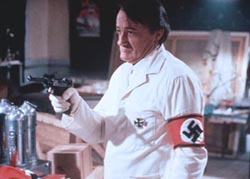 How Hamilton knows the location — or even the general whereabouts — of this supposed “lost” city is not worth wondering about. For starters, the doc is killed almost immediately after being introduced. Eventually, the real story reveals itself, in the form of Third Reich member Dr. Wolfgang Manteuffel (Robert Vaughn, Superman III), who conducts the kind of Nazi experiments adorning many a pulp-mag cover as if Hitler never died, and his in-cahoots benefactor, Heinrich Spaatz (Donald Pleasence, Prince of Darkness). Somewhere in between this sequence of events? Midget boxing.
 In
In 
 No offense is meant to Leslie Bibb, a genial actress with bona fide comedic flair (from