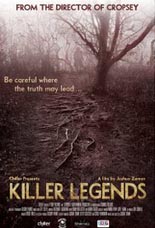

Killer Legends (2014)

killerlegendsAfter the acclaimed 2009 documentary Cropsey, what does filmmaker Joshua Zeman do for a follow-up? More of the same, with emphasis on “more.” See, rather than spend an hour and a half investigating the truth behind another urban legend, Killer Legends sees Zeman investigating four of them. The film’s style continues in that Cropsey vein, meaning I was glad I wasn’t watching this at night or alone.

Again acting as narrator and on-camera interviewer, writer/director Zeman gains a co-conspirator in researcher Rachel Mills. Together, they form a true-life Mulder and Scully, as they travel across the United States to dig into each case, in hopes of separating the myth from the mystery. Only the occasional and obviously staged bit of setup or transition strikes a false note; it’s no coincidence that both times they venture into pitch-black wooded areas, Mills manages to frighten herself.

killerlegends1As for their subjects, the Killer quartet entails the Texarkana Phantom, as depicted in 1976’s The Town That Dreaded Sundown; tampered Halloween candy; killer clowns; and the terrorized babysitter, popularized by 1979’s When a Stranger Calls. Clips of these films, their remakes and related movies — from Campfire Tales to The House of the Devil — give the doc added production value, but Legends manages to elicit enough chills on its own. —Rod Lott

Get it at Amazon.

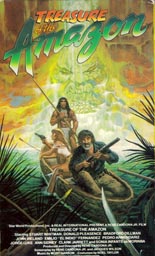
Treasure of the Amazon (1985)

treasureamazonAs an opening title card informs us, René Cardona Jr.’s Treasure of the Amazon takes place in 1958 South America … yet the follow-up card states that the site of the story we are about to see is a “fictitious place.”
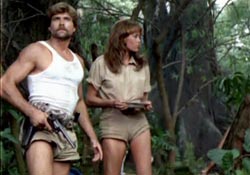
Okay, sooooo not in South America? Not along the Amazon? To what water-based landmark does this supposed Treasure belong? Help me out here, René!

Ultimately, it doesn’t matter. Cardona and co-writer Jacques Wilson soon distract you from those nagging questions by piling on undeveloped characters and storylines they won’t fully see through. Treasure of the Amazon is one of many old-school, serial-inspired adventure films that arose in Raiders of the Lost Ark’s whip crack of a wake. You want lucidity and motivation? Stick to Spielberg. You want the introduction to our hero be him purposely slicing off another character’s finger for reasons never fully explained? Cardona’s your hombre.

treasureamazon1That “hero” is Gringo, played by Stuart Whitman, whose barking delivery is set at maximum-Nolte and whose Invaders of the Lost Gold from 1982 also falls into the Indy-wannabe sweepstakes. Grizzled, bloated and forever sweaty, Gringo is making his second sojourn into the jungle to hunt for diamonds, after the first try some years before resulted in all his pals ending up as shrunken heads. Also looking for these gems is … well, everyone, but among the notable are a tight-shorted adventurer named Dick, who looks like George Michael on safari (Clark Jarrett, Hot Moves); a Nazi anxious for a Third Reich revival (Donald Pleasence, who would play a Hitler acolyte again in 1989’s River of Death); and two beautiful women, one of whom goes the whole movie without a top (Sonia Infante, Cardona’s Beaks: The Movie) and the other of whom goes without nostrils (Ann Sidney, Performance).

Treasure is so underwritten, it somehow appears complex — meaning, if you whiteboarded all the disparate narrative threads that pop up, you’d end up with a bunch of straight lines running parallel, from left to right. This is the kind of action flick that’s all about the points along those lines — the points at which alligators eat the expendable slaves, at which white people are felled by poisoned blow darts, at which a man is ripped apart by crabs (the film’s highlight, as if guest-directed by Lucio Fulci). It’s a fungal jungle of spiders and snakes and natives who look like they just came from a paint party. —Rod Lott

Get it at Amazon.

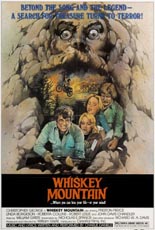
Whiskey Mountain (1977)

whiskeymountainAfter hitting his marketable peak with the 1976 Jaws imitation Mako: The Jaws of Death, Florida-based filmmaker William Grefé (Death Curse of Tartu) latched onto Deliverance’s hillbilly-hell vibe for Whiskey Mountain, his final feature. Although its depictions of the class battle between the rural and the (sub)urban may not make you squeal like a pig, the cut-rate thriller works all the same.
Diana (Roberta Collins, Caged Heat) and Bill (Christopher George, Pieces) are on the hunt for some 200 Confederate muskets her granddaddy supposedly buried up yonder in the North Carolina wilderness, durn near ’round Whiskey Mountain; before he died, he left a map to lead her to that fortune.

whiskeymountain1Bringing along camping equipment, motorcycles and their couple friends (Preston Pierce and Linda Borgeson of, respectively, Angels’ Wild Women and no other movie ever), Diana and Bill attract the ire of the local yokels just by being in their town. Challenged mentally and dentally, the rednecks harass the quartet to no end, setting fire to their camp as they sleep, attempting drowning in a raging river and, heck, even stealing a pair of women’s panties!

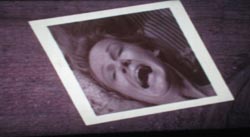
Swapping dueling banjos for an original Charlie Daniels tune, Whiskey Mountain stands mighty tall by the standards of the hicksploitation subgenre and regional indies overall. In a rather good way, Grefé catches us off-guard when the danger dial gets rudely cranked in the second half; see, he doesn’t have to do much to make his antagonists seem threatening, because general skeeviness tends to achieve that just fine by itself. And yet, he throws us for an arty loop with a double-rape scene that’s doubly disturbing because technically, we only hear it. All we are shown is a stationary series of Polaroids developing before our eyes; our mind fills in the rest. The effect is unsettling and raises the movie above the usual drive-in fodder, as does its purposely bitter final shot. —Rod Lott

Get it at Ballyhoo Motion Pictures.

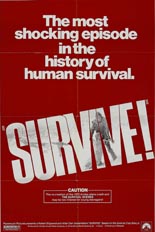
Survive! (1976)

surviveIn 1972, a charter jet carrying a rugby team from Uruguay to Chile crashed in the snowy Andes mountain range. In 1972, a Uruguayan ruby team chartered a plane to take its players to Chile, only to crash-land in the Andes Mountains.

I share this information with you twice because right off the bat, Survive! — exclamation point theirs — does the same; as the camera pans over the faces of 40-some-odd passengers (to whom you should not get attached), the narrator relays information already delivered by an introductory title card mere moments before. This is just one way the film from Mexico’s Rene Cardona Sr. (Night of the Bloody Apes) presents itself as a sloppy, slapdash production — at least in the U.S. version, oddly shepherded by the flamboyant Allan Carr of Grease fame and Can’t Stop the Music infamy.

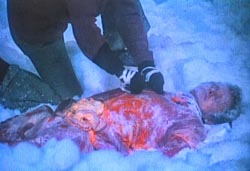
survive1Cognizant of the disaster-film craze of the era (which Cardona’s son took full advantage of in his own work), Survive! wastes little time getting to the goods: the wreck of the plane, thanks to a navigation miscalculation. On a Cardona budget, the tragedy is illustrated with what looks like a toy model drifting into a mound of laundry detergent in powder form. Unspectacular the accident may be cinematically, the aftermath carries no such limitations, as witnessed by a survivor’s attempt to the stuff a goopy loop of intestines back in a fellow passenger’s gut.

As rapidly as Cardona gets to that aviation blooper, he holds back on the scenes on which the film was sold to theatergoers: those involving cannibalism. Amid freezing temps, their hope for rescue runs out as speedily as their rations pilfered from all the up-for-grabs luggage scattered about: wine, chocolate bars, fish tins, cheese and marmalade. The survivors eventually face the coldest and hardest of cold, hard facts: Eat human flesh or die. As history tells us, we know which option they select: They pick their unappetizers straight from the Donner Party menu.

Considering the name-brand source, I wish Survive! were more exploitative than it is. The picture possesses Señor Cardona’s regular hallmarks, from an unflinching eye for gore to his usual leading man in Nightmare City’s Hugo Stiglitz, yet after the initial plane-meets-mountain depiction, those elements disassemble and never quite come together again. Their failure to do so rests upon a glacial pace, as if we, the viewers, were having to trudge alongside the characters to get to the next shocking moment. In 1993, Arachnophobia director Frank Marshall told the same true-life tale with a bigger budget, with the punctuation-free Alive. —Rod Lott

Get it at Amazon.

Random Genre & Cult Movie Reviews