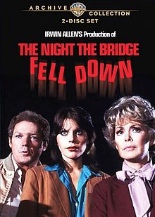
 Shot four years before it actually aired, The Night the Bridge Fell Down is easily the least entertaining of producer Irwin Allen’s disaster pics made expressly for the tube. That said, I believe it is the only film — theatrical or televised — in his illustrious career in which a character is shown picking a booger from her nose and then rolling it between her fingers as if in consideration, before discarding it. This act is hardly the work of some corner-of-the-screen extra caught by the camera, but takes place in the foreground. Great decision, director Georg Fenady!
That’s about the only thing the movie has going for itself, although the requisite introduction of many soon-to-be-imperilled characters promises at least mild decency. There’s clean-scrubbed newlywed Johnny (Dezi Arnaz Jr., House of the Long Shadows), who robs a bank while his clueless wife (Char Fontane, 1989’s The Punisher) sits in the car, leafing through travel brochures. There’s Paul (City on Fire’s Leslie Nielsen, whose name is unceremoniously misspelled in the opening credits), a corrupt businessman juggling a feverish infant, a mistress (Barbara Rush, Can’t Stop the Music) and Xeroxed stolen bonds. There’s Terry (Eve Plumb, aka Jan of TV’s The Brady Bunch), a hair-impaired young woman who gets thee to a nunnery and, while home-delivering a freshly adopted orphan girl, cannot choose between love of the cloth or love for a cop (Richard Gilliland, Star Kid). There’s a Mexican landscaper (Gregory Sierra, Allen’s The Towering Inferno) who fulfills the telepic’s slot of “token minority.”
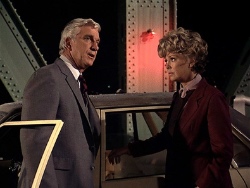 And then there’s city engineer Cal Miller (James MacArthur, Hang ’Em High), who declares something wrong with the Madison Bridge’s expansion joints after a third fatal accident occurs on its asphalt. Post-inspection, his dire, or-else warnings that the bridge needs to be shut down immediately fall on the deaf ears of a government bureaucrat (Boogie Nights’ Philip Baker Hall) whose secretary provides the aforementioned scene of nostril-spelunking. (A note, while we’re on the topic: Fenady also directed Allen’s Cave-In!)
Indeed, as the title makes clear, something does go wrong, 45 minutes in: Tremors in the earth chop the bridge off at both ends, stranding the above characters in a life-threatening situation that Johnny only worsens with his hothead and handgun, while Cal attempts rescue efforts from ground level. Every now and then, more pieces tumble to the water below, depicted via obvious miniatures. This Night’s biggest problem isn’t unconvincing effects, but sheer length, clocking in at a little over three hours. While Fenady and Allen managed to make Hanging by a Thread work just fine within that bloated sum, the idea-bereft Bridge shows wear. The last half could be titled The Night Viewers Learned Real-Time Lessons in Girder Climbing and Knot Tying, while the wire-strung climax comes straight from The Towering Inferno. On this smaller scale, the stakes simply aren’t high enough to justify it. —Rod Lott
Get it at Amazon.


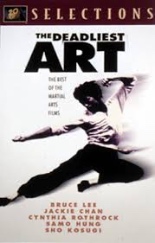 Things I thought about while watching the John Saxon-narrated kung-fu clip show, The Deadliest Art: The Best of the Martial Arts Films:
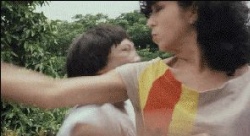 • Cynthia Rothrock may kick ass, but she looks like the cashier at an Interstate 35 truck stop.


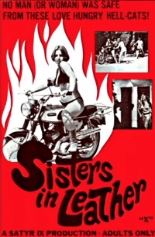
 Zoltan G. Spencer was nothing if not efficient. His softcore