
The Peanut Butter Solution (1985)

I vaguely remember, as a child, watching a creepy French movie about a child who undergoes immediate baldness and somehow ends up in a slavery ring. In the pre-internet age, however, I was not able to find it and eventually chocked it up to being some sort of a spooky fever dream.

So imagine my surprise when, right there in my mailbox, the French-Canadian film The Peanut Butter Solution shows up, bringing back all of those disturbing memories and, upon actually viewing it, giving me even stranger new ones.

Living in a bizarre, French-influenced town with a depressed-artist father and an Electra-complexed sister, young Billy (Michael Hogan) wakes up one morning to find his hair has completely fallen out. After numerous taunts and barbs from his soccer teammates on the field, as he sleeps, an immolated homeless couple shows up and gives him a nasty recipe for a hair tonic.

As Billy mixes and drinks the titular solution, he begins to grow long luxurious locks. His Asian friend, Connie (Siluck Saysanasy), also uses the formula, but on his pubic area, which is slightly uncomfortable.

The fact, however, that it causes his hair to grow to ridiculous lengths isn’t the weird part; it’s that his art teacher is actually a psychotic brushmaker who has kidnapped most of the neighborhood kids and put them to work in an underground sweatshop manufacturing said brushes.

As I viewed the Solution, I could feel that sense of nocturnal uneasiness come back and disturb me — perhaps even worse this time, as it’s now viewed with adult eyes — but maybe it’s that slight terror that makes some of the best kiddie fare to revisit, especially as a young Celine Dion belts out tunes about the power of being young over the end credits. —Louis Fowler


Get it at Amazon.

The Lodge (2019)

One otherwise sunny afternoon, Richard (Ocean’s Eight’s Richard Armitage) deserves a World’s Worst Estranged Husband award for telling his wife he wants to finalize their divorce and marry his new girlfriend — a one-two punch of info that drives the spouse to suicide. Six months later, over Christmas vacation, he earns a World’s Worst Dad trophy to add to that hypothetical mantle by forcing his two kids to spend time in their snow-covered mountain cabin with said girlfriend, Grace (Riley Keough, Logan Lucky), and then leaving them with her for a few days.

Not only is Grace a stranger, but they blame her for their mom’s death. Furthermore, they know she’s literally a psychopath, being the daughter of a Christian cult leader (played by her real-life dad, Danny) whose members killed themselves in a mass suicide à la Heaven’s Gate. Only Grace, befitting of her name, survived, yet bears heavy emotional scars, all of which Keough rightly and consistently plays in the key of dour.

What begins to happen in The Lodge once Richard temporarily vacates is best left to audiences to discover on their own. More eerie than scary, the picture marks just the second narrative feature for the Austrian duo of Veronika Franz and Severin Fiala, following up the acclaimed twin terrors of Goodnight Mommy. This one is even better; call it Goodnight Stepmommy-to-Be. Just when you think Franz and Fiala are pulling pages from their 2014 film for recycling, the course of events changes wildly, and viewers might not be willing to follow if the actors weren’t so good.

Keough is, in particular, excellent, but let’s not diminish the two other equally tricky roles of Richard’s children, played by Jaeden Martell (Knives Out) and Lia McHugh (Along Came the Devil). They interact like real siblings, with McHugh believably conveying grief for which Martell, in turn, provides the big-brother support she needs. And far from Clueless, Alicia Silverstone is terrific in a brief appearance that neither requires nor allows her to lean on her trademark charm.

As was the case with Goodnight Mommy, one important character goes unbilled: architecture. Franz and Fiala build so many shots starting from that foundation, giving The Lodge a touch of delicate elegance even in its darkest corners. Their compositions are crisp and symmetrical, much like the microscopic snowflake of this arthouse horror’s poster. —Rod Lott

Get it at Amazon.

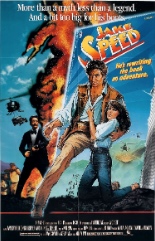
Jake Speed (1986)

Remo Williams and Mack Bolan are the two biggest names in men’s paperback fiction and have been for decades. We’re politely asked, however, to add another adventurer to this roster: Jake Speed.

Sure, I guess.

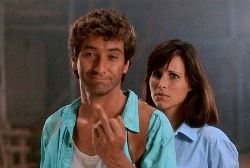
When her sister is kidnapped by some dirty white slavers, Margaret (Karen Kopkins), on the advice of her senile grandfather, seeks out the help of pulp hero Speed (Wayne Crawford, God’s Bloody Acre). With the help of his typist, Desmond (Dennis Christopher), they head to a stereotypical African country beseeched by civil war and, even worse, unclean showers.

After stopping for a drink in a bar where an African band plays a delicious cover of Michael Sembello’s “Maniac,” they find her sister in a fortified jungle villa, kept prisoner by the vicious Sid (John Hurt); it’s at this point when the film truly becomes pulp fiction instead of pop parody, with Hurt squeezing every bit of scum out of his detestable villain.

I remember when this flick came out in the summer of ’86. I confused the hero for many months with the also-recently released Big Trouble in Little China’s Jack Burton, both with similar ad campaigns in the Dallas papers that focused on the macho swagger of these characters. And while Burton has the advantage of being portrayed by Kurt Russell, Wayne Crawford as Speed ain’t no slouch, either.

Still, Jake Speed, though not entirely great, much like a $2.99 drugstore paperback, does its job and does it admirably, providing the world with one of its last true heroes of dime-store fiction and all the derring-do that entails. But forget the movies—I’m just more surprised that it didn’t inspire a series of cheap novels on the spinning rack. —Louis Fowler

Get it at Amazon.

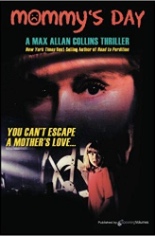
Mommy’s Day (1997)

As the direct sequel to his 1995 Mommy movie, Max Allan Collins’ Mommy’s Day is the superior effort on every level. This achievement is reached despite its love-to-hate lead meta-quipping, “Don’t you know the sequel is never as good as the original?” Then again, this is uttered one moment before pushing a character’s head through a plugged-in computer monitor, so perhaps she didn’t mean it.

Yes, Patty McCormack is back and The Bad Seedier than ever as murderous matriarch Mrs. Sterling — still preppy, still malicious and still xenophobic! She’s an hour away from getting the needle in death row when she’s selected to be a guinea pig for a “revolutionary antipsychotic drug” implanted within the arm, making her — in her own words — “new and improved, like a laundry detergent.” Although sprung from the pokey and into an experimental halfway house, Mommy is banned from seeing her beloved teen daughter, Jessica Ann (Rachel Lemieux, who only acted again in Collins’ next and best film, Real Time: Siege at Lucas Street Market), now in braces and deep in training for an ice-skating competition.

Oh, and homicides soon happen.

Pulp-fic legend Mickey Spillane and scream queen Brinke Stevens reprise their supporting roles, alongside comedy improv legend Del Close and WKRP in Cincinnati program director Gary Sandy, respectively joining this second go-round as the warden and a nose-pokin’ police sergeant. Jessica Ann cedes the spotlight as Collins makes Mommy the focus. Perhaps with her coronation to front and center, McCormack dials the hysteria up one notch, and is more fun to watch as a result.

Apparently, her spirit was infectious; Collins seems more engaged with the material this time around. In particular, he adds a subplot as Mrs. Sterling appears on a daytime talk show, allowing him to satirize (if only mildly) the “trash TV” format popular at the time, à la Ricki Lake, Jenny Jones, Jerry Springer, Maury Povich and their collective ambush techniques. Shot on higher-definition video, Mommy’s Day boasts a sharper picture throughout and a well-earned twist in the third act. With a meatier mélange of kill scenes than its predecessor, Mommy’s Day is often mischaracterized as a slasher film, but it remains a thrifty thriller — albeit one with a shower-set murder via ghetto blaster — from the good ol’ days when America made it a Blockbuster night. —Rod Lott

Get it at Amazon.

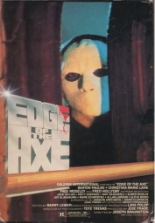
Edge of the Axe (1988)

In an alternate Earth populated by absolute jerks with loutish personalities, a white-masked killer is — and rightfully so — chopping the populace of Paddock County all to gory pieces, using the edge of his ax, of course.

After brutally attacking a woman in the middle of a car wash, two total dicks — computer fuck Gerald and womanizing exterminator Richard — find themselves in the middle of a murder spree of assholes being stalked and slaughtered. Of course, the prick sheriff — convinced these are all suicides — won’t do anything about it as the body count rises.

Meanwhile, Gerald meets a loathsome woman who asks his computer if he’s “gay.”

An unseen sex worker who has apparently pleasured the entire town is killed, a priggish nurse’s head is irrevocably severed and, even worse, the bucolic lady who plays the organ at church finds her dog butchered all to hell. More pre-1990 computer-based intrigue is had, with dot-matrix red herrings printed all along the way. Just give it a few minutes.

When the killer is quickly unmasked with a contemptible list of unseen clues that weren’t discovered until the last 10 minutes, director José Ramón Larraz (The House That Vanished) gives us the ol’ Spanish switcheroo, with the obvious hopes of Edge of the Axe 2: The Wooden Handle of Death to be immediately financed and put into production. It wasn’t.

A gratuitously bloody example of the depths that a somewhat respected horror director of the ’70s would sink to in the ’80s, the only way that I would run out to see Edge of the Axe is if a faceless killer is trying to chop me up, and even then I’d probably just briskly walk to my computer and Google their identity, because apparently it’s just that easy. —Louis Fowler

Get it at Amazon.

Random Genre & Cult Movie Reviews