
House of Mystery (1961)

Sitcom legend John Ritter and erotic thriller queen Monique Parent are forever paired in trivia history for playing realtors who share horror stories of previous homeowners to their prospective buyers. Their respective anthologies are 2000’s Terror Tract and 2012’s The Perfect House, both owing a ton of debt (refi now to lock in 5.56% interest!) to 1961’s House of Mystery.

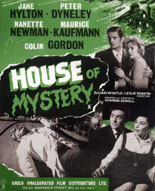
A young couple (Circus of Horrors’ Colette Wilde and Rough Cut’s Ronald Hines) tour a cottage so lovely, they’re perplexed why its market listing is so low. “I suppose it could be,” answers their host (Jane Hylton, The Manster), “because of the ghost.”

Ah, yes, the ghost. She tells them of the newlywed electrical engineer (Peter Dyneley, TV’s Thunderbirds) who lived there, briefly, before being fatally electrocuted under mysterious circumstances.
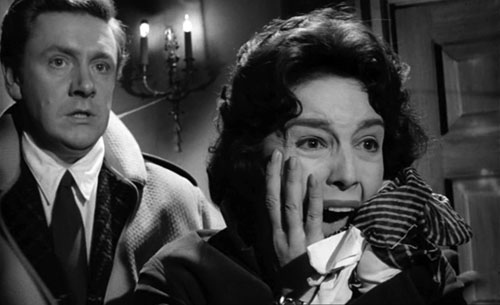
She also tells them of the next owners, the Trevors. Shortly after move-in, Joan Trevor (Nanette Newman, 1975’s The Stepford Wives) experiences strange things, like a lamp flickering and, well, a lamp going out. During these instances of alternating-current chicanery, she sees an apparition, so her husband, Henry (Maurice Kaufmann, Gorgo), hires a psychic investigator (Colin Gordon, 1967’s Casino Royale). When Joan dares to pose a question, Henry scolds, “Do shut up, darling.”

One séance later, thanks to an Edith Bunker-looking medium (Molly Urquhart, The Black Windmill), the Trevors have their answer. So do we, with the three time periods threaded together. Now, the twist ending, I anticipated from the first scene, but that’s not a disappointment because the reveal entails a nifty effect for its time.

From Strongroom helmer Vernon Sewell, House of Mystery is worth a 56-minute tour. It’s an unassuming and unfussy UK shocker, albeit set on the jolt level of a novelty joy buzzer. —Rod Lott


Tuner (2025)

Nothing against crime films in which the bad guys share names with subs and pizzas — your Fat Tonys, your Big Frankies — but it’s nice to see one that uses a simple Benny. That makes the movie feel more realistic. Not that I know anyone with an allergy to loud sounds as Leo Woodall’s protagonist suffers throughout Tuner, but hey, take your cinematic victories where you find them.

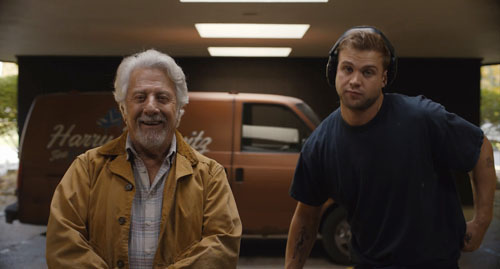
Woodall’s Niki is a piano tuner whose sensitivity issue requires him to wear noise-killing headphones. What the world sees as his disability actually provides him with a superpower: perfect pitch. It may also be his Kryptonite, once he accidentally finds his gift extends from Steinways to safecracking. Soon, a security company owner (Lior Raz, Glaidator II) for the toniest of clients hires Niki for freelance gigs that aren’t exactly — how to put this? — legal.

That’s great for Niki’s cash flow, but potential dynamite to his burgeoning relationship with a composition major (Havana Rose Liu, Lurker) he meets at one of his appointments — the on-the-up-and-up kind. In his fictional feature debut, Academy Award-winning documentarian Daniel Roher (Navalny) had me so invested in their fireworks, I was legitmately thrown for a second when the criminal element kicked back in.

If Tuner weren’t fantastic, the headline would be Dustin Hoffman’s return to the big screen in a high-quality project, here as Niki’s mentor and father figure. Instead, the news is three performers turning in breakout work that knocks Hoffman off said screen. Woodall (HBO’s The White Lotus) brings a sad, quiet intensity, while Liu brings feistiness and distrust to what could been a thankless window-dressing part, giving her character dimension and spark. And Raz is believably chummy one moment, terrifying the next, and back again.

If forced to pick a fourth standout, it’d be one unseen: sound. It — and often the lack thereof — is not merely integral to the story, but immersively so. The auditory experience is reminiscent of 2019’s Sound of Metal, but with a rap sheet. Sharp, tense and unexpectedly moving, Tuner is a thriller in the key of excellence. —Rod Lott

In theaters May 29.

The Yeti (2026)

Every time I come across “yeti,” I immediately think of my introduction to the word: The creature sitting its hairy ass on sno cone after sno cone lining a sidewalk — a trap set by your friendly neighborhood Spider-Man on an episode of the PBS kid series The Electric Company. Although elementary in craft, that cheap, six-minute segment carries more of a kick than the 1940s-set feature film The Yeti.

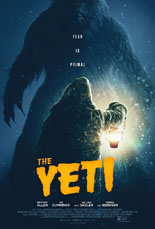
An oil magnate (Corbin Bernsen, Major League) and a group of explorers-for-hire go missing in Alaskan Territory after issuing a distress signal. The energy company assembles a veritable super septet to attempt rescue, including a radio specialist (Jim Cummings, The Last Stop in Yuma County), a demolitions expert (Gene Gallerano, Occupy, Texas) and a navigator (Brittany Allen, Jigsaw) whose father (William Sadler, Hard to Kill) is among the disappeared. 

Co-writers/co-directors Gallerano and William Pisciotta initially employ a spirited, semi-campy style that sets up The Yeti as a towering bundle of fun. Instead, it quickly stumbles into a lumbering slog of speeches. If your characters must hunker down in a cabin for a stretch, either stuff their mouths with cracklin’ dialogue (The Hateful Eight) or put a soul-swallowing demon in the fruit cellar (Evil Dead II)

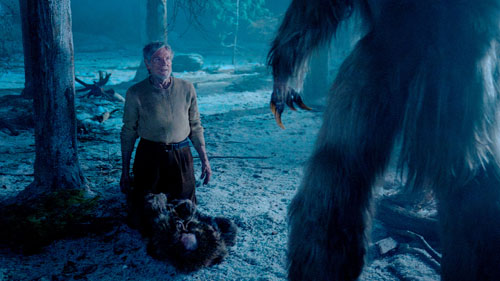
Our titular cryptid attacks here and there and not often enough. When we finally get a good glimpse of it in its shaggy, matted-hair splendor, you may be reminded of Shriek of the Mutilated meets the beast within Creepshow’s “The Crate” segment. The monster’s murders make for the best parts — sometimes literally, like when Allen’s character attempts to save another from a yeti-yanking, only to be left with the poor sap’s large intestines sliding through her grip like a greased rope. Kudos to the filmmakers for going the practical route rather than taking CGI’s easy out.

The Yeti has the post-WWII pulp aesthetic down pat. (It’s so old-school, “Farmer in the Dell” adorns the soundtrack.) However, visual appeal only gets you so far. Watching is like going on a first (and last) date with someone who looks dynamite, but before the salads have arrived, you’ve discovered little going on between the ears. —Rod Lott

Get it at Amazon.

Gridlock (1996)

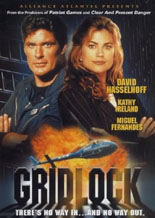
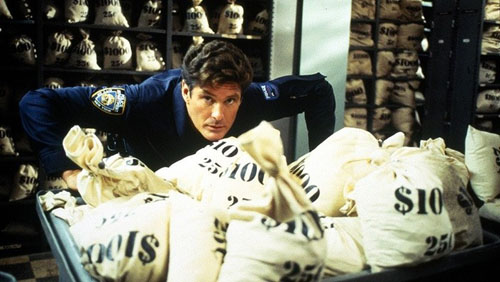
In the opening moments of Gridlock, NYPD super cop Jake Gorsky (David Hasselhoff) foils a hostage situation with little more than a rolled quarter, a janitor’s push broom and a direct threat to a man’s testes. Trouble is, Gorsky’s part of the force’s helicopter unit, so he disobeyed a direct order to let the negotiator do his negotiating. To justify himself, Gorsky argues to his chopper partner that the guy “couldn’t negotiate a hot meal into a starving man!”

What does this have to do with the rest of the made-for-TV movie? Nothing — except to set up that Hasselhoff is basically John McClane (but, of course, isn’t). Gridlock is little more than a third-rate Die Hard clone, with Gorsky cracking wise in the face of danger and woman troubles. Hell, he even goes over the side of a tall building with a firehose tied to his waist.

That building is the Federal Reserve of New York, where his had-it-up-to-here girlfriend (squeaky-voiced supermodel Kathy Ireland) works as a tour guide. Naturally, its gold vault is the target of a team of Euroterrorists in suits and number-based aliases, led by Mr. One (Miguel Fernandes, Ghost Story). From his whirlybird perch in the sky, Gorsky susses out their plan when the bad guys blow up area bridges as distraction. He leaps into action — or as much as an NBC budget will allow — to save his lady and thwart a precious-metals heist.

Much of Gridlock finds Sandor Stern (Amityville: The Evil Escapes) directing Hasselhoff and/or Ireland to walk and/or run down this hallway or that hallway, all while random terrorists shout things like “He’s heading for the coin room!” over walkie-talkies. It’s not as much fun as Terror at London Bridge, arguably the crowning glory of the Hoff’s TV features. But you know what it is more fun than? A Good Day to Die Hard. —Rod Lott

Blast-Off Girls (1967)

WTF

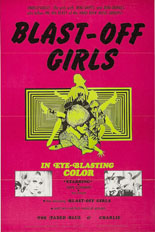
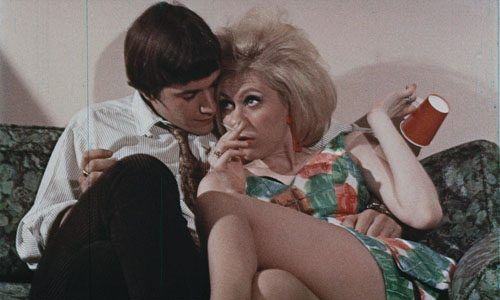
In Chicago’s garage-rock scene — or at least the one depicted in Herschell Gordon Lewis’ Blast-Off Girls — Boojie Baker (Dan Conway) wants to rule the roost as the local music promoter du jour. Imagine Scooter Braun, but carrying a cane for show — one that looks two brim taps shy from producing a rabbit.

Boojie’s latest target for his 50/50 contract scheme is a mop-topped quintet he restyles and rebrands as The Big Blast. He succeeds at getting them noticed, written about, photographed, booked, played, recorded and hitting! That’s because Boojie is a master manipulator as a manager, wheelin’ and dealin’ via cooze-slingin’. Every decent-looking woman in the Windy City is willing to move up and down on whomever can help The Big Blast move up the charts.

It works so well, Boojie lights his cigars with cash … but only a dollar bill — and just the corner, if you please, so the thrifty Lewis could still use it as legal tender, of course. The Big Blast soon threatens to implode when they don’t see any of that money. Such one-sided success forms the template of many a rock ’n’ roll movie so in vogue at the time, but only Lewis, free of studio interference, could get away with a bongo pot party.

Certainly no filmmaker other than Lewis would stop his music pic cold for what amounts to a Kentucky Fried Chicken commercial with Col. Harland Sanders himself supplying buckets to the band in exchange for an impromptu gig outside the restaurant. Original-recipe or extra-crispy, it’s my favorite instance of product placement in movie history. It would be even if it didn’t end with Sanders winking at the camera. Fourth wall, you’ve just been eye-fucked-through by the Colonel.

The biggest shock of Blast-Off Girls isn’t that Lewis titled the film after minor characters (if characters at all), but that the music is legitmately good. Having amped-up tunes supplying energy takes the onus off Lewis to be concerned with camera placement. For what it’s worth, he saves the group members’ Richard Lester-esque montage of mischief for the closing credits.

Worrying over an absence of gore in a Lewis picture turned out to be moot. This movie frugs! As Boojie says about 12 or 13 times, “Have a blast!” —Rod Lott

Get it at Amazon.

Random Genre & Cult Movie Reviews