
The Pit: Emergency Room (1995)

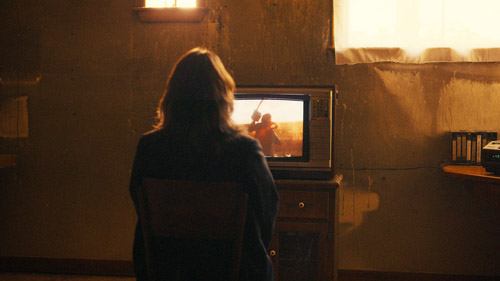
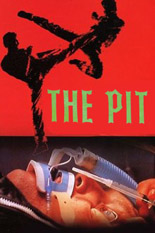
Doctors shouting orders. Patients tired of waiting. Hospital administration being total assholes. Gratuitous intubation. Gotta be HBO’s ER-esque hit, The Pitt, right? Yes! But it’s also The Pit: Emergency Room, highly obscure DOA drivel in no danger of gracing HBO or hitting anything but an aversion to watch.

In this vanity project, writer/director/producer Jon W. Fong casts — who else? — himself as Dr. Paul Qi, “PQ” for short. Our supposed medical superstar of Ocean Coast Hospital somehow is able to check out a woman’s stubbed toe without removing her shoe. In surgery, his main concern isn’t the patient’s life, but the rib spreader tool: “Who last oiled this thing?”

His enemy is Ocean Coast’s underhanded, overweight administrator, Kramer (Lee West, 1995’s Powderburn), who looks like Kevin from
The Office
. Kramer’s scheming to sell the med center for personal gain. (The place may be in serious financial trouble, judging from the break room’s dot-matrix printed signs and banners.) Kramer’s plan entails drugging PQ’s mentor (David Jean Thomas, The Crow: Salvation) into a coma, thereby quashing a dissenting vote at the upcoming board meeting. One problem: PQ holds his mentor’s proxy power, so now he, too, is marked for death.

Prescription: kicking. PQ thwarts attempt after attempt on his life through kung fu. The Pit holds one thing for sure over The Pitt: Unlike Fong, Noah Wyle never disguised himself as a custodian to infiltrate security and whoop bad guys with a mop handle. (Maybe season 2?)

Meanwhile, no one bats an eye at the professionally suited Kramer openly conversing with some rando in a Mötley Crüe tee.

Because Fong was an actual emergency physician in California until his untimely 2017 passing, PQ and company spout “doc talk” with the best of them. But with every other element … well, it’s a good thing Dr. Fong didn’t quit his day job. My prognosis is you’ll never see another medical-themed feature in which:
• hoodlums attack a doctor and then perform chest compressions on a Resusci Annie doll
• alone, a valet loudly narrates his thoughts in real time: “OK, call 911 and start CPR!”
• a comely lady doctor miraculously performs stand-up comedy at the club without a microphone
• a prologue with thieves swallowing diamond-stuffed condoms full of grace

Stem to sternum, this botched-recipe omelette of martial-arts revenger, medical thriller and corporate espionage drama is so lacking of competence, you might not believe Fong’s expertise earned him an 11-year stint as technical adviser to NBC’s venerable ER. From all accounts, he was a terrific human, but based on The Pit: Emergency Room, I just wouldn’t have trusted him to make sound creative decisions, let alone examine my stubbed toe. —Rod Lott
Chain Reactions (2024)

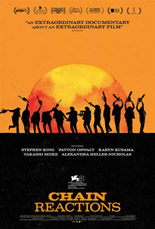
Having grown up sheltered and overprotected, I saw Tobe Hooper’s The Texas Chain Saw Massacre at the house of the kid across the street. Because his single mom let him rent any VHS he wanted. My junior-high self felt so dirty and so guilty, I never wanted to see it again. And didn’t, for decades.

Turns out, the experience of losing my TCM virginity is hardly unique, bearing similarities to the guests discussing theirs in Alexandre O. Philippe’s Chain Reactions. As renegade filmmaker Takashi Miike recalls, “For the first time, I felt that movies could be something dangerous.” (Check.) Comedian Patton Oswalt remembers encountering stills in an issue of Fangoria: “These looked like crime scene photographs that had been stolen and then Xeroxed.” (Check.)

Told in five “chapters,” Chain Reactions is that type of documentary, asking you to commit to creatives waxing nostalgic for 15 minutes or so apiece. I gave myself over willingly and pleasurably.

Leave it to Oswalt to liken Hooper’s grimy, gutsy film to Terrence Malick, Stan Brakhage and Gone with the Wind, of all things. Later, Stephen King, in what plays like pages from his nonfiction classic Danse Macabre come to life, says Texas feels like a Cormac McCarthy novel. Film critic Alexandra Heller-Nicholas remarks that Leatherface “moves like Buster Keaton,” while director Karyn Kusama (XX) proclaims, “It has poetry, beauty.”

They’re all correct, and Philippe keeps up with them, slicing in not only glimpses from the scenes in question, but skillful, side-by-side juxtaposition to influences both concrete and fanciful. Past Philippe documentaries on terror benchmarks include Memory: The Origins of Alien and the wonderful 78/52: Hitchcock’s Shower Scene, yet Chain Reactions is my favorite of his works so far — and I don’t adore TCM like I do the source material of those studies.

Perhaps it helps not to have a space in your heart carved for the work of art; the distance and difference of perspective just might cause you to view it in a new light — human mask of skin blessedly optional. —Rod Lott

Get it at Amazon.

A Hyena in the Safe (1968)

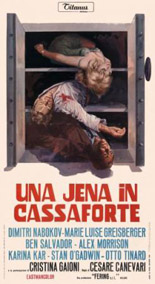
In the Italian film A Hyena in the Safe, various international criminals responsible for a massive diamond heist meet at their late boss’ castle to divvy up shares of the kitty. As ironclad insurance, the loot sits in a safe not only kept underwater, but requires six keys to open and, to prevent drilling, contains a layer of radioactive uranium.

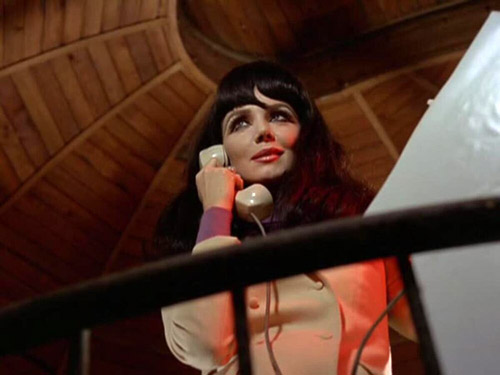
Each crook has brought his or her key … but the arrogant addict Albert (Sandro Pizzochero, The Slasher … Is the Sex Maniac!) suddenly can’t find his. Smelling a put-on, the others even tear the clothes off Albert’s fiancée (Cristina Gaioni, Flesh for Frankenstein) to make sure she’s not hiding the metal key — you know, with all its sharp, jagged edges — in her supple lady parts.

The next morning, one of the gathered robbers dies. Was it suicide or murder? You can guess, because the corpses keep on comin’ until the pic more or less becomes And Then There Were Nessuno.

Cesare Canevari (The Gestapo’s Last Orgy) directs with an unusual level of panache. He gets away clean with a slew of wildly exaggerated shots in part because the script he and Alberto Penna wrote calls for such a treatment, what with the castle’s secret passages, hidden features and occasionally Bedazzled widow. She’s played by the lovely and lascivious Marie Luise Greisberger, who somehow has no other acting credits — a crime in itself.

With a Gian Piero Reverberi theme that sounds like Herb Alpert on an all-expense-paid vacation to Carnival, A Hyena in the Safe does something I’ve never seen another movie attempt: Let a shapeless yellow blob throb in the lower-left corner of the frame for two minutes until it morphs into the parting word “FINE.” If you wish to read “FINE” as English, just know the movie is much more than merely that. —Rod Lott

Get it at Amazon.

Brute 1976 (2025)

Any resemblance Brute 1976 bears to Tobe Hooper’s The Texas Chain Saw Massacre and Wes Craven’s The Hills Have Eyes is purely, assuredly, unequivocally intentional. A closing-credits dedication to their memory confirms it, as if there were any question. Even horror irregulars will detect the influence in the prologue, well before a character asks, “Remember that movie with the chainsaw that came out a couple years ago?”

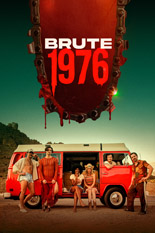
Sure do. Brute 1976 takes its van of half a dozen hippie-dippy protagonists to the middle of nowhere in Nevada for a magazine cover shoot. After snaps, they check out a nearby mining town forebodingly named Savage and now abandoned.

Okay, so it’s not completely abandoned. An unofficial family of felony-hungry fuck-ups call Savage home. They include a guy sporting a half-skull and antlers, another donning a mask of tightly wound beef jerky and, most fashionable, a bald man (Jed Rowen, The Ghastly Love of Johnny X) who admired a woman’s breasts so much, he wears her chest like an apron. Thus, when someone asks, “Is that a chainsaw?” the answer is always “yes.” (For the record, the question is posed twice.)

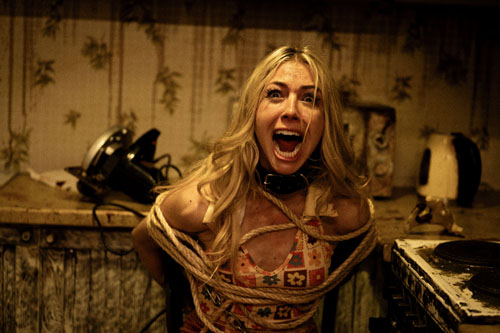
With Brute 1976, director Marcel Walz and writer Joe Knetter do for the grimy slashers of the disco decade what their 2022 collaboration That’s a Wrap did for the glossy slashers of the late ’90s: Embrace with a fervent love, up to and including the point of suffocation. Whether that tickles your sweet spot depends on your tolerance for an often explicit level of camp (a milder sample: “She’s grazin’ for a glazin'”). With the film turning pages of the calendar backward to America’s bicentennial year, Wrap’s ’90s-style sardonicism isn’t merely replaced by post-’Nam pessimism, but buried.

With that, Brute’s strength naturally rests in its depravity, none more memorable or un-unseeable than when a defecating crew member spots two fingers beckoning from a glory hole and can’t think of a reason not to utilize it. What happens next is as if the iconic shower scene from Porky’s accidentally — and graphically — were directed by the Property Brothers.

Taking advantage of the sunny expanse of the Nevada desert, Walz gets to use his outside voice while maximizing minimal resources. Part of that entails bringing along his rep players — reliably, Sarah French and Gigi Gustin — who know exactly how to modulate to his degree of kink-laden kitsch. Brute 1976 represents a step up for him, which bodes well for the sequel, Brute 1986. I’m in. —Rod Lott

Get it at Amazon.

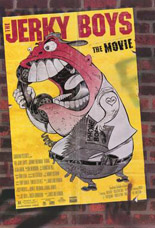
The Jerky Boys (1995)

Even though I might lose credibility, I liked the 1990s comedy team of the Jerky Boys. Crafting a whole mythology that seduced young men with their Howard Stern-era humor, the duo (Johnny B. and Kamal, to the educated) and their prank calls were actually pretty funny when my younger brother played their tapes for me on the way to school.

Complete with their “Hey, jerky!” salutation, we amateurishly taped our own calls from friends’ bedrooms, dialing in to a momentary glimpse of cult stardom we thought we could have, too.

I recall our enthusiasm at the promo screening for The Jerky Boys movie at Oklahoma City’s Penn Square 8 in 1995, where copies of the soundtrack CD (featuring Collective Soul’s minor alt-radio hit “Gel”) were handed out.

But the movie was, in a word, terrible. I realized the Boys’ careers were done, and so was my fandom. These jerks had no more yuks to give. I gave my brother the soundtrack.

Yet 30 years later, my Amazon Prime menu has practically begged me to stream The Jerky Boys, pleading on its scabby knees. After a month, I could no longer resist.

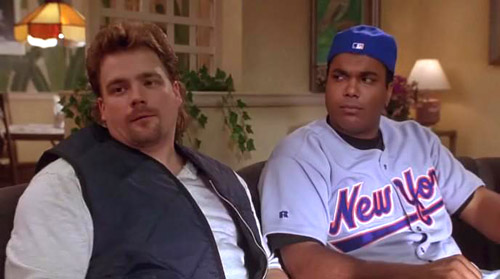
Now, while it’s not the worst cinema of the ’90s as many claim, The Jerky Boys is definitely one of the laziest comedies I’ve ever seen. It even makes hemorrhoids jokes in the first few frames. Johnny B. and Kamal play two unemployed good-for-nothings in Queens. As you might have guessed, they make prank phone calls that are truly scatological in tone and volume.

While trying to look for a job, they create the character of Frank Rizzo, a mob enforcer who fucks with half of the cast of The Sopranos, to great comedic effect. Of course, this gets them in trouble with real mafioso Alan Arkin — let that settle a bit — who orders a hit on them.

In the 81-minute running time, the boys mimic anal sex in a public bathroom, Tom Jones performs “Are You Gonna Go My Way,” Paul Bartel discusses “piss clams” with Kamal’s “Egyptian Magician,” and Ozzy Osbourne manages alt-rockers Helmet. As you probably expected, the climax finds the boys pranking President Bill Clinton.

Oh, to be alive again!

In the hands of The Stoned Age (another of my brother’s favorite films) director James Melkonian, The Jerky Boys was too much, too soon, and he never directed again. Did he kill himself?

While I’ll always snort when I hear the phrases “silly ass,” “milky licker” and “lamby nipple chops,” the movie is so episodic that, if it were made today, it’d be a prestige-format limited series on Netflix and get canceled halfway though, prompting a re-evaluation on TikTok, leading a renaissance of prank calls.

Or maybe The Jerky Boys will be lost to time. —Louis Fowler

Get it at Amazon.

Random Genre & Cult Movie Reviews