1408 (2007)

In 2007, it was nice to see a Stephen King adaptation at an actual movie theater again, where they belong, instead of the watered-down, overlong miniseries that played several nights on network TV and basic cable. It was also nice to see it contain actual scares, surviving the transition from its source material intact.

1408 comes from King’s 1992 short-story collection, Everything’s Eventual: 14 Dark Tales. As King notes in his introduction, it was never meant to be an actual story, but an example of how writing progresses from draft to draft. For whatever reason, he finished it, and it’s one of Eventual’s many highlights. It’s easy to see why it was handpicked for big-screen treatment, and its modest success — combined with Frank Darabont’s The Mist later that year — helped usher in another wave of quality King films still going semi-strong more than a decade later.

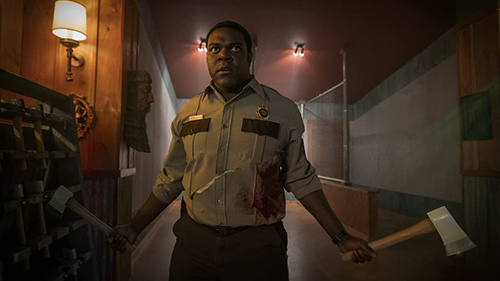
John Cusack stars as Mike Enslin, a writer of several midlist books on haunted places. He’s working on one for hotels, rating each on a scare scale of one to 10 skulls. In his research, he’s found that supposed ghost-infested bed-and-breakfasts are just a way to drum up business. That will all change with his stay in room 1408 at New York’s Dolphin Hotel — a room perennially kept unoccupied for a reason: 56 occupants have died in it, none lasting for more than an hour.

Or, as the Dolphin manager (Samuel L. Jackson) puts it, the room is “fucking evil.”

Once inside, Mike’s stay starts off innocently enough: unexplained mints on the pillow, blared Karen Carpenter from the clock radio. But soon, actual bodily harm comes to him, and the clock starts providing a handy 60-minute countdown toward his apparent doom. With a barrage of spirits and phenomena and other things that go bump in the dark, it’s like The Shining compressed into one compact suite.

While King’s original story of the same name is structured roughly into thirds — before, during and after Mike’s stay — most all of the film is concerned with the during. Granting the tale an ominous touch, King relates the goings-on in the room not as they happen, but only afterward, via whatever details Mike left on his voice recorder.

What he doesn’t say makes our imagination run wild. But movies being visual, 1408 shows all, and some of it is very creepy. With the film more or less being confined to one space, Mikael Håfström does a great job of concocting more and more things to make Mike’s night a living hell. Although it includes all of the shocks of the story, it has to expand upon it in order to hit feature-length, adding a subplot about Mike’s ex-wife (Deep Impact’s Mary McCormack) and dead daughter to help fulfill that.

Hope you like Cusack, because the entire movie is on his shoulders. If he weren’t such a talented actor, we’d want to check out of 1408 early. But he makes the skeptic Mike likable, believable and sympathetic. As much as the moviegoer in us likes to see him go through the ringer, we feel bad for him all the same. In fact, parts of the film are real downers, but that just means it works.

The movie’s not perfect, mostly because of maybe two too many false endings. But it’s a smart and stylish chiller/thriller — everything that Håfström’s previous film, Derailed, was not. —Rod Lott

Get it at Amazon.

The Final Countdown (1980)

Released many years before the absolutely terrible song by Swedish metal-lite band Europe, The Final Countdown is mostly famous for being one of the few science-fiction movies that jaded old men — particularly World War II vets — who typically only watch Westerns seemed to somewhat enjoy, as my father did whenever this came on television.

Still steel-jawed in 1980, Kirk Douglas is the tough-ish Navy captain of an aircraft carrier that, during regular maneuvers in the Hawaiian seas, appears to get sucked into an unexplained time vortex that takes the ship back to a few hours before the events of Pearl Harbor.

Between reasonably dealing with Department of Defense liaison Martin Sheen and needlessly arguing with chubby senator Charles Durning, Cap’n Douglas has to decide if he’s going to do something about Pearl Harbor or not while he’s got that burning number on the upcoming events.

What he does — or doesn’t do — leads to one of the most unsatisfying endings I’ve ever seen on film, subdued with a coda I’m sure we all saw coming.

As I watched this flick, directed by Don Taylor and surprisingly associate-produced by Troma head Lloyd Kaufman, I started to wish my dad was still alive — momentarily — so I could have asked him what exactly it was that he liked about this film, especially when he called Douglas an “ass” and Sheen a “communist” whenever they were brought up in everyday conversation.

Now that I think about it, he never said anything about James Farentino … maybe that’s the reason? —Louis Fowler

Get it at Amazon.

Bleeding Skull! A 1990s Trash-Horror Odyssey

While the rest of the country meme-watches its way through the Friends reunion special, the true ’90s nostalgia awaits in the Fantagraphics-published Bleeding Skull! A 1990s Trash-Horror Odyssey.

The long-awaited, much-anticipated sequel to Joseph A. Ziemba and Dan Budnik’s Bleeding Skull! A 1980s Trash-Horror Odyssey, unleashed to molten minds by Headpress in 2013, this sophomore (and proudly sophomoric) follow-up gives ink to the absolute oddest of no-budget obscurities video stores had to offer, most shot on VHS camcorders. With jackers, crystal forces, death metal zombies, psycho sisters, killer clowns, killer nerds and mad scientists named Dr. Kill, the contents are every bit worth the brand’s fractured exclamation point.

This time, Budnik is nowhere to be found, replaced by Annie Choi and Zack Carlson, whose styles meld better with Ziemba’s. (Please note that’s not a slam on Budnik, whose 2017 book, ’80s Action Movies on the Cheap: 284 Low Budget, High Impact Pictures, is a howlingly funny must-have for every B-movie enthusiast’s library.) The trio’s tag-teamed intro states these virtually unseen movies are deserving of cheers, not sneers … even if the 250 reviews don’t quite carry out this credo, as many flicks are most decidedly mocked — with exuberant affection, but mocked nonetheless.

After all, it’s not until the 10th entry (Asylum of Terror) that readers will arrive at anything resembling a “good” review, albeit one in which Ziemba writes, “no one appearing on-screen seems to understand that they’re being filmed.”

Of course, Bleeding Skull! wouldn’t be the tremendously fun read it is without the writers’ often brutal — and brutally hilarious — observations:
Bad Karma: “The design is one part Etsy, three parts Dollar General.”
Bloodscent: “The music is the finest junior varsity jock rock that western Pennsylvania has to offer.”
Blood Slaves: “Looks like it was cast at a baseball card shop.”
The Laughing Dead: “If a pair of slit wrists got together to make a movie, it would be this one.”
Psycho Pike: “If you like to watch people drive around in a Jeep Wrangler, Psycho Pike is your movie.”
The Witching: “The Witching is a saxophone kicking in for 64 minutes straight.”

More or less escaping ire are the DIY directors whose filmographies number beyond “1.” For example, the authors’ collective championing of the Polonia brothers (one of whom provides the foreword) nears idolatry. Fervent enthusiasm also falls to the Jesus-influenced gore of Todd Sheets, the “monstah” movies of David “The Rock” Nelson and the infidelity-themed slashers of Tim Ritter. Not so much for Todd Cook, whose prolificness is overshadowed by his stream-of-semiconsciousness works’ puerility. No matter where the opinions fall, however, the book is never not informative or entertaining; never before has so much thought been placed on explaining why choking is the laziest of murder methods.

No rave for this book is complete without praise for who may be considered its fourth author: designer Keeli McCarthy. With an aesthetic heavy on Magic Markers, highlighters and the purposeful cut-and-paste sloppiness of zines, her design is more aligned with Carlson’s seminal (and sadly out-of-print) Destroy All Movies!!! The Complete Guide to Punks on Film than Bleeding Skull!’s aforementioned ’80s edition. Either way, it’s now in glorious, garish full color. —Rod Lott

Like shot-on-video movies themselves, taking in A 1990s Trash-Horror Odyssey all at once could be overkill — or simply unfortunate, since we’re eight years away from A 2000s Trash-Horror Odyssey if the current between-books gap between holds. If Camp Blood of all things can get 10 installments, I hold out hope Bleeding Skull! at least merits a third. —Rod Lott

Get it at Amazon.

Kaliman en el Siniestro Mundo de Humanon (1974)

Across Latin America, you didn’t see kids lining up for the latest adventures of Batman or Superman, be it at the newsstand or, later, the movie theater. Instead, they had a reigning culture of their own superheroes who never really crossed over into North America (not that they had to), with the best example being Kaliman.

With blessed powers such as ESP, astral projection, telekinesis and, quite obviously, the martial arts, the mysterious Kaliman made his claim to superhuman fame by traveling the globe and solving dastardly crimes with aid of former street urchin and current young ward Solin, who is in training to become Kaliman’s successor — if that ever happens, honestly.

With well over 1,300 issues of the comic book and a string of popular radio dramas — not to mention a lawsuit from the assholes at Marvel — he made his motion picture debut in 1972 with Dallas talking head Jeff Cooper taking on the somewhat muscular lead to great success in many Latin-based countries.

Sadly, I have not seen it. What I have seen, however, is the follow-up, Kaliman en el Siniestro Mundo de Humanon and, man alive, is this one fun flick!

Here, Kaliman spends his time leisurely walking the beaches of Rio and driving in a car. But when his apartment is telepathically burgled and the inhabitants become murderously possessed by a cursed necklace, he and Solin somehow end up in the jungle, searching for the lackluster hideout of Humanon.

Additionally, Kaliman helps Solin form a completely NSFW drinking tube when their thirst gets the best of them, and there’s a doped-up monkey doing scared flips and tricks somewhere in there, too, among all the stock footage of dangerous animals for them to point at and laugh from a distance.

That’s nothing when compared to when we meet Humanon, the red-cloaked, pointy-capped villain (who reminds me of a rather sassy Grand Dragon) and his army of what I’m guessing are zombies to hunt our heroes down and kill them.

As expected, Cooper is completely ridiculous as a supposedly Middle Eastern mentalist, but the ludicrousness of it helped the movie move forward in a very schlocky way that seems like a lost art. Granted, as far as comic book movies go, it’s not going to blow the roof off the Avengers Tower anytime soon, but how about a big budget retelling of the Kaliman mythos? —Louis Fowler

Get it at Amazon.

Beneath Us (2019)

With Beneath Us, the genius lie entirely in the pun of the title. First-time feature director Max Pachman’s slice of immigrationsploitation leaves subtlety out of the picture, despite the resonance and seriousness of its premise.

Four undocumented workers — including brothers Alejandro and Memo — are hired by the über-wealthy, über-voluptuous Mrs. Rhodes (Lynn Collins, X-Men Origins: Wolverine) to finish construction on a guest home at a bargain-basement price. The property she shares with her husband (James Tupper, 2017’s Totem) is well-fortified, cut off from the rest of the world and all its promise with an electric fence. Forced to work day and night with no rest until the job is done, the workers too slowly realize they’re not going to be allowed to leave alive, what with the underground cavern of hired hands past.

To call the bosses are “racist” is to undersell their cruelty, which is hardly a one-off; Mr. and Mrs. Rhodes are essentially serial killers with the highest credit limit possible on a Home Depot credit card. The longer the job takes, the crazier Mrs. Rhodes gets, which is both the film’s greatest asset and liability. From the first scene, Pachman takes care to set up the troubled family dynamics of Alejandro (Rigo Sanchez, TV’s Animal Kingdom) and Memo (Josue Aguirre, Incarnate), then play them out … until he allows Tupper and especially Collins to approach their parts from rail No. 3.

Make no mistake: Collins is enormous fun in an utterly unhinged performance, but her Karen-to-the-nth-degree antics distract from the movie’s message even more than her push-up bra. It’s difficult to make politics stick in horror when your antagonist vamps and tramps her way through what amounts to a Tex-Mex Avery cartoon. —Rod Lott

Get it at Amazon.

Random Genre & Cult Movie Reviews