Calendar Girl Murders (1984)

Remember when you could sexually harass female co-workers and openly read porno mags in the workplace without fear of punishment? Apparently it was the same time the Big Three networks churned out some decent genre movies made for prime-time household consumption — specifically, 1984, when Calendar Girl Murders debuted on ABC.

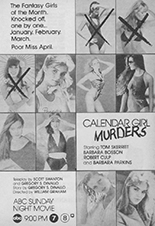
This telepic’s Hugh Hefner, Paradise magazine owner Richard Trainor (Robert Culp, then on the back half of The Greatest American Hero’s run), has a special way to spotlight the dozen lovely ladies posing nude for the coming year: a television special … hosted in part by that icon of testosterone, comedian Rip Taylor. Unfortunately for Trainor, someone else has a different special way to spotlight them: homicide! Miss January is shoved off a hotel balcony; Miss February (Claudia Christian, Half Past Dead) is stabbed while raiding the fridge.

Assigned to the case is midlife-crisis cop Lt. Stoner (Tom Skerritt, Alien), much to the chagrin of his “meh” wife (Barbara Bosson, The Last Starfighter) and the delight of his masturbating teen son (Jonathan Aluzas, Monster in the Closet).
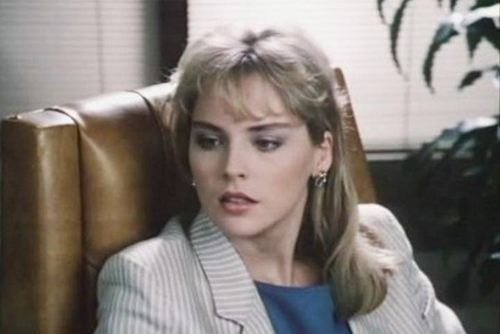
A tip on a photographer who gives the girls the heebie-jeebies leads Stoner to interview former Paradise Angel of the Year Cassie Bascomb (Sharon Stone), and somehow, that creepy shutterbug is not the one played here by Alan Thicke. In a preview of the beautiful Stone’s Basic Instinct breakthrough to come in eight years’ time, Bascomb and Stoner embark in a YMCA-shower-steamy affair while bodies keep turning up. Somehow, one girl manages to be drowned in a busy pool at one of Trainor’s legendary parties. (Then again, with the night containing both an impromptu breakdance and Culp in a Speedo, that’s a shitload of diversion.)

So whodunit? Exactly whom you’ll expect. As predictable as that ending may be, the culprit’s motive is a truly histrionic howler of mid-’80s pop psychology. In the hypothetic hands of, say, Dario Argento, something titled Calendar Girl Murders could be something really special by being really sleazy; in the actual hands of TVM vet William A. Graham (Shark Kill), however, it’s hardly titillating. With Calendar Girl Murders being a Sunday-night movie, its centerfolds — er, calendar girls — sport the most demure one-piece swimsuits and leotards a Sunday-night movie could get away with immediately following an ep of Hardcastle and McCormick. —Rod Lott


Get it at Amazon.

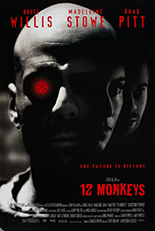
12 Monkeys (1995)

I’ve said it once and I’ll say it again: Terry Gilliam has always been a true visionary who has never received the full credit he truly deserves, and I’m not talking about Monty Python.

While he has done some truly great movies like Time Bandits, Brazil and The Fisher King, I feel that he reached his absolute mainstream height with 1995’s 12 Monkeys, a truly original take on time travel inspired by the absorbing French short film La Jetée, told mostly in photographs.

Bruce Willis stars as James Cole, a prisoner chosen for a dangerous experiment to travel from 2035 to 1996 to stop a deadly disease that was supposedly started by a group known as the 12 Monkeys. However, during his first attempt, he ends up in 1990 in a mental institution, with Jeffery Goines (Brad Pitt) as a bunkmate, giving him — who happens to be the leader of the 12 Monkeys, natch — the idea for starting the simian insurrection.

Mistake (somewhat) fixed, Cole is sent to 1996, for real, kidnapping one of his former doctors from the asylum, Kathryn Railly (Madeleine Stowe). He attempts to stop the 12 Monkeys — and the virus in general — but through a series of continually turning and twisting spheres, we soon learn that Cole can’t change the future, no matter how hard he tries. But he doesn’t know that.

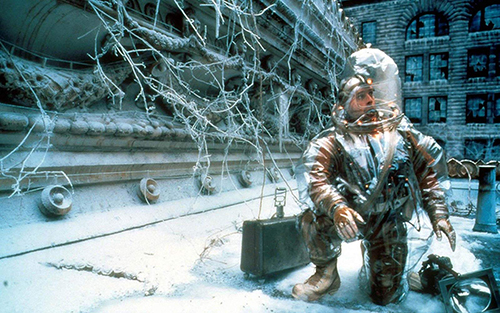
Filmed with Gilliam’s masterful hand, 12 Monkeys presents a claustrophobic underground future, yet somehow makes the then-present feel even grimmer and grimier. That’s one of his specialties, with everything he’s ever done coming together, almost knowing that the end of the world — and the end of his career due to money-hungry studio heads — was coming. —Louis Fowler

Get it at Amazon.

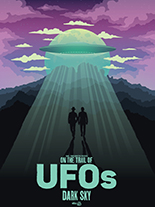
On the Trail of UFOs: Dark Sky (2021)

With his Small Town Monsters label, Seth Breedlove has, well, bred a cottage industry of documentaries on all things cryptozoological and/or mythological. After features on Bigfoot and Momo: The Missouri Monster, he again watches the skies for On the Trail of UFOs: Dark Sky.
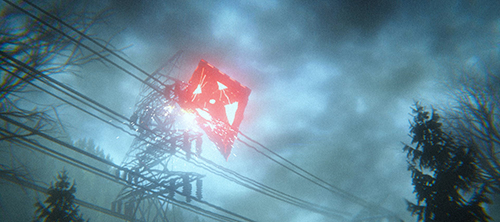
In this one, he and paranormal investigator Shannon LeGro visit the Appalachians and “hills of hollows” of West Virginia, as the Mountain State plays home to several “quintessential cases” in the lore of unidentified flying objects. Mixing clips from 1956’s Earth vs. the Flying Saucers and stock footage with actual interviews, Dark Sky presents firsthand accounts, hearsay accounts, “anonymous witness” accounts and even the occasional kids’ crayon drawings to present the locals’ stories of encounters both close and close enough. Among them are a diamond-shaped craft sucking energy from power lines, a sighting while playing hoops with the old man, spinning lights, flashing lights and more — all professionally recreated with first-class motion graphics. Without them, Dark Sky would feel feather-light on content.

You can practically watch the doc with a bingo card at hand with squares for all the usual-suspect terms one might hear involving UFO conspiracies and conversations: military ops, psy-ops, Mothman, men in black, Project Blue Book, Dow Chemical, WMD, FBI, CIA, NSA, mobile homes …

Not a follower of UFOs, I’m not qualified to state if On the Trail unearths anything new, but Breedlove brings a theory regarding mineshafts to the table, while an interviewee raises the question of whether aliens target families. Typical of his work, this film impresses with top-notch production value. The only drawback is in LeGro’s narration, which is halting and hesitant, as if she’s not only reading from cue cards, but reading from cue cards written in a foreign language she’s translating on the fly. Her interest and knowledge, however, are not in question.

Whether the movie plays as mere entertainment or belief reinforcement is left for you to decide. —Rod Lott

Switchblade Sisters (1975)

I had the ultimate pleasure to meet director Jack Hill in the early 2000s, when he was a at a local college campus showing a double feature that included Switchblade Sisters, a film that gained new prominence once Quentin Tarantino’s Rolling Thunder Pictures reissued it to theaters.

One of my favorite films since a rental in the early ’90s from a now long-gone video store in Oklahoma City, it was thrilling to see it on the (somewhat) big screen and even more thrilling to meet the soft-spoken man who made it, a film that he described as a modern (as modern as the ’70s can be, I suppose) take on Othello.

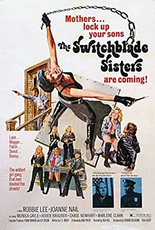
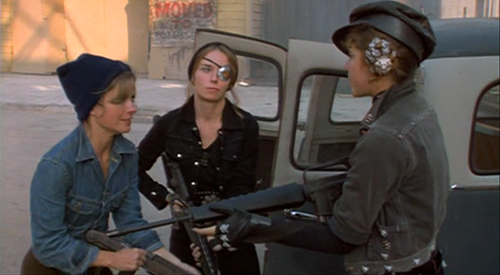
Switchblade Sisters tells the story of blonde Maggie (Joanne Nail, in short shorts and high-heeled boots), a streetwise teenager who, after a scuffle in a local burger bar, ends up in a girl gang called the Dagger Debs, led by Lace (Robbie Lee, who has always reminded me of a Depression-era youth). When her boyfriend, the leader of the Silver Daggers, dies, they become the Jezebels, the meanest bunch of teen troublemakers in town.

However, when high school sleaze Crabs (Chase Newhart, channeling his evil Eaglebauer) tries to take full control, the Jezebels team up with a Black militant squad led by Muff (Marlene Clark, who really should have had a spin-off flick) and take the dirty motherfucker and his boys down, by any means necessary, which, thankfully, includes plenty of machine guns.

A box-office dud upon release, Switchblade Sisters effectively killed Hill’s career, but, even watching it now, the amount of guts on display here proves that he was far ahead of his time, delivering a movie that would probably make at least good money at Redbox, capitalizing on all the things that have made movies in general great over the years: rowdy girl gangs, dark violence, black humor, Black nationalism and, I guess, Shakespeare.

Well, at least all the things I love in a movie. —Louis Fowler

Get it at Amazon.

Maximum Impact (1992)

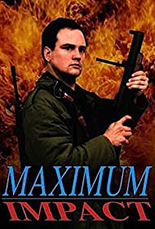
At just 61 minutes — and not a minute more! — Maximum Impact appears built upon minimal effort. Shot on video in Ohio, the movie even makes a case against itself from the start with opening credits slowly unfolding atop more than three minutes of burning paper.

Huntsacker Industries insurance salesman Jerry Handley (Ken Jarosz) lives the life of Riley, what with a job, a pretty(-enough) fiancée named Jan (Jo Norcia) and an operational Ford Taurus; judging by the needless footage of him driving it — and smiling while doing so — he sure seems to be pleased. He’s traveling to a big corporate meeting held in a rather tight room, where he reconnects with his estranged best bud, Phil (Scott Emerman). Post-meeting, the dudes reconvene at a diner to reminiscence over chips and queso about that great time when they went skinny-dipping. Together. Just the two of them. At age 12. (Note this odd conversation takes place under a sign reading “Snacktacular!”)

Their bonding sesh is interrupted by a scar-faced, ponytailed Huntsacker heavy (Bill Morrison) who invites them to a company-paid prostitution party later than night at HQ. Phil accepts, not realizing he’s being set up to star in a snuff film. At least he gets a little bra-and-panty action with his reluctant scene partner, Tonya (Christine Morrison), before being murdered. Being suspicious and nosy, Jerry witnesses the whole thing going down through the cracked door. When the cameraman (Michael Cagnoli) steps out to meet the pizza deliveryman, Jerry steps in and flees with Tonya.

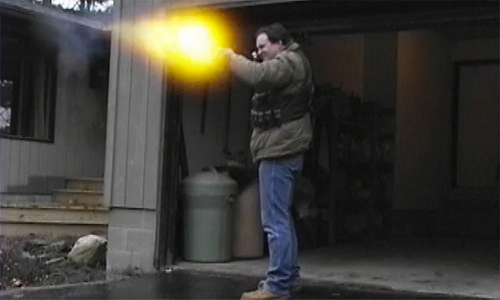
In doing his best to keep this total (but fairly curvy) stranger alive, Jerry fails at affording his future wife the same fate — oops! Jerry’s loss is the viewer’s gain — assuming said viewer hasn’t checked out by then — as he takes revenge with an armory’s worth of loaded weapons.

Maximum Impact is, as you’ve guessed, a mess — one acknowledged by its makers, who hide behind pseudonyms. Most notable among them is director Lance Randas, actually DIY diehard J.R. Bookwalter, whose second-made feature, Robot Ninja, can be seen on Jerry and Jan’s TV screen (as can the reflection of a crew member holding a blanket in a failed attempt to block incoming light for day-for-night deception). Bookwalter made the woefully underfunded Maximum Impact as best as one can with a paltry $2,500; nearly every penny is onscreen. After all, chips and queso aren’t free! Nor is makeup, and the scar on the Huntsacker muscle’s face looks just like the one my younger brother had applied at our 1980 elementary school fair for three whole tickets.

I’m thankful for each shortcoming on both sides of Bookwalter’s camcorder, because without them, Maximum Impact would be unwatchable. I’d say you could skip it entirely, but then you’d never hear this line of dialogue in your life: “His schlong fell off! Who knew?” —Rod Lott

Get it at Amazon.

Random Genre & Cult Movie Reviews