
Altered (2025)

Want to see a great sci-fi movie with Tom Felton that explores themes of human evolution? That’s what Rise of the Planet of the Apes is for, because Altered sure isn’t.

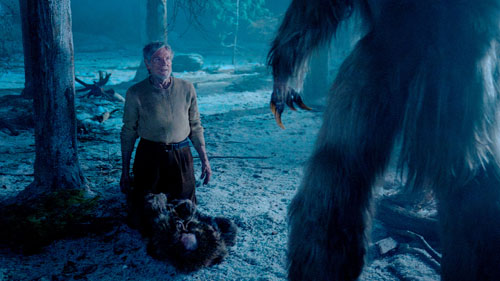
In its dystopia, citizens can opt for incredible DNA enhancements from the Genesis Institute “laboratry” (as is visible in one shot), like the ability to drink through a straw that unfurls from your nostrils or to check the temp of your dinner steak via a simple gaze of your glowing peepers. These upgrades and more can be yours! Unless you’re one of the unfortunate 10% of the population immune to bio-modifications, that is; derisively dubbed “specials,” you losers are segregated from society.

Being paraplegic, Felton’s Leon is one such special. He and his 12-year-old roomie, Chloe (Liza Bugulova, Disney’s The Last Warrior), luck upon a mechanical suit of Dr. Doomy armor that allows Leon to walk again, plus fight bad guys with kitchenware from a Pampered Chef party, and save a politically minded pop star (Aggy K. Adams, Netflix’s The Witcher) from kidnapping.

As if that weren’t enough, Chloe injects the superhero suit with essence from a smuggled flower that converts nuclear energy into pure energy so Leon also can shoot vines and, ultimately, deadly thorns. Now he’s like Spawn, if created by Guerney’s Seed & Nursery. As Leon quips in the film’s climax, “That’s flower power … that’s flower power,” in case you didn’t get it the first time, I guess.

The science-fiction genre is an ideal medium to explore hot-button issues of today under the guise of a tale of a near-future tomorrow. Yet Altered is all toothless, surface-level junk, as if adapted from a tween activist’s change.org petition. Shot in the glorious nation of Kazakhstan, it sounds dubbed in post, despite an English-speaking main cast. The visuals are so inert and uninvolving, I would not be shocked to learn they were generated with a single prompt of an AI tool.

Writer/director Timo Vuorensola would have been much better off utilizing even a smidge of the satire (however mild) from his Nazi UFO breakthrough, Iron Sky. At least then, lines like Felton’s praise to a wind-up mouse, “Good work, Mr. Stinky,” could be laughed with, rather than at. —Rod Lott

Get it at Amazon.

Seeds (2024)

In films, Indigenous characters (both fictional and non-), are usually created, written and filmed to be stereotypical “redskin” primitives as generic, nonsupporting players in whitewashed plots. If you even get the part, you’re killed off in the first 15 minutes for union scale, an IMDb credit and another notch in white supremacy’s belt.

It seems Indigenous filmmakers aren’t going to take it anymore. In the past few years, when an wholly Indigenous creative team goes all-in, their projects personify simmering rage against polite society’s established systems. A Canadian film by Kaniehtiio Horn (Possessor) puts all those sharp feelings in a blender and goes hits “cultural purée.” Of course, I loved it.

That genre-bending film is Seeds, recently named Best North American Indigenous Film by the Oklahoma Film Critics Circle, of which I’m part. I felt like I triumphed; as half-Choctaw, I identified with Horn’s character, Ziggy, as she tries to reconcile the old world with the new, the traditional ways with the savage, and, naturally, the comedic side with the horrific. Seeds plays very well at balancing these sides.

Living in the city, Mohawk tribe member Ziggy is an influencer/food delivery driver with some outstanding bills she’s trying to pay off. Looking to recharge her account, her cousin (the very funny Dallas Goldtooth, TV’s Reservation Dogs) asks her to come to the Pine River rez to house-sit. Many out-of-water comic scenarios — including strapping ex-boyfriends, homemade energy drinks and clandestine internet issues — make you think Seeds is a comedy.

But soon enough, a storm builds when the town’s white-trash thief and his two accomplices try to steal Ziggy’s aunt’s most prized possession: legacy corn, bean and squash seeds. They break in and kill her cat to scare her to give up the seeds. If you know Natives, that’s easier said than done, because 500 years of Indigenous rage pours out. With total prejudice and no mercy, she strings the guys up, whips them, covers them in hot oil and “de-barks” them in an act of Indigenous revenge that’s very raw and justified.

With a true supporting cast that includes the late Graham Greene and an impossibly Goblin-esque soundtrack by Alaska B, writer and director Horn has ripped up the playbook that white people have used for a hundred years and deftly mixes humor and horror to the hilt.

I am proud to champion this film and hopefully more people will see it, from Indigenous cinephiles to all-around horror fans. However, a different movie called Seeds, a documentary about Black farmers, was released around the same time, causing confusion. As a result, both may go unrecognized. I guess when it comes to non-white films, they all look the same, right? —Louis Fowler

Get it at Amazon.

Obex (2025)

In 1987, Baltimore elected its first Black mayor — not that a resident like Conor Marsh (Albert Birney, I Saw the TV Glow) cast his vote. After all, he’s a shut-in who chooses to experience life through screens; when he’s not watching TV, he’s on his computer, earning a meager living by turning people’s photos into ASCII art. Watch, type, sleep, repeat.

One day, a floppy diskette with the game Obex arrives in the mail. The objective: Defeat a soul-eating demon named Ixaroth. The game literally changes Conor’s sad, lonely life! But by kidnapping his dog. 

Conor’s mission to save his four-legged best friend takes him outside his comfort zone of dot-matrix printers and computer magazines bagged with shareware, and into the forest. It’s a fantasy world all its own, with an animated fairy, a Zelda-ready elf (Callie Hernandez, Alien: Covenant) and a walking, talking RCA television set (Frank Mosley, Don’t Look in the Basement 2).

Written and directed by Birney himself (Strawberry Mansion), Obex revels in the 8-bit aesthetic. But it’s not all about that. Its sound design, black-and-white visuals and extreme close-ups of cicada bring Pi to mind, not to mention that film’s loner protagonist. Heck, so much absurdity is planted within Obex, it could have oozed from the mind of Pi’s protagonist after his DIY trepanation.  

Birney’s film is imaginative throughout, although significantly more winsome in its first half, before Conor ever leaves the house. Not that the video game-inspired environment is a loss. Turns out, a cursor floating in the sky can be a beautiful thing. —Rod Lott

Get it at Amazon.

Deep Crimson (1996)

The salacious true crime story of the Lonely Hearts Killers in the 1940s was dramatized in the down-and-dirty flick The Honeymoon Killers, with Shirley Stoler and Tony Lo Bianco. (Surely, you’ve seen the far-out promotional images for that 1970 movie, right?)

Even though Killers was a slight precursor to John Waters’ comic misanthropy, it took director Arturo Ripstein — one of Mexico’s premier filmmakers — to really give it a sensational retelling in 1996’s dark and dour Deep Crimson, not to be mistaken for Deep Red, Crimson Peak or the pornographic Deep Peaks.

In 1940s Mexico, slightly overweight nurse Coral (the brilliant Regina Orozco) leads an extremely unhappy life. She not only is a single mother of two young kids, but has monstrously bad breath. Her only sexual outlet is to feel up her comatose and disabled patients, and she’s obsessed with actor Charles Boyer, an obsession that plays to her disembodied fantasies of leading a full life.

On the other side of town, Coral meets a man named Nicolás (a swarthy Daniel Giménez Cacho). He’s dangerously slick, well-toupéed and, of course, also seriously lovelorn. After a brief meeting and a slice of cake, they make passionate love and fall head over heels in love. So, what do they do next?

They send her kids to the orphanage, then immediately find a drunken woman to kill with rat poison. After dumping the stranger at a train station, they continue their murderous streak, conning elderly women and taking out their liver-spotted bodies Their worst act is an old-time home abortion that cumulates in the bathtub drowning death of a 4-year-old.

This being 1940s Mexico, justice is appropriately dealt. Cut to credits.

Having seen only a few of Ripstein’s genre films — the severely spooky La Tía Alejandra being the creepiest — I found the impact of the couple’s crimes, combined with the damaged psychology of the mother, makes Deep Crimson a truly engaging movie, especially for Orozco, whose performance always rides the tenuous line between depressive love to maniacal woe. Turning subversive love and perverse longing into a real necessity, Deep Crimson is a dry, dusty tale told through the perceptive lens of the sterile Mexican desert. Ripstein tears apart the Lonely Hearts Killers’ story and rebuilds it the way should have been done right from the beginning. —Louis Fowler

Get it at Amazon.

Christmas Bloody Christmas (2022)

Built by the U.S. military for defense, an animatronic Santa Claus goes haywire to turn homicidal on Christmas Eve. Why? Like the old joke about a dog licking its testicles, because it can.

And also because Joe Begos’ movie is titled Christmas Bloody Christmas, shot through a head-shop haze. 

The Final Girl of this self-knowing slasher is Tori (Riley Dandy, 2022’s Interceptor), owner of a record store patronized by hipsters. After a night of liquor and oral, she and cashier Robbie (Spiderhead’s Sam Delich, here a dead ringer for John Oates), find themselves targeted by the fire ax-wielding RoboSanta+ (a mute and committed Abraham Benrubi, The Belko Experiment).

Bloody’s highlight arrives all too early as we see the robotic Kris Kringle awaken through its POV, each metallic boot step clunking as it hunts its first fornicating victims. From there to the bitter end, when RoboSanta’s green laser eyes come in handy, Begos (Almost Human) hasn’t supplied a story to hold attention between slaughters. He opts for that laziest of indie-horror solutions: time-biding NSFW conversations, from Robbie telling his boss to “flick your bean” to a toy store employee ordering her boyfriend to “eat my ass out” — all so utterly uhh-noy-ing and free of imagination, you’ll root for RoboSanta just to be done with the thing.

Fatally pitched as a Silent Night, Deadly Night reboot, Christmas Bloody Christmas seems conceived as a seasonal Terminator parody. That kernel of an idea is all Begos has, though, short-circuiting any chances of holiday horror immortality. —Rod Lott

Get it at Amazon.

Random Genre & Cult Movie Reviews