
Category Archives: Kitchen Sink

Light of Day (1987)

WTF

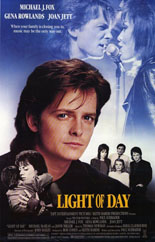
After the one-two punch of Back to the Future and Teen Wolf, with all their time-traveling and van-surfing going on, Michael J. Fox went for the box-office hat trick with a film that, sadly, had none of those fantasy leanings: the rock ’n’ roll drama Light of Day. He failed.

That said, I never considered Light of Day a Michael J. Fox movie. Instead, I viewed it as a Joan Jett film detailing her fictional rocky road to ill-fated stardom. With her gloriously raspy voice belting out the mid-’80s hard-rocking tunes within the context of a late-phase cancer drama, it’s an uphill battle for the entertaining devil-signing hordes of the decade’s lost children. By God, it works for me, but for others? Woof.

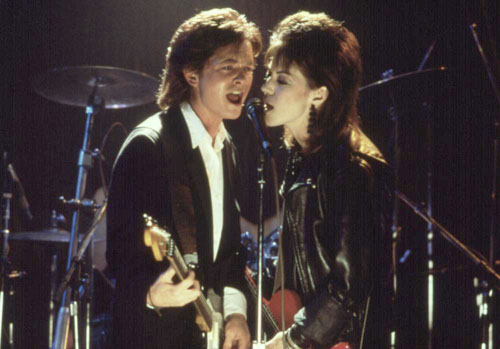
In Light of Day, Jett’s a single mom collecting cans around town while her brother Fox “works on the line,” whatever that is. As the sun goes down, they’re in a band called the Barbusters, the kind of band only movie people can make. Fox is on guitar and works a steady job, while Jett is the type of musician who believes “music is all that matters.” Together, they go on the hardest road imaginable. It’s a bad scene, cumulating with her using kid in a shoplifting scheme that tears them all apart. Sad!

After a label-mandated Fabulous Thunderbirds show — they are tuff enough! — their overbearing mother (Gena Rowlands) is diagnosed with late-stage ovarian cancer. As depressing as that is, Jett and Fox play the terrific Bruce Springsteen-penned title tune at the close, so everything is all right in the end.

Directed by Paul Schrader — the guy behind Hardcore, Cat People and, um, Dominion: Prequel to the Exorcistis a fine director, sure, but he is way out of his element here. Like a Michael Bolton biopic, it seems like he wants to create a rock movie with plenty of drama … with little to no rock involved.

In her film debut, Jett is not the best dramatic actress. But she’s better than most erstwhile rockers in their debut, creating real gravitas and a rocking performance. Who could do it: Alice Cooper? Ozzy Osbourne? Jon Mikl-Thor?!?

On the other hand, the supporting cast of Fox, Rowlands and Jason Miller are good actors, but likely terrible musicians. (Supporting player Michael McKean is passable in that Spinal Tap way, so he gets a pass.)

Light of Day could have been a real rock drama with a good screen story, impassioned performances and the best soundtrack around. Instead … well, the music is pretty good. As a staid Fox vehicle, it’s pretty flawed and very rundown. But if hard-rocking, screaming-metal sirens of filth and fury are your spiked bag, it’s the best Joan Jett movie around! —Louis Fowler

Get it at Amazon.

Freaky Tales (2024)

WTF

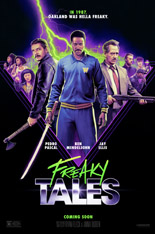
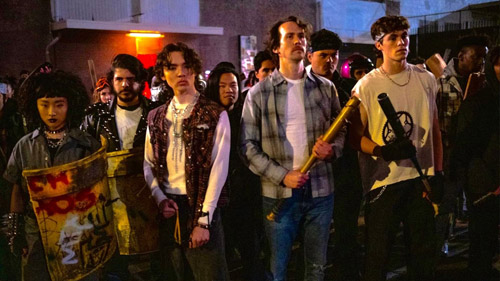
Clearly filmmakers Ryan Fleck and Anna Boden didn’t work out all their 1980s love on Captain Marvel. The decade’s aesthetic — from green neon to VHS tracking fuzz — is all over Freaky Tales like an infection. No can of Bactine stands a chance against the interlocking foursome of stories set in ’87 Oakland, California. (But bookended by unapologetic Nazis and sports stars’ homes robbed mid-game, the movie could take place in ’25 Anywhere, America.)

A simple siege of a peaceful punk club by skinheads, the first story establishes Freaky’s darkly comic, heavily violent tone. The second concerns a different type of war: one of words in a rap battle between Too $hort (Symba) and two young ladies (Normani and Black Panther: Wakanda Forever’s Dominique Thorne) who might be set up to lose. This bit would be entirely incidental, if not for introducing the movie’s ultimate villain (Ben Mendelsohn, Ready Player One) as an ultimate piece of shit. 

Things pick up considerably in the third segment, fronted by Pedro Pascal (Wonder Woman 1984) as a freelance enforcer on what he promises to his pregnant wife is his last assignment … until suddenly, he’s willing to work overtime for vengeance. (Psst: Somewhere within those ellipses, a surprise A-list cameo awaits to delight.)

Tales reaches its cathartic crescendo in sharing the legend of NBA player Sleepy Floyd (Jay Ellis, Top Gun: Maverick). Although the former Golden State Warrior is a real athlete, the night depicted here sure isn’t as Floyd takes grisly, glorious revenge upon a house party of Confederate scumbags for misdeeds against his family. This bravura sequence not only feels like a kung-fu cousin to the thwarted Manson murders in Quentin Tarantino’s Once Upon a Time in Hollywood …, but practically doubles as a bid for Ellis to front that long-gestating Blade reboot.

Befitting a Tarantino reference, Freaky Tales often plays like chunks from a weekend’s Blockbuster Video binge — say, oh, Repo Man, Heavy Metal, Wild Style and Game of Death — vomited back up in a fever dream. Scrappy and strange with infrequent bursts of energy, this mishmash tries throughout to reach the level of fun it continually teases, until achieving near-nirvana in that fourth and final chapter. —Rod Lott

Get it at Amazon.

Performance (1970)

WTF

When I moved to Fort Collins, Colorado, years ago, somehow I fell into a commune-like situation, with plenty of wheatgrass juices, patchouli incense and Kundalini yoga — woven, parachute-like pants sadly not included.

With all the flatmates, bunk buddies and transitional couch surfers really into the crunchy granola lifestyle as they professed, I slowly noticed they didn’t bring their free love and other wanton charges around me. To be sure, it’s because I was so darn square and far too fat.

Such is life, right?

Viewing the movie Performance, my counterculture dreams became my transient nightmares, as well as a revelatory cream dream of the demeaning sod I would’ve become around the arousing ’60s temptations and erectile ’70s eruptions.

The musings and teachings of Mick Jagger and his Rolling Stones’ Their Satanic Majesties Request have been accurately depicted here, even if the album’s drug-swaggered, free-loving altera-utopia was never to be seen in real life (mostly due to the release of Running Out of Luck in 1985, but that’s a whole other story).

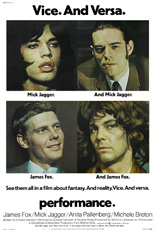
In the rogue hands of director Nicolas Roeg, Performance’s prince/pauper fable might have been overlooked, if not for its dispassionate narrative and drab surroundings making it one of Roeg’s definitive defective works.

East London gang member Chas (James Fox) goes about muscling the wrong people — beating, extorting, shaving a man’s head bald. It’s sitar raga in basic 4/4 time, man, as the scared Chas goes on the run and finds himself in the slovenly boudoir of strung-out rock star Turner (Jagger).

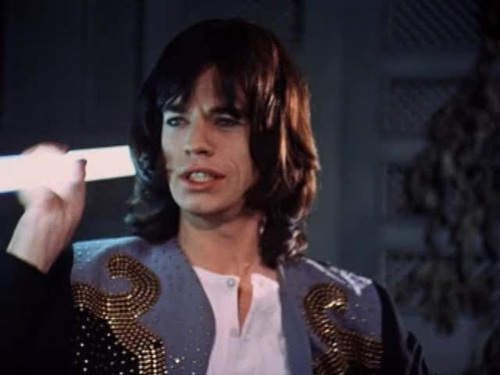
In addition to a drug habit, Turner has quite the sexual addiction. He leads Chas into drab games of master and servant, with bisexual Pherber (Anita Pallenberg) and Lucy (Michèle Breton) feeding him LSD and handling loaded weapons in a slim bathtub while smoking cigarettes and, probably, scissoring.

As Turner performs the movie’s lone single, “Memo from Turner,” he and Chas physically and metaphysically transform into one another, resulting in not only the type of spiritually devolved finale Roeg was wont to do later (in Don’t Look Now and The Man Who Fell to Earth), but also one of his most troubling films, all in a syncopated tabla-beat way.

With all the pomp and circumstance a man can muster, Jagger’s performance is very invasively tight, but Fox is no slouch, giving an enthusiastic, bleak portrait like he did in films such as The Loneliness of the Long Distance Runner. Together, they’re a satanic pair of spilled wine decanters filled with all the vice in the world, and it’s impossible to take your eyes off them.

But, in the end, Roeg’s masterfully hypnotic direction, aided by artist Donald Cammell, is the burning, the consumption and the dying of the fading rock star and his homunculus’ wet ashes, mystically and masochistically buried along with their names.

I never found my hellish opening to that detached, debauched, hedonist rock-star lifestyle I so secretly craved, but Jagger — and, really, Roeg — were kind enough to show me their vacation photos. That’s good enough for me. —Louis Fowler

Get it at Amazon.

Gummo (1997)

WTF

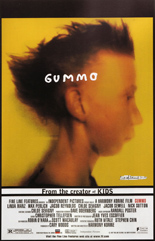
A white-trash travelogue through the scabies-infested underwear of the crusty underworld of destitute hell, Gummo is the overpriced souvenir photo you get the world’s worst gift shop.

Featuring budding sociopaths, disabled sex fiends and freshly killed pets, the rancid smell of this movie is a combination of rotting trash, decayed carcasses and dirty jean shorts. Filmed in a cinéma vérité-style anti-style somewhat within the boundless boundaries of the supposed Dogme 95 movement, it’s an art film for the perpetually artless.

In the ruins of Xenia, Ohio, a traumatic tornado has decimated the mostly white population and their malformed brethren in a drastic cycle of abject poverty, serious non-education and, for the most part, death metal. Gummo starts with an emaciated boy in dingy bunny ears, spitting and urinating from an overpass. From this first minute, things get progressively worse with the mostly amateur cast of jobless ne’er-do-wells excreting the most anti-social behavior.

In small, disparate sections, a kid feeds glass-riddled food to stray cats, platinum blondes with puffy nipples dance on a bed, skinhead brothers engage in bareknuckle horseplay, a pair of foulmouthed youngsters shoot cap guns, director Harmony Korine sexually assaults a gay little person, and, in the most suitable section of the film, the world championship of chair wrestling goes down.

Even with all that, Gummo has a through line of two junior delinquents like to huff glue, score with an underage prostitute, murder a comatose granny, drown numerous kittens and, worst of all, take baths in the foulest green water while eating sparse spaghetti.

Known for his shock-based indie features like Spring Breakers, Korine has assembled a stellar cast of the worst possible losers, users and in the case of Chloe Sevigny, poseurs. It’s a remarkably pathetic time at the movies — and one that is infinitely watchable.

It’s a totally class-based scare film about that one house on the block whose residents drunkenly play their music too loud at 3 a.m. and then pistol-whip you for complaining. You know the one!

Some people think Gummo is truly destitute outsider art — actually, most of Korine’s work is like that, but that’s a whole other thing — leading me to wonder if this is an actual narrative film or a documentary of the most homeless order.

Or both?

Either way, it’s that type of movie that will make you claw deeper into your white-bread Christian worldview of opioid-addicted sinners or expand your holy subconscious into venereal medicines usually administered though the penis. —Louis Fowler

Get it at Amazon.

Slade in Flame (1975)

WTF

Mistakenly thinking they were the glam-rock band Sweet (the passionate ones, oh yeah!, according to “Ballroom Blitz”), I now realize the musically similar band Slade is, of course, the glam-rock band Slade. (But no disrespect to Sweet!)

Known for their kinda-sorta bottom-tier glam-slams in the ’70s, Slade had a few hits like “Mama Weer All Crazee Now,” “Cum on Feel the Noize” and that one festive Christmas song that everyone in Britain seems to like. In America, they are incorrectly known as a Quiet Riot cover band.

In 1975, at the height of polyester-uniform infamy, the band was an overseas hit machine that somehow starred in the rabble-rousing, rags-to-riches fable Slade in Flame. They play the fictional band Flame, a working-class combo that starts from the bottom and, in a drastic move, stays there.

The movie, with the benefit of hindsight, goes nowhere but down, down, down.

After being the backing musicians for a tepid wedding singer with a lounge act that really is terrible, the guys — Dave Hill, Jim Lee, Don Powell and Noddy Holder — drop all their pretensions and precognitions and become the band Flame, a very popular (I guess) but volatile musical act.

But this is no A Hard Day’s Night, as Flame burns out with stuffy money men, wanton groupies and a seemingly terrorist organization that takes down pirate radio stations of the middle of an estuary — the brightest spot in the movie, referencing Radio Caroline — as they all tire of fame and stardom, disbanding after a (pretty good) show.

As expected, the members of Slade are semi-passable as working-class musicians and real ne’er-do-wells. With footage of the screaming audience passing around Flame merchandise, banners and signs, I was led to feel that the act was truly real.

And that’s great, but the one thing that should work here is the soundtrack. Sadly, it’s ho-hum, reworking Slade’s already formulaic music that already doesn’t do much, except go in one ear and out the other. A band with their own movie should have some real rippers, but instead they had to concentrate on their acting. And scene!

Though Slade in Flame has been rediscovered by a minute cult audience over the past decade, there are so many other gems in the rock era to cover. While the real Slade is a serviceable band that can rest on their laurels; much like the wholly fictional Flame, they should go their separate ways with no reunion tour. —Louis Fowler

Get it at Amazon.