
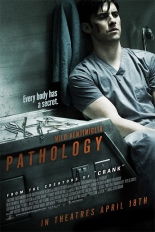
 There’s not a single likable character in Marc Schölermann’s Pathology. Not a one! Ostensibly, the lead character of med student Ted Grey should be, but they cast Milo Ventimiglia. Oops! His brand of acting — squinting, really — only worked for him in TV’s Heroes, and nowhere else.
Ted’s new to the bestest pathology tract in the country, where his fellow students are all like, “to hell with the Hippocratic Oath — let’s fuck around and play some reindeer games with these here corpses, aight?” Their unofficial leader, Jake (Michael Weston), introduces Ted to the game they play after hours: autopsy! See, they kill random people and bring them in to see who can guess how they offed them. When did Quarters go out of style?
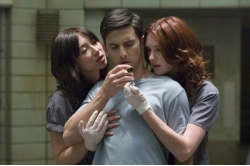 But, wait, there’s more! They also engage in group activities like smoking crack and having sex on the slabs. Why? The only good reason I can think of is because this was written by the reigning kings of over-the-top cinema, Neveldine/Taylor, who wrote and directed the Crank films and Gamer; it’s too bad they didn’t direct this one, too, because it could stand to be more outlandish. Redeeming quality: Ol’ Dr. Giggles himself, Larry Drake, pops up as a fat bastard credited as Fat Bastard.
It’s a mess — and not just because of all the bodies being cut open — but I get what Ventimiglia saw in the project: free feels. In the first scene, his hand slips underneath fiancée Alyssa Milano’s shirt and works itself all over her left boob; later, he’s all over the bared breasts of Lauren Lee Smith. It’s a living. —Rod Lott
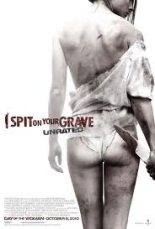
 And now here is where I’m supposed to tear apart
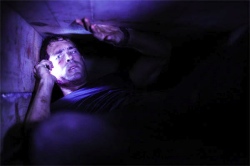 When I first saw the movie’s trailer, which includes the moment when an asp slithers into the coffin through a crack, I thought the film would be a tough sell — not because it plays so strongly on the common fear of enclosed places, but because its lack of action would bore younger audiences.
 When Uggams is towed into town by Ted Cassidy (Lurch from
 Second are Lo and her boyfriend (Cary Woodworth), attempting to coerce one of their friends into a threesome, and finally finding a willing partner (Tiffany Shepis). Finally, there’s a sad-sack loner (Lee Schall) attempting to buy roofies for a girl he likes, so he calls a delivering drug dealer (Rodney Eastman,