

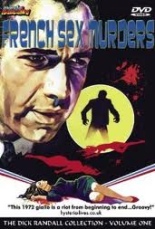
 One has to love how direct The French Sex Murders is, not only in title, but making good on that title. Viewers will get healthy doses of all three things in B producer Dick Randall’s shot at a giallo. Heck, the opening of a man leaping from his death (partly rendered in crude cartoon) from atop the Eiffel Tower is even repeated at the end. What scenery!
And I don’t mean just the Eiffel Tower, either, because much of the film is set in an exclusive Parisian brothel headed by Madame Colette (Anita Ekberg, La Dolce Vita). One of its hottest whores (Barbara Bouchet, Don’t Torture a Duckling) is discovered murdered, and her last client (Peter Martell, Death Walks at Midnight) is fingered for the crime. He accidentally beheads himself fleeing the police, yet the call-girl killings do not stop with his grisly death.
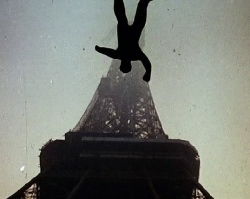 Inspector Pontaine (Humphrey Bogart lookalike Robert Sacchi, in his debut) continues to hunt for the real killer, taking him from the bosom of Lady Frankenstein‘s lovely Rosalba Neri to the laboratory of Professor Waldemar (Howard Vernon, The Awful Dr. Orlof), who proposes an intriguing theory.
The mystery is so easy to crack, it hardly qualifies as one. But that’s not the point; a giallo is less about the killer, and more about the kills. Director Ferdinando Merighi likes his so much that he shows you the exact same shot of the violent act in several times’ succession, but each in a different colored tint. He also shows you many women in the altogether nude, but keep in mind that some of them are French, which means their armpits match the drapes. —Rod Lott
 When an arrogant art buyer (Herbert Lom, the
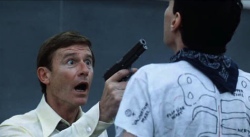 It takes about one class for King to get on the bad side of these ruffians, led by a gifted maniac played by Timothy Van Patten (
 And for a while, this Japanese thriller is as well, as authorities attempt to draw the line that connects the three tragedies. What director Masayuki Ochiai does wrong is then steer the story from a procedural mystery to the supernatural element of the “creepy young girl” then so prevalent and in vogue among Asian cinema — and soon in American remakes. Even with accompanying surreal set design that suggests hiring Dr. Caligari as a contractor, what was interesting becomes unimaginative and tiresome. —Rod Lott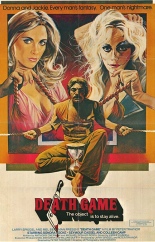
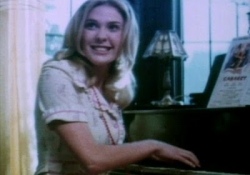 They have no intentions of going. In fact, they tie him up and “hold court,” pledging to kill him at the end of the weekend. Jackson goes all nom-nom-nom on his groceries like a brain-damaged pig (“You have the manners of an alley cat!” he screams), while Donna plays the piano horribly. Both fuck with his wife’s makeup so they look like they’re part of a troupe called Whore du Soleil, and cackle like the batshit-crazy loons they are. But, hey, Camp’s breasts.