
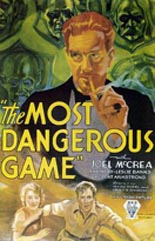
 From the makers of King Kong the following year, 1932’s The Most Dangerous Game is one of the most influential and imitated movies in history, and for good reason: It’s a splendid, Prohibition-era adventure with a concept that transcends time. And that concept is that, unequivocally, rich people are assholes.
Based on Richard Connell’s excellent 1924 short story of the same name, the RKO Radio Picture begins with a ship capsizing in shark-infested waters. The only survivor, Bob (Joel McCrea, Alfred Hitchcock’s Foreign Correspondent), washes ashore on an island and arrives at the only home around, belonging to one Count Zaroff (Leslie Banks, Hitch’s The Man Who Knew Too Much of 1934). As if the host’s name isn’t scary enough, his door knocker is a demon holding a woman. In life, we call such things “a red flag.”
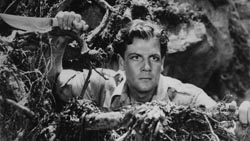 Zaroff is crazy, all right. Having lost his love of life, the man has resorted to big-game hunting, but hunting humans. Bob and another “guest,” the alluring Eve (Fay Wray, King Kong), are to be his latest prey. If they can survive from midnight to sunrise in the jungle, Zaroff will give them keys to the boathouse so they may float their way to freedom.
Bob and Eve believe staying alive is a swell idea, so they build traps in the hopes of turning the tables. And therein lies the fun. Utilizing a mix of backlot sets and rear-projection tricks, co-directors Irving Pichel and Ernest B. Schoedsack pull off an exciting exercise exploring man’s inhumanity to man, via swamps and caves and dogs, and waterfalls for those dogs to tumble down. It’s not politically correct; it’s not meant to be. —Rod Lott
 Michael Caine (who later saw true disaster in
 Every time the jar bubbles, somebody gets horny or murderous — sometimes both. During one particularly heated round of intercourse, Howard and Carol start slapping the crap out of each other. The boom mike makes its way into the frame once.
 Operating on a budget of what looks like a hundred dollars and change, Trost gives it an admirable go, but the movie becomes bogged down in too many plot holes (how did Rickshaw manage to capture them in the first place?), too many unanswered questions (their superpowers are never explained), too many eye-rolling scenes (the characters have a knack for heart-to-heart conversations while their time is clearly running out) and too many seams showing (in both their costumes and the “special effects,” as in explosions being shown by an off-camera stagehand tossing bits of wood and handfuls of dirt into frame).