

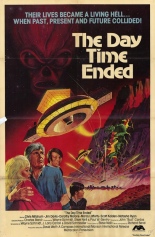
 I hope you like images of stars in space — because that’s the first three minutes of The Day Time Ended, an early Charles Band production in which a family living on a desert ranch in California finds strange things afoot after three supernovas explode and the light is absorbed by their abode’s solar paneling.
First off, the requisite annoying little girl finds a glowing green pyramid thing behind the barn and thinks nothing of it because she’s a selfish bitch whose one-track mind is dead-set on her new pony. This leads to bathroom lights and faucets turning themselves on and off, and soon the nighttime appearance of a 3-inch-high stop-motion alien who dances and flitters about the cabinets and bedding.
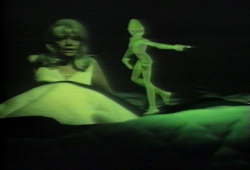 Then there’s a poorly matted spaceship that chases them through the house, and ultimately, as the title promises, time ends. Or rather, the family just gets warped into the future, on the outskirts of the city of tomorrow, and for some reason, this suits them just fine.
For us, however, it’s a whole other story — namely, one that can’t believe how director John “Bud” Cardos could follow up the greatness of Kingdom of the Spiders with dumb ol’ crap like this. —Rod Lott
 Based on a
  In basic terms, that’s ridding Japan of aliens, which take on wildly varying forms, from onion-headed mutants and a clockwork robot to statues that come to life, all of which the players shoot with powerful, energy-pulse weaponry that results in exaggerated explosions of gore and grue. Die in the timed game, and you die for good; survive, and you can return to your former life, but remain at the ball’s nightly beck and call.
 Cursed with the kind of voice that causes dogs to howl in misery whenever she speaks, her is further diminished by a script that requires her to essay the role of the whiniest protagonist in the history of narrative storytelling. At times, the dialogue suggests that this was a deliberate choice on the part of director/co-writer Albert Pyun. Forced to cast Ireland as his lead, he obviously decided to turn her greatest weakness into the film’s main running joke, but chose to do so in a way that only makes watching it more of a chore than it might have otherwise been.
 They’re all fighting for control of something called a “grimhole.” (Can you say that in a Disney film?) Distracting Dave are his hormones; his magic wand grows for his childhood crush, bland blonde Becky Barnes (Teresa Palmer). He impresses her by playing musical Tesla coils. When she’s coming over, he has to clean up the place lickety-split, allowing the film to re-create Mickey Mouse’s ill-fated, abracadabra approach to housekeeping, but only after a shot of a dog urinating.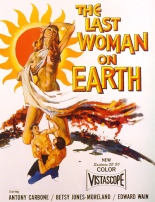
 This leaves them lots of time to talk and eat and talk. The men start seeing each other as a threat, and Betsy as a prize. But all they do is talk and eat and talk.