
Category Archives: Mystery

Hayseed (2022)

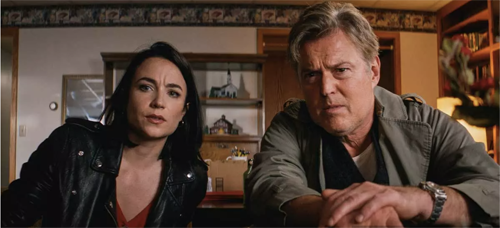
In a small Michigan town known for faith, family and farming (probably in that order), a local reverend is found drowned in his church’s baptismal pool. Insurance investigator Leo Hobbins (Bill Sage, 2021’s Wrong Turn) drives in from Detroit to determine whether the death was an accident or a suicide. The late rev’s right-hand woman, Darlene (Ismenia Mendes, 2019’s Lost Holiday), attempts to convince Leo of Option C: murder. She’s also the policy’s primary beneficiary — freshly added, at that. 

As unassuming a film as the cozy, close-knit town in which it unfolds, Hayseed marks an exceptionally assured first feature from writer/director Travis Burgess. Although every resident exhibiting a quirk isn’t exactly innovative, his film is an arch, wry comedic whodunit, aiming more for smile-all-the-time than laugh-out-loud, and succeeding.

With Leo, Burgess has gifted Sage the leading role that’s eluded him since his Hal Hartley heyday in the indie-friendly ’90s. The deeper the evidence takes the former cop, the more his gruff peevishness melts drop by drop into something the everybody-knows-everybody populace recognizes as human empathy. (Not so much that Leo wants to stick around after case-closing to solve more crimes alongside Darlene … but if he did, I’d watch that TV series.) Sage is utterly charming in the part, giving the movie its heart and its ulcer. Imagine Robert Redford as Fletch, if your mind allows such a flight of fancy. 

Best exemplified in recent years by Rian Johnson’s Knives Out pair of films, this style of mystery thrives on support from a talented pool of suspects. Here, that ensemble includes Kathryn Morris (Minority Report) delightfully playing against type as a flirty waitress, Jack Falahee (TV’s How to Get Away with Murder) as a recovering addict who’s renamed himself Duck, and Blue Ruin sibling Amy Hargreaves. Their individual work adds color to a plot that’s not hard to solve, but a blast to watch unfold — and hear, thanks to Xander Naylor’s Farfisa organ-fueled groove of a score. 

Other than another tightening of the wrench, Burgess could do precious little to improve Hayseed without potentially upsetting the recipe that baked such an out-of-nowhere winner. With pleasant surprises so hard to come by these days, don’t let this one go unnoticed. —Rod Lott

Get it at Amazon.

Killer’s Delight (1978)

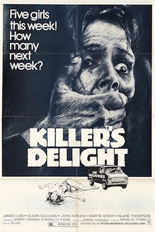
Like David Fincher’s Zodiac, Jeremy Hoenack‘s Killer’s Delight draws from case files and follows San Francisco police detectives in search of a real-life serial killer. Here, the maniac in question — based shoelace-loosely on Ted Bundy — clearly has a type: beautiful teenage girls hitchhiking home from bowling alleys and public pools. After use and abuse, he dumps their nude bodies like trash; a freeze frame of one victim in free fall serves as the title card’s backdrop.

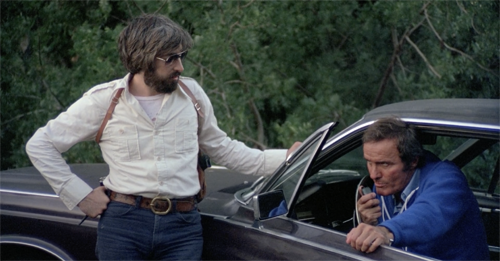
As lead investigator Sgt. De Carlo, James Luisi (1980’s Fade to Black) makes for a reasonable John Saxon substitute, especially with the easy rapport he shares with his partner on the force (Martin Speer, Exo Man). Once they suss out the ID of the murderer (John Karlen, Daughters of Darkness), the guys set a trap involving a radiant psychiatric doctor (Susan Sullivan, Cave In!) specializing in the criminal mind. Said trap requires her to go undercover as a nightclub singer, which works, by gum — both for the characters and for us, the viewers.

The lone directorial credit for Emmy-winning sound editor Hoenack, Killer’s Delight looks, sounds and acts like a made-for-TV movie, full-frontal nudity excepted. As the story unfolds, however, you’ll find yourself surrendering to its mighty grip. It’s top-shelf El Lay pulp — comfort-food viewing for the armchair detective.

Also released as The Sport Killer and The Dark Ride, it’s a film ahead of its time. If made today, it’d be a Netflix miniseries stretched across eight or 10 episodes; I’m thankful it exists as is, shock ending included. Imperfect though it may be, I wouldn’t change a moment. —Rod Lott

Get it at Amazon.

To Catch a Killer (2023)

Auld acquaintance should be forgotten, not sniped. Someone in Baltimore failed to get the message, killing 29 celebrants on New Year’s Eve from a downtown perch several stories up. As soon as the authorities determine where, the place explodes, leaving no DNA for them to trace.
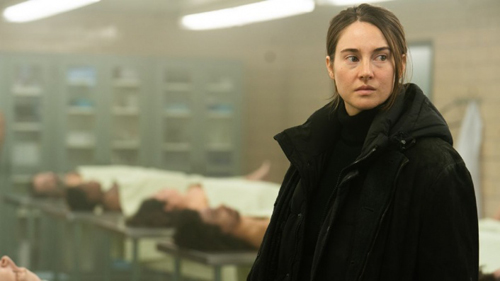
What’s an FBI chief investigator to do? If you’re Agent Lammarck (Ben Mendelsohn, Ready Player One), you recruit beat cop Eleanor Falco (Shailene Woodley, the Divergent trilogy), because you sense the destructive force within her. Whereas the killer turns the harmful urge against others, she turns it against herself (i.e., she’s a cutter); therefore, she’s exactly who he needs.

To Catch a Killer, Wednesdays this fall on NBC.

Kidding about the TV part, although — generic James Patterson-esque title and everything — To Catch a Killer is the definition of crime procedural as comfort-food viewing. A couple of factors elevate it above network-tube fare. For one, Mendelsohn. Always fantastic, he’s a pleasure not only to watch, but to hear; his voice betters the material, as does the hands-and-fingers acting on display here — magnetic once you notice.

I run hot and cold on Woodley, but she’s fine as what is essentially a more paternally influenced take on Jodie Foster’s iconic role in The Silence of the Lambs. Woodley’s pairing with Mendlesohn is like Clarice Starling had spent hours with Agent Jack Crawford instead of Dr. Hannibal Lecter.

The movie’s other pinch of je ne sais quoi is Damián Szifron, the Argentinian director of 2014’s sharp, acidic anthology, Wild Tales, rightly Oscar-nominated for Best Foreign Language Film. His camera is fluid and adept at zeroing in on unusual angles; showdown sequences in a mall and a drugstore ring with discomforting tension and demonstrate an impeccable control of timing. That’s why it’s so disheartening to watch Szifron give the eventually discovered killer the opportunity to deliver the de rigueur speech on Why He Is Who He Is.

Oddly, To Catch a Killer represents Szifron’s first gig since Wild Tales — an alarming, near-decade gap! How he went from something so unhinged to something that could end with Dick Wolf’s production company logo (not to mention a three-hour programming block along its spin-off series, To Catch a Killer: Seattle and To Catch a Killer: Behavioral Science Unit) is an even greater mystery than this one poses. Unlike Killer’s, it remains unsolved. —Rod Lott

Get it at Amazon.

The Long Wait (1954)

In The Long Wait, Anthony Quinn gets his kicks on Route 66 — kicked by physics right out of a car after it careens off a cliff, that is. Although he survives, he emerges with a serious case of amnesia. Not only did his ID burn in the crash, but so did his fingerprints! He’s so desperate to discover who he is, he thumbs through the White Pages at random, hoping any name will trigger the necessary synapse.

A chance meeting results in a tip he’s from the town of Lyncaster, where he learns his name is Johnny McBride. Oh, and that he’s also wanted for murdering the district attorney. Despite not recalling a thing, McBride knows enough to know he couldn’t have committed such a crime. Could he? Only a woman named Vera West holds the key to unlock the vault that is his clouded noggin — if he can find her. And recognize her.

Based on the Mickey Spillane novel of the same generic name (the author’s lone non-Mike Hammer book for about a dozen years), The Long Wait followed the 3-D I, the Jury to theaters a year later, striking while the Spillane iron was still hot. A film noir that grows more stylish as it goes, The Long Wait is the better picture by far.

For starters, it has an accomplished director in Victor Saville (Dark Journey), who pulls off some real doozies of shots and sequences, adding a dab of the Impressionistic without being showy about it. One particular instance shows McBride standing where he used to work as a bank teller; Saville briefly frames Quinn (Across 110th Street) behind the counter’s bars, foreshadowing where our protagonist will end up if he can’t solve his own mystery.

Another ace up the film’s sleeve is co-scripter Lesser Samuels (rightly Oscar-nominated for Billy Wilder’s Ace in the Hole), adapting Spillane’s slim novel with equal thriftiness. Hammer-less though the movie may be, the signature character’s tough-guy vibe ably lives in spirit through McBride, who answers a “why” question with a curt, “I took a Gallup poll.”

This film arrived at Quinn’s post-Academy Award transition from supporting parts to leading man; with ink-black hair and eyebrows the size of XL caterpillars, his mere presence commands the screen. He gives the proto-Memento pic its stony heart, while Saville stacks the deck with four gorgeous women to provide the sizzle, with Jury forewoman Peggie Castle joining Shawn Smith, Mary Ellen Kaye and Dolores Donlon. Losing one’s memory has always been this dangerous, but never so sexy. —Rod Lott

Get it at Amazon.

I, the Jury (1953)

Suitably, I, the Jury begins with a bang — literally, as the sawed-off muzzle of a .45 pokes through an apartment door and fatally plugs a one-armed man. And it should, this being the first live-action depiction of Mickey Spillane’s Mike Hammer character. At the time, Spillane had sold millions upon millions of paperbacks featuring the private dick, so a movie was a big deal — so big, it was made in 3-D!

Biff Elliot (The Day of the Wolves) plays the investigating Hammer like an exposed nerve with a hair-trigger temper. If he’s not shoving a nosy journo into the contents of a china cabinet, he’s throwing a drink in the face of some hood. Equally agile is his mouth, eveready with a salty cutdown of doubt. For example, when a person of interest claims he can prove he was in bed at the time of the crime, Hammer snaps, “How? Take a notary public with ya?”

With a Christmas setting making misery, writer/director Harry Essex (Octaman) keeps the frames moving at a pace approximate to the seemingly effortless swiftness of Spillane’s pages. We follow Hammer as he leaps from informant to suspect and back again, including an alcoholic fighter, a veterinarian, a dance instructor, a Spanish bartender and, most notably, a hotsy-totsy shrink (Peggie Castle, 1952’s Invasion, U.S.A.) who serves as our femme fatale. Everyone is so colorful, the whodunit aspect practically becomes secondary.

Although limited as an actor, Elliot makes for a fine-enough tough guy, excelling in his narration of Jury, which is an admirable way to transition the character from novel to screen. I’d say it’s a shame neither he nor Essex got the opportunity to repeat their jobs as a franchise, but then we wouldn’t have Robert Aldrich’s definitive Kiss Me Deadly two years later. That’s a crime classic; I, the Jury is a pretty solid lead-in. —Rod Lott

Get it at Amazon.