
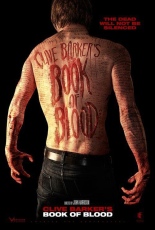
 Well before the end-of-Bush-era housing market collapse, I had the damnedest time trying to sell a perfectly good home. We had spent thousands of dollars in updates; the neighborhood was safe; and the school district was solid. Took me 16 agonizing months.
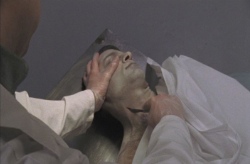
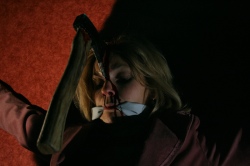
But in Book of Blood, a young woman gets her face ripped clean off by an unseen force of malevolence in her parents’ home, and professor Mary (Sophie Ward, the little girl from Young Sherlock Holmes, all growed up!) is all like, “Huh, I think I’ll move in and see whassup. So long as it passed inspection!” She invites her hunky new student, Simon (Jonas Armstrong), to move in, too.
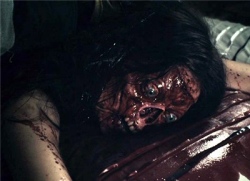 This being based on two Clive Barker stories, all is not well. Writing appears all over the walls of the upstairs bedroom, warning not to “mock us.” Plus, flesh carving (just how rough does it Barker like it, I wonder?) and forbidden sex, in which Ward’s nipples are so erect and pencil-eraser elongated, her partner risks ocular trauma.
Adapted and directed by John Harrison of the underrated Tales from the Darkside: The Movie, it has an ending that makes you think, “Who wrote this? Jeane Dixon?” It’s also not scary, unless you’re terrified of dragonflies, in which case you’re totally fucked. It’s no Candyman or even Midnight Meat Train, but it’s decent enough, if senseless. —Rod Lott
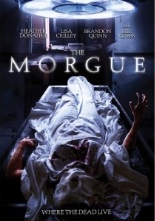
 So on this night of nights, Margo is interrupted by a family of three that comes in because they ran out of gas. (Mom is played by Heather Donahue, she of the enraged nostrils in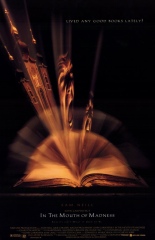
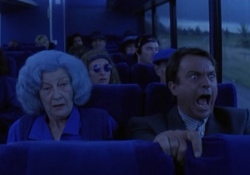 Mouth contains several set pieces that blend Lovecraftian concepts with Carpenter’s vision to create an unsettling atmosphere that grows more and more surreal, twisting reality, religion and fantasy around each other like an insane caduceus. The film is loaded with references to Lovecraft’s tales, and maybe that’s why it has never been particularly popular. It may be too old-school and literary for teen horroristas. Perhaps, too, Carpenter’s devotion to prosthetic rather than CG monsters makes it seem quaint. The director calls it the final film in his “Apocalypse Trilogy,” along with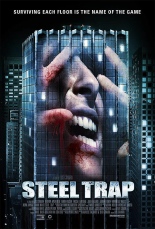
 The table’s place settings sport not only the guests’ names, but unofficial titles like “Loser,” “Heartless” and “Two-Faced,” yet they don’t see anything wrong with that. The clues are given in nursery rhymes, yet they aren’t the least bit creeped out by them. The first one takes them to a disembodied pig’s head wearing a crown, yet they keep on going.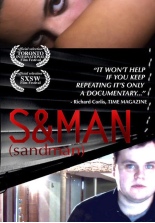
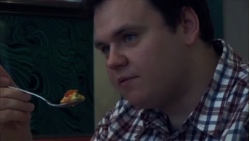 It’s no easy task to combine the real and the fictional as well as Petty does here, but ultimately, I found myself troubled by the conclusions he reaches. In his final narration, he tells us that we watch horror movies knowing that the violence is fake, while wishing it were real — which, in my case, simply isn’t true.