
Category Archives: Horror

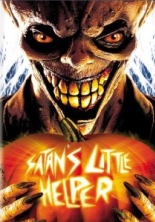
Satan’s Little Helper (2004)

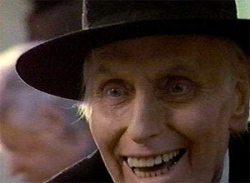
An odd bird, this Satan’s Little Helper. Its whacked-out premise centers around college girl Jenna (Katheryn Winnick, Amusement) coming home on Halloween just to take her little brother, Dougie (Alexander Brickel), trick-or-treating. That itself isn’t bizarre; the kid’s newfound fascination with Satan, however — and one totally encouraged by his parents — is.

Dougie tells Jenna and Mom (Pulp Fiction‘s Amanda Plummer, repellent as never before) that’s his Halloween dream is to find Satan and be his assistant for the night, to send people to hell. By sheer coincidence, Satan is in town — he of the horned head and mouth that cannot move — murdering people in brutal fashion. Dougie witnesses Satan’s doings, laughs, befriends him, and asks him to kill Jenna’s new boyfriend (Stephen Graham), who kind of deserves it, once you see the guy in his Pretentious College Theater Major Douche hat.
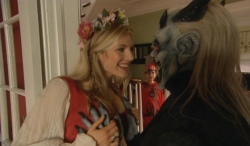
This gives way to a rollicking, stab-a-rific caper — perhaps even a love story between a lisping child and the demon to end all demons, bonding over harming innocents that include a pregnant woman, a newborn baby, a blind man, Dougie’s own father and many more. An elderly lady gets hanged to death on her porch by Satan, and Dougie, for whatever dipshit reason, thinks it’s the funniest trick he’s ever seen. Ditto for Satan squeezing Jenna’s generous breasts in her Renaissance slut costume. (“I can see your boomies!” says Dougie with a disturbing chuckle.)

Writer/director Jeff Lieberman has never been a great filmmaker (1976’s Squirm made Mystery Science Theater 3000, after all), but with Helper, he’s hackier than ever. I mean that in a good way, however, because the flick is an empty-calorie equivalent to a bag of fun-size Snickers. It’s like no other Halloween movie you’ve ever seen, and while I wouldn’t put it up there with Michael Myers’ ongoing efforts at reducing the population of Haddonfield, Ill., it definitely holds mega-potential for annual October viewing. —Rod Lott
Buy it at Amazon.

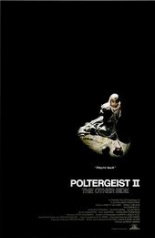
Poltergeist II: The Other Side (1986)

The Other Side must refer to where the grass is greener, because this sequel is full of manure. JoBeth Williams and Craig T. Nelson return as the heads of the Freling family, now living with her mom after their haunted house vanished into thin air at the close of the original.

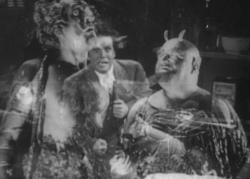
Everything’s fine and dandy for a while, until Grandma notices that lil’ Carol Anne (Heather O’Rourke) appears to have extrasensory powers, and a skeletal-faced preacher named Kane stalks the family. Then Grandma dies, and an Indian (Will Sampson) starts camping out in the backyard and making leaves levitate to help protect the family. Inside, Carol Anne gets otherworldly telephone calls on a toy phone; her brother, Robbie (Oliver Robins), is menaced by his own braces; and Dad vomits up a giant tequila worm with huge testicles.

With the aid of Sampson and pint-sized Tangina (Zelda Rubinstein), the Frelings return to the site of their old home and cross over to another dimension, resulting in a ludicrous, laughable sequence, culminating in a return from Dead Grandma as an angel. Williams cries; you’ll laugh.
It’s amazing how something that was mildly disappointing at the time is utter trash today. The original Poltergeist remains one of my all-time favorites, but all of its thrills have been replaced here by Native American mumbo-jumbo, bad acting and wrong turns in every scene. It’s one of the most disappointing sequels in history. Where’s a clown when you need him? —Rod Lott

Buy it at Amazon.

Maniac (1934)

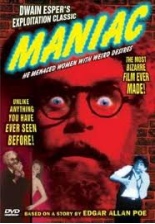
Dwain Esper’s Maniac is one of the more notorious early exploitation films, but it’s still dreadfully boring, even at 50 minutes. And while you can cut it a little slack for being from the 1930s, the story still doesn’t make a lick of sense. Maniac is amateurish in all aspects, from the actors (sometimes gazing in the camera) to Esper’s direction (sometimes the performers’ faces are blocked by props).

An old, eccentric doctor and his young assistant are experimenting with formulas to revive the dead. When the doctor wants to kill the assistant and then bring him back with a new heart, the assistant shoots the doctor dead. Instead of shooting him with reanimating juice, however, he holes him up in the wall of the basement and then changes his appearance to look like the doctor so no one will notice his absence.

To help mask the illusion, the assistant-as-doctor keeps seeing patients, including a shy, topless chick and one man who goes mad, kidnaps a formerly dead girl, strips off her clothes and rapes her. Meanwhile, the assistant’s wife hangs out with her friends in their bras and granny panties. The nudity in this must have been shocking way back then; now it’s simply comical.
The high point comes out of no-where, when the assistant grabs a cat and pokes its eye out in graphic detail, admires it (“Why, it’s not unlike an oyster … or a grape!”) and pops it in his mouth. Bon appétit! Then the cops arrive and find the doc in the wall, thanks to the cries of a cat accidentally trapped in there with him, thanks to a storyline swiped from Edgar Allan Poe. Then you get to go to sleep, if you haven’t already. —Rod Lott

Buy it at Amazon.

The Toolbox Murders (1978)

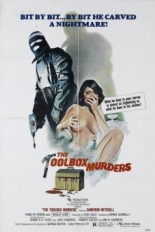
To be fair, the slasher portions of this infamous slasher film make up only a small part of the picture. It should be called A Criminal Investigation Into the Toolbox Murders. Regardless, The Toolbox Murders is one of those movies I was too young to watch at the time it hit VHS, only able to read and hear about it being one of the most vile things ever committed to celluloid. Not sure if this says something about hype or me, but really, now that I’ve seen it, I found the movie fairly tame.

Don’t worry, though: Bloody murders using tools do occur. They all go down at an apartment complex that, conveniently, is the kind where lovely ladies undulate in their underthings at night in front of open windows, as if inviting pervo-psycho killers with a True Value rewards card. The most infamous moment involves porn star Marianne Walter (Screw My Wife Please 44: She Needs Your Meat) being nail-gunned after masturbating in the tub. It happens.

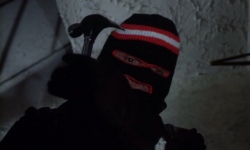
After the ski-masked killer’s rounds of chiseling and hammering tenants, one right after the other, The Toolbox Murders switches into a police procedural, à la Law & Order: Hardware Victims Unit, as the cops investigate. Unlike Tobe Hooper’s superior 2004 remake, the movie then hits some serious drag. Had it spaced the crimes out, one’s attention would be better held.
Still, it’s The Toolbox Murders. When something with such a demented concept enjoys cultural impact decades later, it’d be a shame not to embrace it at least a little bit. It’s almost worth watching just to see Wesley Uhre, simultaneously breaking out of his Land of the Lost typecasting and smothering his career. It’s definitely worth watching just to see Cameron Mitchell, being Cameron Mitchell. —Rod Lott

Buy it at Amazon.

The House on Skull Mountain (1974)

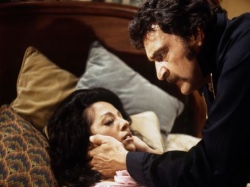
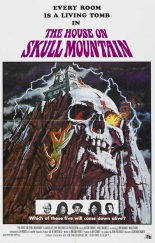
The House on Skull Mountain is pretty much everything you want in ’70s cinema: stylistic horror, blaxploitation, Victor French with a porn ’stache. The story goes that an old, Haitian, voodoo priestess has died in her mansion atop a mountain (shaped like a skull, natch) in eastern Georgia (look for it in finer guide books right next to Stone Mountain). She leaves the place and a couple of eerie servants to a quartet of distant relations: prim Lorena (Janee Michelle), jive-talking Phillippe (Mike Evans), God-fearing Harriet (Xernona Clayton) and inexplicably white Andrew (French).

The movie, of course, realizes that Andrew’s racial heritage needs accounting for and explains that that’s actually why he’s there. He was adopted and is jumping at the chance to learn about his real family. Unfortunately, he runs late to the reading of the will, and the lawyer’s not set to return for another week. Plenty of time for everyone to settle in and start dying.

Phillipe is a creepy fool who drunkenly hits on Cousin Lorena; Harriet is a timid housemaid who sees visions of death. Lorena and Andrew quickly form a relationship that may or may not be romantic (I choose “not,” because it allows me to continue judging Phillipe while still liking the two leads), giving this House some appeal that it probably doesn’t deserve. There’s nothing overtly sexual in the way they act around each other; they’re just extremely comfortable in one another’s company and encourage each other in more ways than simply trying to stay alive. There’s a particularly sweet scene where Andrew complains about not knowing anything about himself: “I don’t even know what color I am.”

“Oh, Andrew. Is that really important?”

“You know that it’s not,” he says. Convincingly, too. “But I’d like to know.”

It’s nice to see since they were so obviously lonely people before they showed up in voodoo country. I’m not sure that Georgia actually is voodoo country, but we’ll run with it. At any rate, the sweetness of their relationship raises the stakes for both Andrew and the audience when Lorena becomes the next to be drummed out. —Michael May

Buy it at Amazon.