
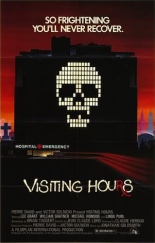
 I am not a fan of hospitals. I can’t take three steps into one without being overcome with a wave of anxious nausea, keenly aware that somewhere in that building — far closer than I’d like — someone is drawing his or her last breath. Ironically, it’s that same anxiety that draws me to hospital-set and medical-themed horror movies, since they allow me to face my fear without risk or consequence. Having seen a lot of them, I can comfortably say that the 1982 Canadian-made Visiting Hours ranks near the top of the list.
While it admittedly never exploits its setting as effectively as Boaz Davidson’s Hospital Massacre, it manages to avoid descending into the ridiculous camp that mars that otherwise interesting effort and, more importantly, creates sympathetic characters we want to see live, rather than die — the hallmark of every successful horror movie.
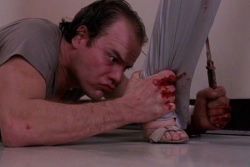 The film stars Michael Ironside as a misogynist maniac on a mission to kill the popular female broadcaster (Lee Grant) who has taken on the cause of a battered woman unjustly convicted of murdering her abusive husband. When his initial attack on her is thwarted, he returns to the hospital to finish the job, but only manages to kill a bunch of other people before she is able to use his own knife to end his deadly spree.
Directed with style and tension by Jean-Claude Lord, Visiting Hours succeeds thanks to effective performances from its talented cast, which also includes William Shatner as Grant’s producer, and Linda Purl as the young, single mom/nurse who finds herself also stalked by Ironside after she witnesses him leaving the scene of one of his crimes. —Allan Mott
 “So Far” is a quasi-ghost story that goes on too long, with a twist that mitigates any power. It examines what happens when an only child’s parents are killed in a car crash, but return as ghosts, only unable to be seen or heard by the other spouse. “The Poem of Collected Sunlight” stands out, but only because it’s animated. The two-character bit is like the Frankenstein myth rendered as a tonal piece.

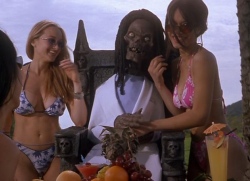 Her employer, Craig Sheffer, explains his crazy brother (Daniel Lapaine) believes he’s a zombie. With so much voodoo afoot, lots of hallucinations are experienced in this ridiculously routine shocker: crawling spiders, moving trees, crashing ceiling, Medusa hair and so on. Holy shit, does Grey sure scream a lot. But she has no Principal Rooney to kick in the face immediately thereafter, which makes a huge difference.

 That’s before he and the thesps get locked in the theater with the killer, who’s now using the aforementioned owl head as his trademark, so take that, hockey mask! Members of the musical get stabbed, drilled, sawed and axed, and they all wonder who, who could it be? (That’s an owl pun.) Meanwhile, the oblivious cops sit outside, talking about James Dean and Popeye.
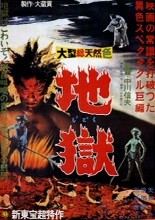
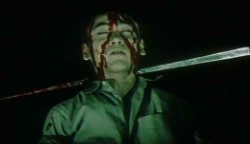 Finally, with a little more than half an hour to spare in the running time, he goes to Hell. Worse, Buddhists believe in a Hell comprised of eight Hells, so buckle up! Upon arrival, he gets his throat pierced, has to view a Your Life’s Greatest Fuck-Ups reel and learns just how hot flames of eternity can be. Shirô gets the 25-cent tour and sees the newly dead being flayed, boiled and spiked for punishment — different strokes for different folks, all rather graphically depicted with lots of red acrylic paint.