
Category Archives: Horror

Jim Haggerty’s Grave Danger (2009)

Poor Becky. After walking for the length of the entire opening credits to her apartment, hopes for R&R get decimated by a phone call from an unnamed man who wants to tell her some “scary stories” and says she’s in … grave danger!

And also she’s in Jim Haggerty’s Grave Danger, a no-budget, shot-on-video anthology from the New York-based moviemaker whose name adorns the title. Not exactly the cachet of Tyler Perry, but perhaps a PSA of sorts, lest someone thinks they’re renting Quentin Tarantino’s CSI two-parter.

In the first story, paranoid Victor (Jae Mosc) believes he’s being followed by a tuxedoed chap, whom no one else sees. Becky’s reaction to this tale o’ terror? “Yes, it scared me. It was scary. Okay, is that what you want? Yes, it scared me.”

Then, there’s Carol (Kate Webster), who buys a gaudy tribal statuette that entrances her into donning lingerie and seducing deliverymen, only to kill them.

Thirdly and finally, Abe (Bud Stafford, The Putt Putt Syndrome) is a washed-up ventriloquist struggling to afford meds for his ailing wife (Kaye Bramblett, Squeeze Play). When a birthday party gig stiffs him on payment, Phineas extracts the debt in blood. Phineas is his dummy, BTW.

Oh, in between those vignettes, the caller (Jonathan Holtzman, Sweet, Sweet Lonely Girl) convinces Becky (Debbie Kopacz) to undress to nothing. She complies.

Needless to say, none of Grave Danger qualifies as scary, outside of characters’ goombah pronunciations like “PAH-k,” “TAH-k” and “re-TAHD” for, respectively, “park,” “talk” and, well, let’s not get canceled. It needs a fourth story in which Haggerty explains how he convinces all these women — friends? family? apartment complex neighbors? — to take off all their clothes for, what, maybe $20 and free cardboard pizza?

Strangely, the one who doesn’t is top-billed Cathy St. George, erstwhile Playboy Playmate for August 1982, as Dr. Geraldine Masters, which I take as a reference to Don’t Look in the Basement. —Rod Lott

Get it at Amazon.

The Mouse Trap (2024)

Monday, Jan. 1, 2024 — a date which will live in infamy — the original version of Mickey Mouse scampered into the public domain. And enterprising filmmaker Simon Phillips was ready, dropping a trailer for the slasher flick Mickey’s Mouse Trap.

Now simply titled The Mouse Trap, it borrows the Star Wars crawl to deliver a disclaimer erring on the side of the caution, lest someone confuse this for actual Walt Disney Company product. With this Mickey teleporting and stabbing, how could they?

At the FunHaven arcade, the manager (Phillips) forces Alex (Sophie McIntosh, The Sacrifice Game) to work late on her 21st birthday for a party that’s rented out the place. Turns out, it’s for Alex — a pretty shitty thing for her “friends” to do, if you ask me. They kick off a night of sex, drugs and Skee-Ball — all spoiled by the Mickey-masked manager, who kills them one by one … and sometimes by two, somehow hiding within a space that isn’t exactly a labyrinth.

Why become such a fun-killer? If Phillips knows, his script doesn’t show it. As far as I could muster, it’s because the manager spills a drink on a frayed cord of a film projector loaded with Mickey’s debut cartoon, Steamboat Willie, thereby transforming him into a homicidal maniac. I suppose that could happen, question mark.

Unlike the similar Winnie-the-Pooh: Blood and Honey, the movie is watchable, with Deinfluencer director Jamie Bailey giving it more of the rhythms that resemble a “real” film. Also unlike Blood and Honey, in a select few spots, it approaches fun. (One of them: Asked whether she’s ever seen a horror movie, a young woman answers, “No, Marcus, I have a sex life!”)

But very much like Blood and Honey, The Mouse Trap is first and foremost a rushed-out cash grab, existing only to exploit Disney’s copyright loss before anyone else could, quality be damned. Another commonality the two flicks share: just ending without an ending. While I get the curiosity factor, this chunk of cheese isn’t worth taking the bait. —Rod Lott

Get it at Amazon.

Stopmotion (2023)

From Robert Morgan, the creator of the wonderful animated horror short The Cat with Hands, comes the feature-length debut Stopmotion, a film exploring the unraveling mind à la Videodrome or Possession. The film centers on Ella Blake (Aisling Franciosi, The Nightingale), a stop-motion animator helping her arthritic and overbearing mother, Suzanne (Stella Gonet), finish what will likely be her final film.

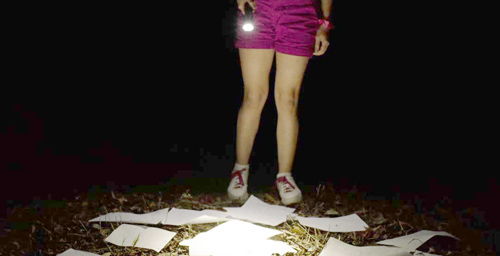
Ella’s tumultuous but structured life gets thrown for a loop when Suzanne has a stroke and falls into a coma, leaving Ella to potentially finish the film on her own. The problem is, she struggles to come up with ideas — she’s a brilliant animator, but not much of a storyteller. So when a mysterious little girl begins showing up at Ella’s apartment and dictates a new story about a girl lost in the woods being chased by a grotesque figure called the Ash Man, Ella reluctantly listens, and begins making the young one’s narrative.

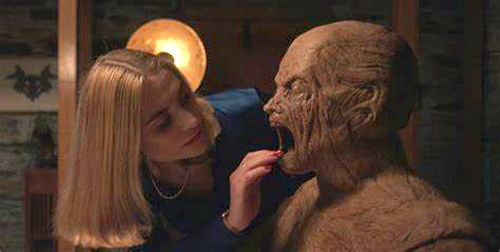
The new story is much darker, with figures made of mortician’s wax and spoiled meat, creating visuals that give ’90s-era Tool videos a run for their money. The little girl proves to be just as demanding as Suzanne, and this combined with the disturbing nature of the work begins to effect Ella’s sanity and her already fraught relationship with her boyfriend (Tom York).

Featuring stunning stop-motion animation from director Morgan, appropriately moody cinematography from Léo Hinstin, and a skin-crawling score by experimental sound artist Lola de la Mata, Stopmotion is a masterful slow-burn horror film with genuinely creepy imagery and a thoroughly shocking explosion of violence in its third act. Franciosi delivers yet another psychologically complex performance, proving herself to be one of the most dynamic actors in the horror landscape right now. Fans of Cronenberg, Zulawski and the eerie stop-motion films of Jan Svankmajer will not want to miss this one. —Christopher Shultz

Get it at Amazon.

Stupid Games (2024)

If there’s a saying I wish social media could ban, it’s, well, hundreds. But “Play stupid games, win stupid prizes” vies for the top spot alongside fellow bandwagon comments as “All the feels,” “I’m not crying, you’re crying” and, of course, “This.”

At least the movie Stupid Games has good reason for plopping the sentence on a title card, as what follows is a literal depiction of the adage.

Three young women host a dinner and game night at their apartment. They invite three guys, oddly insisting on the 1:1 gender ratio. We know something is up — we’re just not sure what. By candlelight, the assembled six play a board game whose rules mix Truth or Dare with Two Truths and a Lie; Fuck, Marry, Kill; and a bag of Scrabble tiles.

And by “play,” I mean it, as the flick devotes nearly an hour to watching them do so in real time. As proven, that can make for some serious screen boredom, yet Stupid Games might be the exception. Although the acting is inconsistent and its visual palette overly dependent on blah hues of brown, we keep watching because of Tanner Adams’ script: For nearly two-thirds of the running time, we’re not quite certain where it’s going, but we genuinely want to see the destination.

How co-directors Nicolas Wendl and Dani Abraham (both helming their first feature) handle the eventual “bogeyman,” so to speak, is eerily effective for something so simple. Sometimes, having a $10,000 budget that makes CGI cost-prohibitive is a good thing. —Rod Lott

Get it at Momentu.

MaXXXine (2024)

Add Ti West’s MaXXXine to the list of exploitation flicks Joe Bob Briggs would insist you check out. The much-anticipated, giallo-inspired climax to the X trilogy (2022’s X and Pearl) features voyeuristic knife-fu, car compacter-fu and, of course, stiletto-dick-stomping-fu. Despite the compelling and outrageous boxes it checks, MaXXXine provides a conclusion that — while in many ways incomparable — feels limp in the shadow of its predecessors.

Six years removed from X’s bloodbath, final girl Maxine Minx (Mia Goth, Infinity Pool) vies to move from porn to blockbusters. She’s made a name for herself in Hollywood’s underbelly, but her dreams have quickly outgrown the back alleys, strip clubs and peepshows where she finds herself. She nails an audition for a much-anticipated horror movie, The Puritan II. Unfortunately, a shady, annoying private investigator (Kevin Bacon, Tremors) and a serial killer targeting her closest friends muffles her celebration. Oh, and Pearl haunts her.

It can’t be understated: Each entry in the X trilogy has something to appreciate. X was an excellent homage to classic slashers supported by a phenomenal, dual performance from Goth. Pearl was a fascinating character study that combines the best parts of The Red Shoes and Henry: Portrait of a Serial Killer. MaXXXine, on the other hand, has an undeniably distinct style splattered across a living and breathing (and profusely bleeding) world.

But style alone can’t carry the film. It clearly defines what it’s examining, and the main idea it leans into — “fame’s a killer” and the sharp edge of stardom — yet only touches the surface. It’s like MaXXXine’s afraid to say anything challenging, so it instead opts for the most narratively convenient off-ramp it can scrape for. Similar to what made Nicolas Winding Refn’s The Neon Demon and Alex Garland’s Men lackluster, an uninspired climax rarely earns what those films’ effective first halves vie to accomplish.

That’s not to say MaXXXine is irreparably ruined by its final act. Goth still emerges as the backbone of all three Xs. She has a vast range that, though best showcased in Pearl, remains firing on all cylinders here. And West’s ability to keep dialogue snappy and natural is only exceeded by his talent for shooting captivating and alluring frames. Unfortunately, none of those exceptional traits can mask disappointing ends. It doesn’t matter how many times you punch Kevin Bacon in the face. Sequences pop an audience, but a thoughtful and well-rounded plot gives a flick permeance.

That said, you should still see MaXXXine; at the end of the day, even the weakest of the X trilogy is still far from schlock. True, what it does manage to say about an artist’s meteoric rise doesn’t carry the same weight as Pearl’s showstopping dance into a cruel reality. Still, like virtually all of West’s work, it clearly captures the tone it pursues. It’s just hard not to wish that aesthetic was part of a more realized package. Please don’t tease us like this next time, Ti. Please. —Daniel Bokemper

Get it at Amazon.