
So you’ve left your neo-Nazi, death-metal band behind after the suicide of its clown-faced frontman. Congrats! What do you do for an encore?
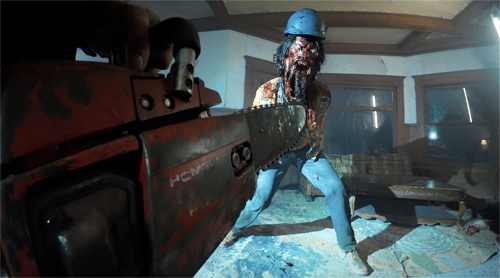
If you’re Louis (Michael Kunicki, Silent as the Grave), you emerge from rehab, speak to schools and attempt to make amends. You even visit surviving bandmate, Andy (writer/director Quinn Armstrong), at his remote farmhouse, where you see two flashlights wolves’ eyes ominously penetrate the ink of night. That may or may not have something with do with the cult Andy may or may not run on the property.
Second in the Fresh Hell trilogy — “3 realities, same hell,” goes the tagline — Wolves Against the World positions itself as a werewolf movie. This is true, albeit metaphorically rather than explicitly.
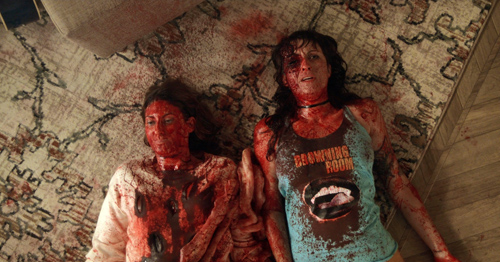
Like its predecessor, The Exorcism of Saint Patrick, Armstrong’s Wolves spends much of its running time as a single-location affair. That enables him to stretch his budget, the thinness of which is most obvious in blood the same bright red and semisolid consistency as Betty Crocker icing gel for cookies and cupcakes.
Wolves Against the World’s strength stands in the color and composition of its visuals. The story, however well-acted, is a scattershot mess, ambling around things rather than getting at things. After long, unbroken passages of dialogue, snatches of found footage tease a plot ready to kick in, only to fall back into another tedious exchange. Whether as a middle chapter or on its own, this film heavily disappoints. —Rod Lott
Who knew Hunter Schafer could take so much blunt-force trauma? Despite a comically constant battering throughout Tilman Singer’s Cuckoo, Schafer miraculously stands tall with standout performance. But a powerful lead isn’t enough to carry a film. Cuckoo flies the coop more than once, though it isn’t incoherent to a fault. Rather, it sort of circulates clarity, letting its mystery glide just enough to land on an ultimately satisfying place.
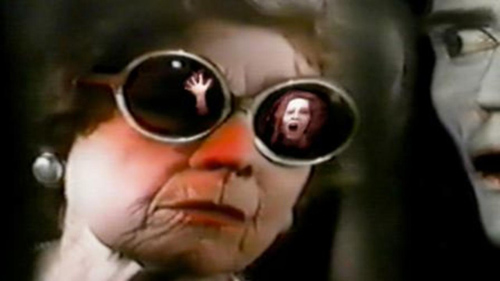
Gretchen (Schafer, Kinds of Kindness) finds little motivation in anything, save remotely practicing with her band, as her family relocates to a mountainside resort in Germany. Her dad (Marton Csokas, 2014’s The Equalizer) and stepmom (Jessica Henwick, Glass Onion) work for Herr (Dan Stevens, Abigail), the resort’s owner and a strange bird in his own right. Peculiar, overbearing employers become the least of Gretchen’s worries, however, as she’s relentlessly stalked by a bizarre “woman” wearing shades and trench coat.
Singer’s writing isn’t particularly coherent, though the big picture is never completely lost. Rather, it suffers from frequent detours that, while stylistic, tend to create more confusion than terror. Conceptually, the monster at the center of Cuckoo is intriguing, but Singer (Luz) can’t quite strike the balance between explanation and mystery. It’s like the filmmaker tried to delicately pull back the curtain, only to stumble and reveal a gaggle of puppeteers. It doesn’t ruin the film, but it also strangles the power its ambiguity could have had.
That said, the creature of this feature is secondary. Gretchen, firmly caught between grief and apathy, gives Cuckoo its legs. Schafer nails the malaise of late-stage adolescence, channeling a realistic portrayal without veering into just another whiny kid. Against Stevens and Luz star Jan Bluthardt’s increasingly deranged acting, Schafer serves as an anchor that allows every other character to go utterly off the rails. Without her establishing what’s normal, Cuckoo’s alluring strangeness would just be nonsensical.
What Singer could benefit from most, ultimately, is even just a basic amount of restraint. The film’s violence is mostly well-choreographed, but it doesn’t always feel earned. It often seems like Cuckoo is a compelling coming-of-age drama that has a weird contractual obligation to moonlight as a horror movie. (Though, admittedly, its cold opening does a decent job of keeping the thought of some malicious force at the back of your mind, sort of like the first scene of Valdimar Jóhannsson’s Lamb.)
This makes Cuckoo a bit difficult to qualify. On one hand, it more than establishes Schafer as a capable lead. With any luck, this won’t be her last appearance at the top of a cast. However, it probably won’t be for another one of Singer’s pictures. His premise is intriguing, but Cuckoo itself seems to be locked in an identity crisis that style and strong performers can’t manage to shake. If the director insists on remaining horror, they should rightfully keep swinging for the fences. Likewise, he’d be wise to remember that not every “high concept” needs to float in the stratosphere. We’ll receive him with open arms back on Earth. —Daniel Bokemper
And The Exorcism of Saint Patrick isn’t. Although it does contain the requisite expulsion of green puke, blame falls not to satanic possession, but a glass of ipecac syrup.
But try telling that to the fiercely religious parents of Patrick (newcomer Michael J. Cline), an obese, socially awkward teenager. Wanting to rid their son of his homosexuality, they send him to a secluded cabin for “conversion therapy” — aka abuse in the name of Jeeeee-zus — with a pastor (Steve Pinder, channeling the dapper smarminess of Justin Kirk). Really bad shit happens.
It’s like Joel Edgerton’s Boy Erased redressed as a microbudget indie with a third-act jaunt into experimental horror. Before then, the horrors are real-world, and Quinn Armstrong’s work as the film’s writer and director feels deeply, disturbingly personal. Its turn to the ambiguous and allegorical is likely to frustrate viewers invested in the story, however spare. Be warned that about-face is preceded by snippets of hardcore gay porn as the conversion therapy becomes aversion therapy, bringing the aforementioned emetic into play.
I enjoyed Armstrong’s first feature, the bizarro cop comedy Survival Skills. While it wasn’t entirely successful, its subversive streak and VHS aesthetic felt original in the throes of COVID-19. The most creative piece of Saint Patrick is that it kicks off a trilogy Armstrong has branded under a Fresh HellPresents banner, with the interconnected Wolves Against the World and Dead Teenagersfollowing this first tale to VOD with one-week gaps between each. Whether the entire experience delivers a payoff that this one-off viewing cannot, we’ll know soon enough. —Rod Lott
Who is Agatha Black and why is a chef’s dozen of tracks trying to frighten her? As appealingly (albeit a bit stiltedly) played by Bridie Marie Corbett, Agatha is practically a recluse — or “ree-cloose,” as a family member drawls — who barely gets out of the house she shares with her sickly aunt.
Make that shared, past tense, as Aggy is healing from the horror of a recent break-in that ended with her aunt murdered. To cope, she absorbs herself with a beloved childhood curio: a stack of ghost story LPs her late father gifted her.
As she revisits the stories, which get progressively more grisly and adult, elements from the slabs of vinyl bleed into real life, like a neighboring couple fatally hammered beyond recognition. As they say in Dallas, where this was shot, just what in the Sam Hill is going on here?
13 Tracks to Frighten Agatha Black is a perfect title. I admire not only its rhyming structure, but also how it sounds like the names adorning so many of the spooky albums that entertained kids in the 1960s and ’70s. I should know; I was one of them (for the ’70s half, at least). Before we were allowed to see horror movies or read horror comics, we could listen to horror story records. They were a gateway. As such, I hold reverence for them, even if I never want to hear them with middle-aged ears, preferring to leave that spell unbroken.
Whatever writer/director Bradley Steele Harding’s relationship is with 33 1/3 rpm novelties, his idea for 13 Tracks is ambitious, but also kinda brilliant! Other first-time filmmakers should be as lucky. Each time the needle drops on another tale, the fuzz on the soundtrack is so, so satisfying.
However, I almost didn’t watch it past the opening credits (narrated by cult legend Udo Kier, incidentally) because the dialogue-free prologue depicting Agatha as a child is off-puttingly overacted with motions befitting a mime’s routine. To be bluntly honest, I abandoned the movie twice across two years’ time before finally ceding my full attention, encouraged by a rave review in David John Koenig’s Lowest Common Denominator review guide. I’m glad I did.
While not “sure to give you the whim-whams” — a Monster a Go-Goreference, I assume — Harding’s movie bears enough ingenious touches for a rainy afternoon’s entertainment. I’d love to see his idea fleshed out with real financial weight behind it. Additionally, I look forward to his sophomore feature, Occult Canvas, which appears to mine another object of 1970s nostalgia: Rod Serling’s Night Gallery. —Rod Lott
From director Peter Brophy and co-writer Rod Bishop comes Body Melt, a goofy, goopy Australian body-horror splatter fest that plays like the unholy love child of Peter Jackson’s Dead Aliveand David Cronenberg’s Rabid, with some Lynchian weirdness and a throbbing techno score thrown in for good measure.
It follows the citizens of Pebbles Court in Homesville, Melbourne, who all fall victim to an experimental body-enhancing vitamin sent to them in the mail by an unscrupulous pharmaceutical company. The filmmakers are concerned less with character and plot and more worried about grossing the audience out, which they achieve in spades. True to its title, the film is a smorgasbord of nasty death scenes as hilarious as they are disgusting.
There’s not a single protagonist in Body Melt. Rather, the film is comprised of several characters who almost all meet gnarly ends. There’s a detergent-guzzling man whose throat opens to sprout tentacle-like growths. Another resident of the quaint Pebbles Court suffers hallucinations from the drug until his face melts away, leaving only his bloody skull. A family vacationing at the very health spa that produced the vitamin suffers all matter of slimy, mucus-dripping indignities, while one of the spa’s workers — an oversexed muscle man — gets an erection so turgid his penis explodes. But perhaps the most vomit-inducing scene involves a pregnant woman, whose fate is best left for sick viewers to see for themselves.
In addition to all the madness listed above, Body Melt features a clan of possibly inbred service-station workers who torment two teen boys from the court, a clear nod to The Texas Chain Saw Massacre. To say that the film is bonkers is an understatement. It can be a bit tricky at first to follow all the seemingly disparate storylines, but then again, the stories aren’t exactly the point. The practical effects are the true star here, and they are every bit as convincing now as they were in 1993.
Body Melt is a perfect midnight movie — just be sure to watch it on an empty stomach. —Christopher Shultz