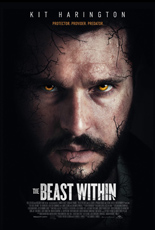
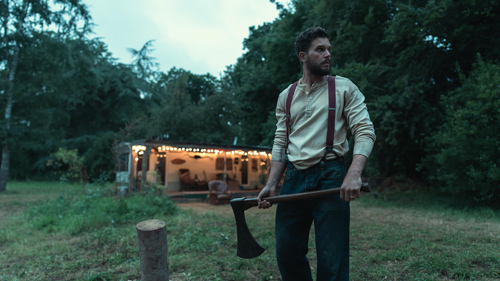
Father doesn’t know best in The Beast Within. That’s because every full moon, he turns into a werewolf, requiring him to be chained in the British wilderness to keep his loved ones safe and sound.
Eternals’ Kit Harington headlines as Noah, the current owner of the gosh-darned generational curse. “I am a coward and I am a monster,” he says to his 10-year-old daughter, Willow (Caoilinn Springall, Stopmotion), who’s begun to suspect as much anyway. Kids these days be smart.
With Within, documentarian Alexander J. Farrell (Making a Killing) makes a move to fictional features. This first attempt is inauspicious, however, being laboriously paced and predictable; regarding the latter, when the script introduces Willow as suffering from life-or-death breathing issues, you know Farrell’s doing so to establish Chekov’s oxygen tank. With intended scares overly dependent on either the eye-through-keyhole variety or the just-a-dream conceit, the movie plays too conventionally.
And not conventionally enough, where the werewolf is concerned: rarely spotted outside of shadows and, when he is, clearly built in cash-deficient CGI that belies the beauty of the West Yorkshire forest. Either way, we’re left wanting more. Like the scene with the splinter plunged underneath one’s fingernail — at least that, we feel.
While The Beast Within is not a remake of 1982’s same-named raping cicada movie, maybe it should be? —Rod Lott
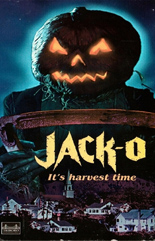
Do you know the pumpkin man The pumpkin man, the pumpkin man Oh, do you know the pumpkin man In Jack-O, he’s very lame
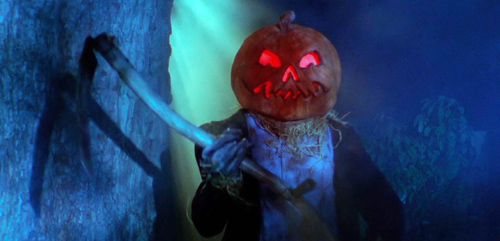
Because good Christians in the olden times don’t cotton to sorcerers, a man by the last name of Kelly kills a warlock. To get revenge, that wizard, played by (visibly deteriorated stock footage of) John Carradine, conjures up a scythe-swingin’ man with an oversized pumpkin for a noggin. Call him Jack-O if you like, even though the movie Jack-O never does.
As Halloween nears in modern-day Florida, Jack-O (né Lantern) goes after a grade schooler in glasses named Sean (Ryan Latshaw, son of Jack-O director Steve Latshaw) because he’s the last of the Kelly clan. In the climactic scene, li’l Sean even goads his monstrous pursuer with, “Come and get me, pumpkin man!” Them’s fightin’ words, kid.
Meanwhile, babysitter Linnea Quigley takes a shower; Cameron Mitchell posthumously appears on TV via leftover footage; Sean’s ineffectual father (one-and-doner Gary Doles) turns his garage into a spookhouse; and Sean’s mom (Rebecca Wicks, Latshaw’s Biohazard: The Alien Force) forever looks like an unblinking deer caught in headlights. I dunno, maybe it’s just her perm.
It shouldn’t be hard to make a passable horror movie out of a gourd/guy hybrid, yet for about an hour and a half, Latshaw and his frequent producer, Fred Olen Ray, show you how soundly they failed. Their monster (Patrick Moran, Latshaw’s Dark Universe) looks cool, but — like the flick itself — barely bothers to move. —Rod Lott
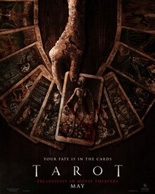
Whilst scouring for booze in the Catskills mansion they’ve rented for a birthday blowout, seven stupid collegians explore a basement full of astrological shit, including a — spoiler — deck of tarot cards. Haley (Harriet Slater, Indiana Jones and the Dial of Destiny) reads everyone’s fortunes. And I do mean everyone’s, which takes up a lot of time.
Before long, the kids start to perish in ways their readings predicted, each carried out by the supernatural character on the card in question. For example, the birthday girl is the first to go, attic-laddered to death by The High Priestess.
Tarot is the kind of dead-teenager movie that, 20 to 25 years ago, would have starred the likes of Chad Michael Murray and/or Rebecca Gayheart. However, the most recognizable face is this cast belongs to Jacob Batalon (Ned from Jon Watts’ Spider-Man trilogy), who essays one of the more annoying stoner characters the genre has seen this millennium.
In today’s horror-film landscape, the concept is the true star. This one comes courtesy of Horrorscope, a forgotten (if ever known) 1992 paperback, but the source matters not with co-writers/co-directors Spencer Cohen and Anna Halberg squandering nearly any potential. Visually, the film looks drawn with only the darkest-colored crayons, so it’s difficult to discern what you’re seeing when it most counts: with the kills!
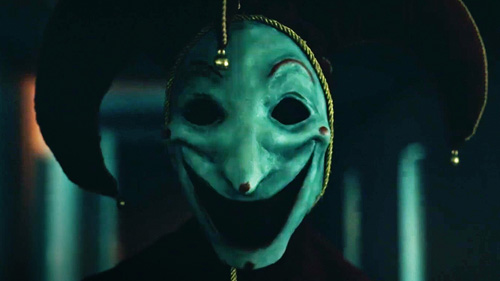
Among the death sequences, those featuring The Fool, The Hanged Man and The Magician emerge as the most notable almost by default, by virtue of at least getting a fair glimpse of the architects of these kids’ fates. (And you just know producers have a whole “Tarotverse” in mind with spin-offs spotlighting each villain.) Tarot is pedestrian at best, and it’s never best. —Rod Lott
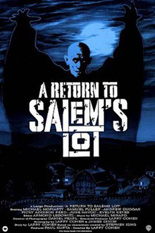
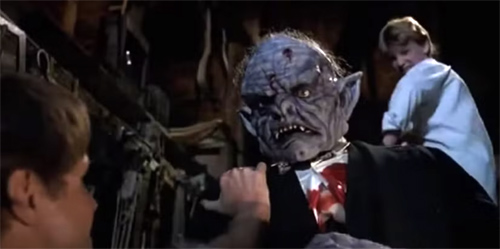
Much of the promotional material for A Return to Salem’s Lot features the caped, grotesque figure of Barlow, the head vampire from Tobe Hooper’s adaptation of the Stephen King novel ’Salem’s Lot. Fans of that 1979 TV miniseries will be disappointed to learn, however, that Barlow does not actually appear in the sequel, which strays pretty far from King’s source material.
Written and directed by Larry Cohen, creator of satirical horrors It’s Alive, Q: The Winged Serpent and The Stuff, among others, the film teases a few interesting ideas about the origins (and symbolism) of vampires in society, but never fully ties these concepts together.
The plot follows anthropologist Joe Weber (frequent Cohen collaborator Michael Moriarty), who must look after his troubled, foul-mouthed yuppie son, Jeremy (Ricky Addison Reed, in his only onscreen role). The father and son decide to restore a house left to Joe by his deceased Aunt Clara in the little town of Salem’s Lot, Maine.
They of course quickly learn that the townsfolk are all vampires, led by Judge Axel (Andrew Duggan), and they have a proposal for Joe: Study their ways and create a “Vampire Bible” to formally introduce the oldest race of creatures to the rest of the world. Joe appreciates the anthropological implications of this proposal, but isn’t sure about helping the bloodsuckers out.
Meanwhile, the vampire children of Salem’s Lot, primarily Amanda (a young Tara Reid), tempt Jeremy with a life of eternal youth, and a crusty Nazi hunter (cult director SamuelFuller) comes snooping around town. Will Joe and Jeremy choose evil over good, or will they “do the right thing” and fight the vampires?
Ultimately, the film isn’t sure what the right thing is, and thus, neither is the audience, leaving viewers more confused than ponderous. On top of this, A Return to Salem’s Lot is neither scary nor funny, making it a rather tepid entry in Cohen’s otherwise outstanding body of work. —Christopher Shultz
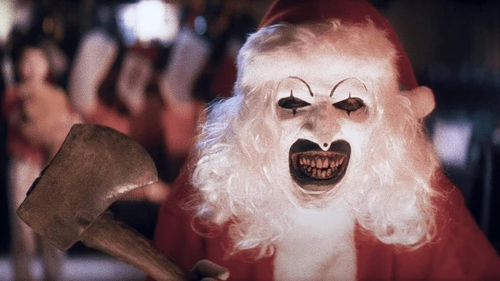
For every Cinema Paradiso, there’s a film primed to make us regret ever watching movies. Since 2016, Damien Leone has seemingly gone out of his way to put that “honorary” distinction on the Terrifier franchise. And he does a pretty damn good job at it. Still, pushing the grotesque envelope can only go so far until it eventually busts. With Terrifier 3, Art the Clown (David Howard Thornton) makes a tragic misstep from shockingly scary to schlocky slapstick.
After his head’s cut off by Sienna (Lauren LaVera) at the end of Terrifier 2, Art’s reanimated corpse reconvenes with his first victim turned disfigured villain, Victoria (Samantha Scaffidi), at an insane asylum. (Conveniently, she also gave birth to his head at the end of the second flick.) The starstruck lovers seal their union by ceremoniously bashing in the brains of an unsuspecting Chris Jericho.
Five years later, Sienna’s released from a trauma center to the care of her aunt (Margaret Anne Florence) and uncle (Bryce Johnson). She quickly reconnects with her niece, Gabbie (Antonella Rose), while trying to do the same with her similarly scarred little brother, Jonathan (Elliott Fullam). At the same time, Art and Victoria resurface to dismember families and blow up some children. You know, the usual.
Terrifier 3 isn’t outright bad. The kills seem somehow more brutal and deranged, and Leone’s choice to set the film during Christmas seemed like an easy way to frame Art’s violence toward children. It’s a setup that yields some entertaining payoffs, like when the clown toys with a drunken mall Santa at a dive bar. Yet these fun sequences ring hollower when the narrative that facilitates those scenes feels like an afterthought. Bone Tomahawk provides enough evidence that intense gore — even when it seems to be the entire point of a movie — doesn’t require a weak and uninspired plot.
Which begs the question: Why create any continuity for Terrifier at all? It ultimately feels like the best vehicle for Art was All Hallows’ Eve, Leone’s 2013 anthology film that used the clown as more of a chilling concept and occasional slasher villain. If the intent is to make Art into a lawless agent of chaos, Leone’s tale of angels versus demons seems like a horribly messy distraction.
That said, Terrifier 3 is still a gorehound’s smorgasbord. The supposedly gruesome opening scene, however, feels a bit overblown. Yes, it’s grizzly, but it feels like extremely familiar territory for anyone who’s watched 15 minutes of either previous film. And by the time we get to the real show stealer, a chainsaw massacre in a coed shower, its effect almost seems muted by what came before. The practical effects are still impressive, but beyond lingering on the brutality for a bit longer than usual, it doesn’t really feel like leap into a horrifying new direction. It’s more like a gentle shuffle.
As it stands (or hobbles), it feels like Terrifier has run its course. Art is still legitimately creepy, but he’s starting to resemble a black-and-white crutch for Leone. With the next installment alleged to be the last, it’ll be interesting to see the filmmaker try a bit more than excessive blood and guts. Because, ultimately, the gory torture porn is about the only thing that distances Terrifier 3 from a Lifetime original movie. —Daniel Bokemper